 TIGERFASTENERS
DIN 137 is still sold, and the standard behind it is gone
Read about seven minutes. Wave and curved spring washers are quoted, packeted and ordered as DIN 137, and they arrive and they work. The document that number points at has been withdrawn, nothing replaced it, and the last edition had already dropped one of the two types that shops still sell. Below M3 that dropped type is the only one made.
The number outlived the document
Westfield Fasteners publishes a product specification for its DIN 137 range. Two sentences into the section on the standard, it says something most catalogue pages do not:
DIN 137 has been withdrawn as a standard and has not been replaced with a newer equivalent. Off the shelf parts are still being manufactured to this standard though.
Withdrawn is not the same as superseded. When DIN 2093 gave way to EN 16983, the content carried over and the part stayed specified — a case we covered in the disc spring series letters. Here there is no successor to point at. The number on the packet refers to a document that the issuing body has taken out of circulation, and no other body picked the part up.
That does not make the washer unusable. Parts outlive their paperwork routinely, and a supplier can hold dimensions to a withdrawn drawing indefinitely. What it does mean is that “to DIN 137” on an order has no current document behind it, so it is a reference to a shared memory rather than to a specification either party can open.
Two types, and the last edition kept only one
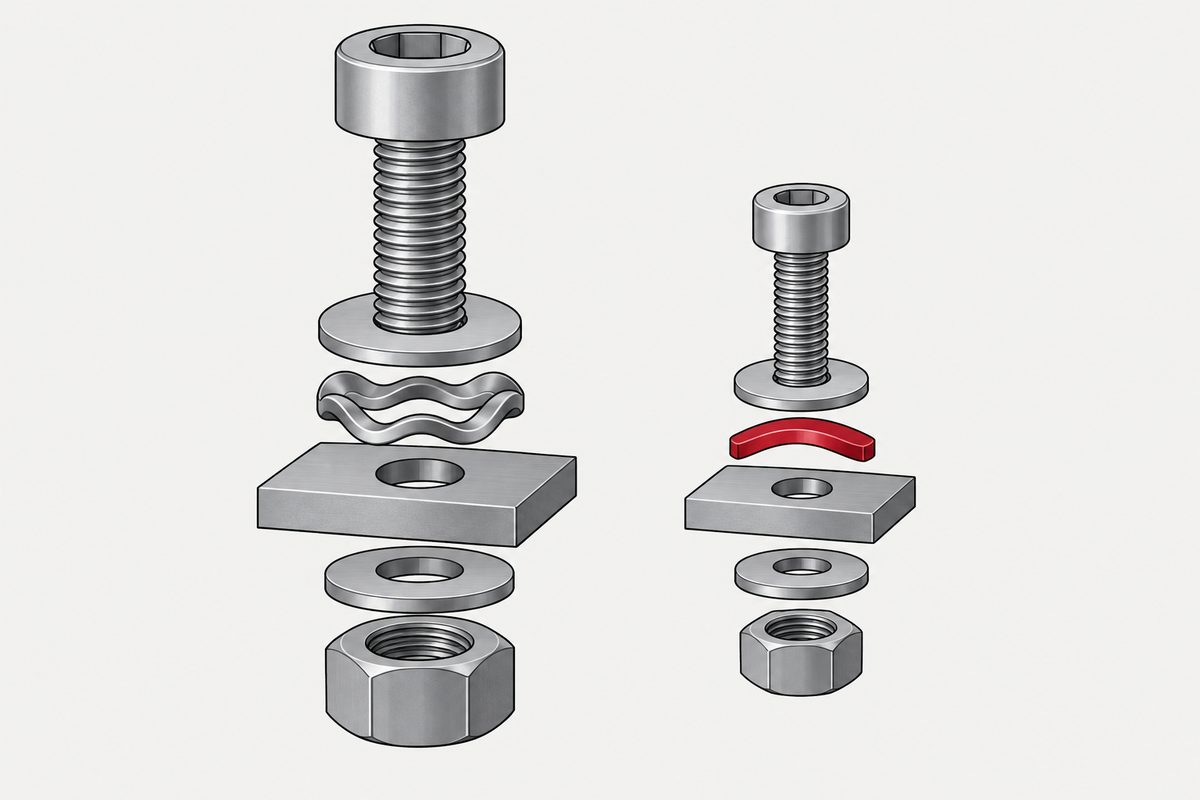
DIN 137 covered two forms: a curved washer, dished across its whole face, and a waved one, rippled around its circumference. The same Westfield page continues:
The final release of DIN 137 only specifies details for the type B variant, and no longer mentioned type A. Despite this, wave washers are still produced to this standard in both type A and type B variants.
The publisher’s own catalogue entry settles that without needing the distributor. DIN 137:1994-05 is titled Federscheiben, gewellt — wave spring washers. The title carries no curved form, the entry is flagged withdrawn, and it lists no successor. A title is a thin document, but it is the publisher’s, and it says the last edition was the wave one.
So type A lost its edition when the 1994 one replaced it, and type B lost its in the withdrawal, while both stayed in production under a single number.
The same is true of the washer people actually picture when they hear “spring washer”. DIN 127, the split helical ring, has a catalogue entry marked withdrawn with no successor listed either. Both of the classic spring washer standards are gone, and neither was handed on. A cross-check gave dates for the two withdrawals, 2003 for DIN 137 and 1993 for DIN 127; the publisher pages we read do not show dates, so we are not stating them.
Two suppliers, and they disagree about which is which
With no current document to check against, the type letters drift. Westfield’s sheet gives a table for type A and a table for type B. Aspen Fasteners publishes its own DIN 137 sheet with a table headed “Curved Type A”. We compared them line by line:
| Thread | Aspen, headed “Type A” | Westfield, type B |
|---|---|---|
| M3 | 3.2 / 8 / 0.5 / 0.8–1.6 | 3.2 / 8 / 0.5 / 0.8–1.6 |
| M4 | 4.3 / 9 / 0.5 / 1–2 | 4.3 / 9 / 0.5 / 1–2 |
| M5 | 5.3 / 11 / 0.5 / 1.1–2.2 | 5.3 / 11 / 0.5 / 1.1–2.2 |
| M6 | 6.4 / 12 / 0.5 / 1.3–2.6 | 6.4 / 12 / 0.5 / 1.3–2.6 |
| M8 | 8.4 / 15 / 0.8 / 1.5–3 | 8.4 / 15 / 0.8 / 1.5–3 |
Bore, outside diameter, thickness and both height limits, identical at all five sizes. The table Aspen heads as type A carries the numbers Westfield gives for type B, and it starts at M3, which is where Westfield’s type B table starts rather than where its type A table starts.
We are not calling that an error, because there is no current document to be wrong against — which is the point. Two suppliers describing the same withdrawn number have ended up labelling the same dimensions differently, and a buyer comparing quotes has no authority to appeal to. If a drawing says “DIN 137 type A”, the safe move is to send the dimensions rather than the letter.
Below M3 there is only one of them
The two tables cover different ranges, and that is where this stops being trivia:
| Type | Range in the tables | Its edition |
|---|---|---|
| A, curved | M1.4 to M10 | superseded in 1994 |
| B, waved | M3 to M36 | withdrawn, no replacement |
Below M3 only the curved form is tabulated. So in the M1.4 to M2.6 band there is one option, and it is the one whose edition was replaced in 1994 and which the final edition no longer mentioned. Anyone specifying a spring washer of this kind on an M2 assembly is specifying a part described by a document that was superseded thirty-two years ago and then withdrawn.
That band is our production range. It is also the band where the washer is proportionally largest: at M2 the free height sits at 0.5 to 1.0 mm against a head that is itself around 1.3 mm high, so the spring is a visible fraction of the stack rather than a shim. The paperwork is thinnest exactly where the part is most of what is there.
The scope nobody quotes
The Westfield sheet also carries a limit we have not seen on a single product listing:
According to the standard, DIN 137 wave or curved spring lock washers are designed for use with bolt and nut assemblies with property class less than 5.8 tensile strength and are made from spring steel.
A ceiling on property class is an unusual thing for a washer to carry, and it reframes the part. Under a class 8.8 or 10.9 bolt, this washer is outside the scope its own standard claimed, which fits the mechanism: a spring that is soft relative to the joint is flattened by preload and stops being a spring. The same sheet points the same way on application: best suited to shorter bolts under thrust, and it may not work well with varying radial loads.
Material carries a footnote of its own. The standard names spring steel, and the stainless commonly supplied, 301 or 1.4310, is a stainless spring steel — so the question is not whether stainless qualifies. Westfield’s note is narrower than that: because of the material’s limitations compared with non-stainless spring steel, it should be subjected to reduced loading. Whether a given stainless part meets what the withdrawn document asked for is a question about its hardness and condition, and neither of us can look the answer up.
What this page did not establish
- No edition of DIN 137 was read. It is a paid document and it has been withdrawn. Full scans circulate on file-sharing sites; we did not download or cite one. The withdrawal, the type-B-only final edition, the property class ceiling and the material note are all quoted from a distributor’s specification sheet.
- The version history is catalogue-level. That a 1994-05 wave edition superseded a 1987-10 curved edition comes from standards catalogue listings, not from either document.
- No spring force appears here. We could not find a published spring force or rate table for these washers, so this page gives none, and does not estimate one from the dimensions.
- This is not the split lock washer. The NASA finding that a split spring washer is useless once flattened, which our washer specification page reports, is about a different part. We have no test data on wave or curved washers and are not transferring that conclusion to them.
- Withdrawn does not mean unusable. Nothing here says the part is bad. It says the reference behind the number is no longer a document you can open.
This is not one of the six steps. It shows up across them, or after assembly. Where the decisions that lead here were made is in specifying a screw, which sets out the order and why doing it out of order is rework.
Common questions
Is DIN 137 still a current standard?
No. Westfield Fasteners’ product specification states that DIN 137 has been withdrawn as a standard and has not been replaced with a newer equivalent, while off-the-shelf parts are still manufactured to it. That is different from a superseded standard such as DIN 2093, where EN 16983 took the content over. Here there is no successor to cite.
What is the difference between DIN 137 type A and type B?
Type A is the curved form, dished across the face; type B is the waved form, rippled around the circumference. Be careful with the letters: the final edition of DIN 137 specified only type B, and we found two distributor sheets that label the same dimensions differently — one heads a table “Curved Type A” carrying the numbers another gives for type B, identical at M3, M4, M5, M6 and M8. With no current document to check against, send dimensions rather than the letter.
Can I use a DIN 137 washer under a class 8.8 bolt?
The scope reported by Westfield says these washers are designed for bolt and nut assemblies with property class less than 5.8. Under 8.8 you are outside what the standard claimed, and the mechanism agrees: a spring soft relative to the joint is flattened by preload and stops acting as a spring. We have no test data of our own on this part.
Which type is available in small sizes?
Only the curved form, type A, is tabulated below M3 — the tables we read run M1.4 to M10 for type A and M3 to M36 for type B. So in the M1.4 to M2.6 band there is one option, and it is the type whose edition was superseded in 1994 and which the final edition no longer mentioned.
Is a wave washer the same as a split spring lock washer?
No. A split lock washer is the cut-and-twisted ring, and the NASA fastener design manual’s verdict that it is useless once flattened by preload is about that part. A wave or curved washer is an uninterrupted disc that works as a light spring, most often to take up axial play. We have no test data on wave washers and do not carry that conclusion across.
Does stainless change anything?
Westfield notes that the standard names spring steel, and that 301 or 1.4310 stainless counts as a spring steel but should be subjected to reduced loading because of the material’s limitations. So a stainless part supplied against this number is a variant on the withdrawn document rather than what it described.
References
- Westfield Fasteners, DIN 137 Wave Washers product specification — the withdrawal and lack of replacement, the type-B-only final edition, the property class ceiling, the spring steel note, and the type A and type B dimension tables (free PDF)
- Aspen Fasteners, Metric DIN 137 Curved & Waved Spring Lock Washers — the sheet whose table headed “Curved Type A” carries the dimensions Westfield gives for type B (free PDF)
- DIN 137:1994-05, Federscheiben, gewellt — publisher catalogue entry, flagged withdrawn with no successor listed; the standard itself was not read
- DIN 127:1987-10, Federringe, aufgebogen oder glatt mit rechteckigem Querschnitt — the split lock washer; catalogue entry also flagged withdrawn with no successor
Both distributor specification sheets were downloaded and read directly, converted with pdftotext, and every quotation above is taken from the Westfield sheet. No edition of DIN 137 was read: it is a paid document, it has been withdrawn, and although full scans of the 1994 edition circulate on file-sharing sites we did not download, read or cite one. Everything attributed to the standard here — the withdrawal, the final edition covering only type B, the property class ceiling of less than 5.8, the spring steel material and the application notes — is what a distributor reports about the standard. The version history, a 1994-05 wave edition superseding a 1987-10 curved edition, comes from standards catalogue listings rather than from either document. The comparison of the two dimension tables is ours: bore, outside diameter, thickness and both height limits were checked at M3, M4, M5, M6 and M8 and match at all five. No spring force is published on this page because we found no public spring force or rate table for these washers, and estimating one from dimensions would be inventing it.
Enquiries
If a drawing calls out DIN 137 in a small size, send the dimensions alongside the number. With the document withdrawn and two suppliers labelling the types differently, the four figures — bore, outside diameter, thickness, free height — are the only part of that callout everyone reads the same way.
Request a quotation
Tell us the part and the quantity. We will come back on feasibility, lead time and price.
Or email us directly sales@tigerfasteners.com