 TIGERFASTENERS
A beveled washer’s 8% and 14% are the beam’s numbers, not the washer’s
Read about nine minutes. Catalogues list beveled washers by slope: DIN 434 at 8%, DIN 435 at 14%, ASTM F436 at 1 in 6. None say where the number came from, and none say when you need one. Both answers exist in free documents, and one of the four slopes turns out to sit exactly on the threshold.
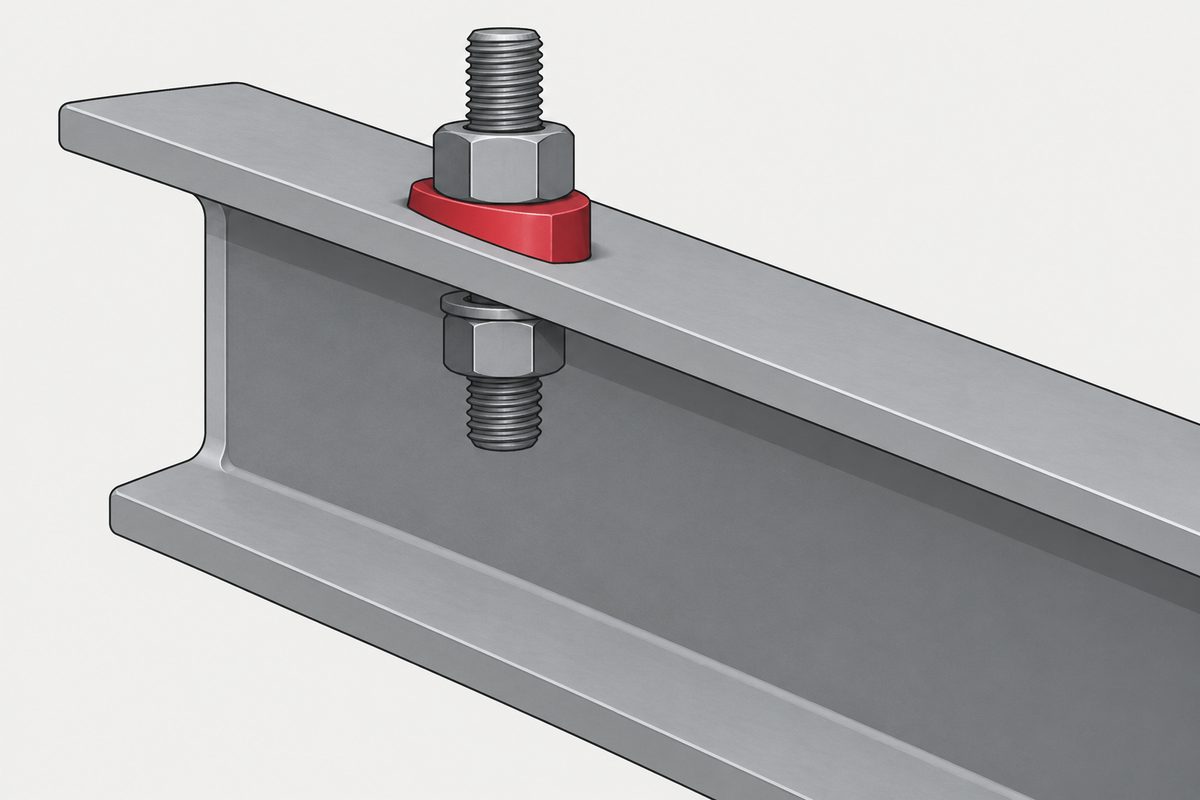
Three numbers, none of them explained
A square washer with a wedge cross-section goes by several names — beveled washer, taper washer, sloped washer. Distributor pages list them by the slope of the wedge, and three numbers come up:
| Designation | Slope | Said to be for |
|---|---|---|
| DIN 434 | 8% | U-sections (channels) |
| DIN 435 | 14% | I-sections |
| ASTM F436 beveled | 1:6 | American Standard beams and channels |
The pages that sell them stop there. They do not say why 8 and not 10, why the American number is a ratio while the German ones are percentages, or how you decide whether the surface in front of you needs one at all. That last question is the one that gets decided on site, and it has a published answer.
The threshold is 1:20, and it is free to read
The Research Council on Structural Connections publishes the Specification for Structural Joints Using High-Strength Bolts. The June 11, 2020 edition is a free PDF. Section 3.1, on connected plies, limits the geometry before it says anything about washers:
The slope of the surfaces of parts in contact with the bolt head and nut shall be equal to or less than 1:20 with respect to a plane that is normal to the bolt axis.
Section 6.1.1 names the remedy for the case that fails that limit:
When the outer face of the joint has a slope that is greater than 1:20 with respect to a plane that is normal to the bolt axis, an ASTM F436 beveled washer shall be used to compensate for the lack of parallelism.
Read the two together and the boundary is sharp. Section 3.1 permits a slope equal to 1:20. Section 6.1.1 triggers only when the slope is greater than 1:20. A surface landing exactly on the number is inside the permitted range and calls for nothing. That reading matters later on this page, because one production section lands exactly there.
What is bending is the bolt
The commentary to Section 3.1 gives the reasoning, and the subject of the sentence is worth noticing:
Structural bolting assemblies are generally ductile enough to deform to a surface with a slope that is less than or equal to 1:20 with respect to a plane normal to the bolt axis when pretensioned. Greater slopes are undesirable because the resultant localized bending decreases both the strength and the ductility of the bolt.
Two things follow. A shallow slope is absorbed by the fastener itself: the assembly deforms to meet the surface when pretensioned, so no washer is asked to do anything. And past the limit, what goes wrong is not a missing washer. It is that the bolt is being bent locally, and the commentary lists two consequences of that bending rather than one. Strength and ductility both drop.
Ductility is the one that gets left out of summaries. A bolt that has lost strength has a lower number. A bolt that has lost ductility has lost the warning it would have given before it failed. Only one of those shows up in a calculation.
Where the slopes come from
There are several numbers instead of one because the washer is copying something. Older hot-rolled sections were made with tapered inner flange faces, the taper being a help in rolling. ArcelorMittal’s current sections catalogue prints the slope on the page for each family, and the figures are these:
| Section | Inner flange slope | Matching washer |
|---|---|---|
| IPN I-beam | 14% | DIN 435 (14%), DIN 6917 (14%) |
| UPN channel, h ≤ 300 | 8% | DIN 434 (8%), DIN 6918 (8%) |
| UPN channel, h > 300 | 5% | DIN 6918 (5% form) |
| American Standard S beam | 1/6 | ASTM F436 beveled (1:6) |
| American Standard C channel | approx. 16⅔% | ASTM F436 beveled (1:6) |
| IPE, HEA, HEB, UPE | parallel | none needed |
Read down the middle column and the washer designations stop looking like separate standards with separate opinions. Each is the mating half of a flange that already existed. The number on the washer is the number on the beam.
The third row is the one that breaks the tidy version of this story, and it is worth dwelling on. The UPN channel series does not have one slope. It has 8% up to a height of 300 mm and 5% above it, printed as two columns on the same catalogue page. A statement that “UPN is 8%” is right for most of the series and wrong at the top of it.
The washer standard changes where the beam does
REYHER’s fastener technical handbook carries an identification table for square washers, giving the slope and the number of grooves milled across each one:
| DIN | Slope | Grooves |
|---|---|---|
| 436 | 0% | — (flat square washer) |
| 434 | 8% | 2 |
| 435 | 14% | 1 |
| 6917 | 14% | 1 |
| 6918 | 8% / 5% | 2 / 0 („Form A“) |
DIN 6918 is listed with two slopes, 8% and 5%, and those are the two slopes the UPN channel series has. The washer standard splits where the beam standard splits. That is about as direct as the evidence for this article’s claim gets, and it arrived from a handbook about washers rather than from anything about beams.
The groove count is the field identification. You cannot eyeball 8% against 14% on a part that is a few millimetres thick, so the standards put a countable feature on the face: two grooves for the 8%, one for the 14%.
Checking the slope against the dimensions
The same handbook page gives dimensions, and it writes the thickness as two values, thick end and thin end, alongside the two side lengths. That is enough to recover the slope without trusting the header. Slope = (thick − thin) ÷ b, and we ran it on every size printed:
| Size | DIN 434, computed | DIN 435, computed |
|---|---|---|
| M8 | 8.18% | 14.09% |
| M12 | 8.00% | 14.00% |
| M16 | 8.06% | 13.89% |
| M20 | 7.95% | 14.09% |
| M22 | 8.00% | 14.00% |
| M24 | 8.04% | 13.93% |
| M30 | 8.06% | 14.03% |
The arithmetic reproduces the two headline numbers across the range, with the spread you would expect from dimensions rounded to a tenth of a millimetre. M8 is the loosest fit in both columns, and it is listed here rather than dropped, because a table that only shows the sizes that agreed would not be a check.
This check was possible because that handbook labels its columns. A different distributor sheet for DIN 434 carries a full M8 to M27 table and defines none of its columns; trying the same arithmetic on it three ways gave answers between 5% and 9%, which measures the missing definitions rather than the part.
Putting the slopes and the threshold in the same unit
The threshold is a ratio, most of the slopes are percentages, and that alone is enough to hide the comparison. Converting is arithmetic anyone can repeat:
| Slope | As a percentage | Against the 1:20 limit |
|---|---|---|
| 1:20 (the limit) | 5% | — |
| UPN, h > 300 | 5% | equal to it |
| 8% (DIN 434, UPN h ≤ 300) | 8% | over |
| 14% (DIN 435, IPN) | 14% | over |
| 1:6 (ASTM F436, S sections) | 16.7% | over |
The tapered families sit above the limit, which is the sanity check on the whole arrangement: these washers exist because the surfaces they go on are outside what a bolt absorbs on its own. The second row is the interesting one. A UPN 320 or UPN 400 flange is at 5%, which is 1:20 exactly, and Section 6.1.1 triggers on slopes greater than 1:20.
Two documents from different countries and different systems land on the same number, and we have no evidence that either was written with the other in mind. What can be said is what each says on its own, and that they agree about where a bolt stops coping.
What this page did not establish
- No DIN washer standard was read. DIN 434, 435, 436, 6917 and 6918 are paid documents. The slopes, groove counts and dimensions come from REYHER’s technical handbook, which is a fastener supplier’s document rather than the standard. It agrees with the other distributor material we checked.
- ASTM F436 was not read. The 1:6 and the intended sections come from the steel catalogue and from suppliers. No hardness, dimension or material figure from that standard appears here.
- EN 10365 does not carry the slopes. The percentages are printed by ArcelorMittal on its own catalogue pages, which cite EN 10365:2017 for dimensions and EN 10279:2000 for tolerances. The slope figure is the mill’s.
- The 2024 editions were not verified by us. A cross-check reported that DIN 434:2024-10 and DIN 435:2024-10 are current and that no EN or ISO standard replaces them. The publisher’s catalogue entries are paywalled, so we did not confirm this ourselves and it is repeated here as a lead rather than a fact.
- The 1:20 belongs to structural bolting. It governs high-strength structural joints and should not be carried into general machine assembly without a reason. What does carry over is the mechanism: a seat that is not perpendicular bends the fastener.
One correction is worth recording. The first draft of this page said the UPN series is tapered at about 8%, full stop. A cross-check flagged it, the catalogue confirmed the flag, and the exception turned out to be more interesting than the generalisation.
The same geometry, one size down
None of this is about small screws, and structural steel is not what we make. What travels is the mechanism rather than the number. A seat that is not perpendicular to the screw axis loads the head on one side, and the smaller the screw the less it takes — a burr or a moulding draft angle can be the whole error budget under an M2 head. Our page on washer specification covers what a flat washer does and does not do, and which side the washer goes on covers the one document that answers a related question people ask constantly.
This is not one of the six steps. It shows up across them, or after assembly. Where the decisions that lead here were made is in specifying a screw, which sets out the order and why doing it out of order is rework.
Common questions
When do you actually need a beveled washer?
The RCSC Specification for Structural Joints Using High-Strength Bolts, 2020 edition, Section 6.1.1, requires an ASTM F436 beveled washer when the outer face of the joint has a slope greater than 1:20 with respect to a plane normal to the bolt axis. Section 3.1 sets the same 1:20 as the limit on surfaces in contact with the bolt head and nut, and permits a slope equal to it. This is a rule for structural bolting, not a general machine-design rule.
Why is 1:20 the number?
The commentary to Section 3.1 explains it in terms of the bolt rather than the washer: structural bolting assemblies are generally ductile enough to deform to a surface sloped 1:20 or less when pretensioned, and greater slopes are undesirable because the resulting localized bending decreases both the strength and the ductility of the bolt. Note that it lists two losses. Ductility is the one usually dropped when the rule is repeated.
Is the UPN channel flange 8%?
Up to a height of 300 mm, yes. Above 300 mm it is 5%. ArcelorMittal prints both on the same catalogue page as two columns, split at h = 300. The washer side reflects it: REYHER lists DIN 6918 with two slopes, 8% and 5%. A flat statement that UPN is 8% is right for most of the series and wrong at the top of it.
What is the difference between DIN 434 and DIN 435?
REYHER’s identification table gives DIN 434 as 8% with two grooves and DIN 435 as 14% with one groove, with DIN 6917 at 14% with one groove and DIN 6918 at 8% or 5%. The groove count is the field identification, since 8% and 14% are not distinguishable by eye on a part a few millimetres thick. We have not read any of those standards; they are paid documents.
Does EN 14399-6 replace DIN 434 and DIN 435?
No, and the confusion is worth naming. EN 14399-6 covers plain chamfered washers for preloaded structural bolting — round washers with a chamfer at the hole. It is not a wedge-shaped washer with an overall 8% or 14% taper. The hardened wedge washers in the preloaded structural family are DIN 6917 and DIN 6918.
Do modern beams need beveled washers?
Parallel-flange sections such as IPE, the HE series and UPE have no taper on the inner flange face, so a flat washer already sits flat and the 1:20 question does not arise for the section geometry itself. Beveled washers remain relevant for the older tapered sections, which is why they are often a repair item rather than stock.
Can you use a flat washer on a sloped flange instead?
Above 1:20 the specification does not offer that option; it requires the beveled washer to compensate for the lack of parallelism. A flat washer on a sloped seat leaves the head bearing on one edge, which is the localized bending the commentary warns about, and that bending is what reduces the strength and the ductility of the bolt.
References
- RCSC, Specification for Structural Joints Using High-Strength Bolts, June 11, 2020 — Section 3.1 and its Commentary, and Section 6.1.1 (free PDF)
- ArcelorMittal, Sections and Merchant Bars Sales Programme — flange slope printed per family: IPN 14%, UPN 8% / 5% split at h = 300, American Standard S 1/6, American Standard C approx. 16⅔% (free PDF)
- REYHER, Technische Informationen TI/2020.04/DE — square washer identification table (slope and groove count for DIN 434, 435, 436, 6917, 6918) and the dimension table used for the arithmetic check (free PDF)
- ASTM F436/F436M, Hardened Steel Washers — catalogue entry only; the standard itself was not read
- Aspen Fasteners, Metric DIN 434 specification sheet — the dimension table with undefined columns referred to in the arithmetic section
Three documents were downloaded and read in full for this page: the RCSC specification (Sections 3.1, 6.1.1 and the Commentary to 3.1 quoted verbatim), the ArcelorMittal sections catalogue (the flange slope lines were located on the IPN, UPN, S and C pages), and the REYHER technical handbook (the square washer identification and dimension tables). None of the DIN washer standards, and not ASTM F436, was read; all are paid documents, and the slopes, groove counts and dimensions attributed to them here are what the supplier documents print. The slope arithmetic is ours: slope = (thick end − thin end) ÷ b, run on every size in the REYHER table and reported in full including the two loosest fits at M8. The same arithmetic was not possible on the Aspen Fasteners sheet, which defines none of its columns and returns answers between 5% and 9% depending on how they are read. The conversions of 1:20 to 5% and 1:6 to 16.7% are ours. The claim that DIN 434:2024-10 and DIN 435:2024-10 are current came from a cross-check we could not verify behind the publisher’s paywall, and is flagged as such in the body.
Enquiries
If a screw has to seat on something that is not perpendicular to its axis, tell us the angle and what the seat is made of. On small sizes that geometry changes the head form, and sometimes the washer, before it changes the thread.
Request a quotation
Tell us the part and the quantity. We will come back on feasibility, lead time and price.
Or email us directly sales@tigerfasteners.com