 TIGERFASTENERS
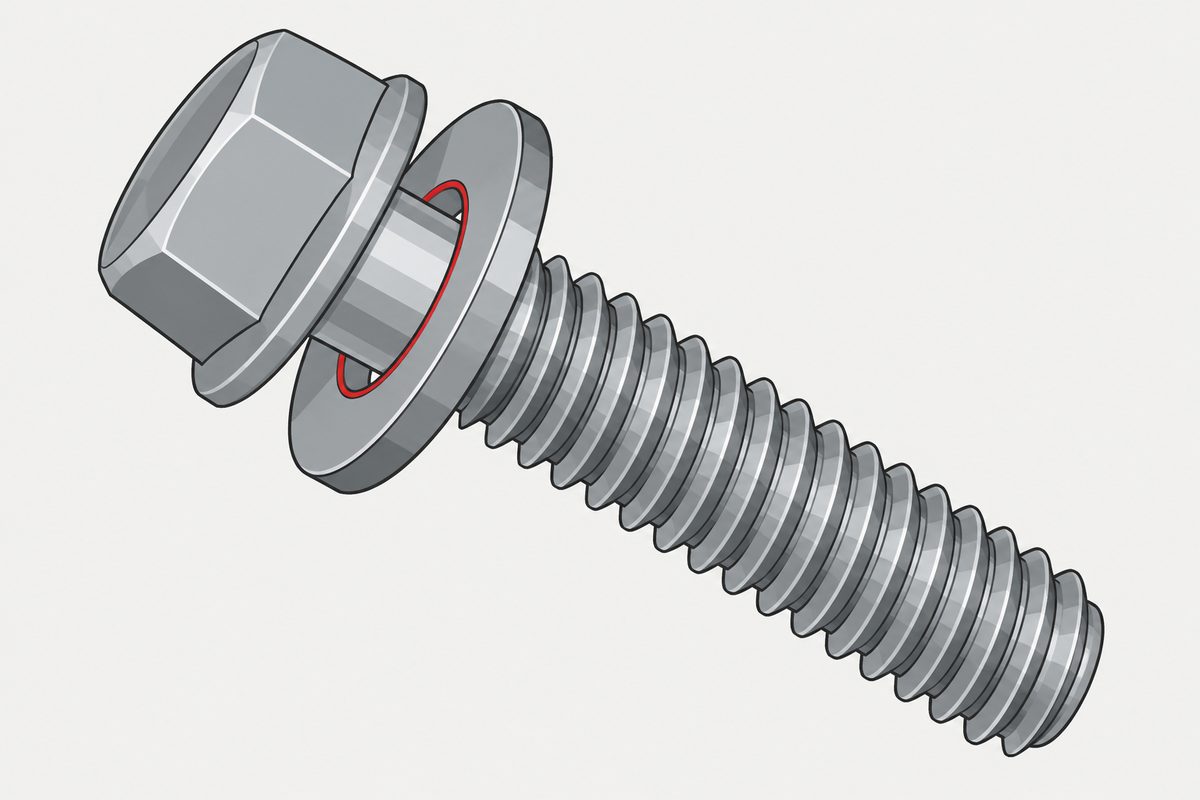
The washer on a SEMS has a hole smaller than the screw
Reading about 9 minutes. We have a page saying an M4 washer is not one specification but three. If the washer arrived already on the screw, it is a fourth thing, from a standard that page does not name, and the giveaway is that its bore is smaller than the screw it sits on.
Where this page starts
Our washer sizes page makes a point worth repeating: a nominal size does not specify a washer. The same M4 exists in a small, normal and large series, and the outside diameters differ by more than a factor of two.
That page lists three series and the ISO numbers behind them. It is accurate for washers you buy loose and put on yourself. It does not cover the washer that arrives already fitted to the screw, and that one is dimensioned by a different standard.
Captive is a defined word, not a description
ISO 10644 covers screw and washer assemblies in steel, coarse thread M2 to M12, flat seating heads, property classes up to and including 10.9. Its scope contains the definition in one line:
The plain washers are captive, i.e. prevented from disassembly and free to rotate.
Both halves matter. Prevented from disassembly is what makes it an assembly rather than two parts in the same bag. Free to rotate is what keeps it behaving like a washer: if it were clamped to the head it would turn with the screw and the friction interface would move to the washer face instead of staying between washer and joint.
Which is why the bore is undersize
A washer cannot be prevented from disassembly if it fits over the thread. So it does not. ISO 10673 gives the bore as a range that sits below the nominal thread diameter at every size:
| Nominal size | Bore d1 (min to max) | Shortfall vs nominal |
|---|---|---|
| M2 | 1,75 to 1,85 mm | about 8 to 13 % |
| M2,5 | 2,25 to 2,35 mm | about 6 to 10 % |
| M3 | 2,75 to 2,85 mm | about 5 to 8 % |
| M3,5 | 3,20 to 3,32 mm | about 5 to 9 % |
| M4 | 3,6 to 3,72 mm | about 7 to 10 % |
| M5 | 4,55 to 4,67 mm | about 7 to 9 % |
| M6 | 5,5 to 5,62 mm | about 6 to 8 % |
| M8 | 7,4 to 7,55 mm | about 6 to 8 % |
| M10 | 9,3 to 9,52 mm | about 5 to 7 % |
| M12 | 11 to 11,27 mm | about 6 to 8 % |
The washer goes on before the thread exists. It is placed over the blank shank and the thread is rolled afterwards, and the rolled thread is then larger than the hole the washer came through. Nothing holds the washer except geometry.
The practical consequence runs both ways. You cannot add one of these washers to a finished screw, and you cannot replace a lost assembly washer with an ordinary loose washer of the same nominal size and get the same part — the bore is wrong in one direction and the outside diameter is likely wrong in the other.
The series is chosen by head type, not by preference
This is the part that differs most from the loose-washer world. In ISO 10673 the three types are not simply small, medium and big; the standard states what each is preferably for.
| Type | Preferably for | Outside diameter at M4 / M6 / M10 |
|---|---|---|
| S — small | Hexagon socket head cap screws and cheese head screws | 8 / 11 / 18 mm |
| N — normal | Hexagon head screws | 9 / 12 / 20 mm |
| L — large | Hexagon head screws | 12 / 18 / 30 mm |
The reasoning is not stated in the clause, but the pairing is consistent with what the head can cover: a socket head is a small circle, so a large washer under it would stand proud with nothing bearing on its outer ring.
And the hardness is set by the screw, not chosen separately
ISO 10644 ties the two components together:
| Screw property class up to and including 8.8 | Washer hardness class 200 HV or 300 HV |
|---|---|
| Screw property class 9.8 and 10.9 | Washer hardness class 300 HV |
So the washer on a 10.9 screw is not a free choice. Specifying the assembly by the screw alone leaves the washer under-defined at the lower classes, where either hardness is permitted, and fully determined at the upper ones.
One more clause worth knowing if you ever have to settle an argument with a supplier: for referee purposes, mechanical property testing to ISO 898-1 is carried out with the washer removed. The assembly is judged on its screw.
What this page did not establish
The outside diameters of the loose series — ISO 7089, 7090, 7092, 7093 — are not quoted here. The comparison with those series is qualitative and rests on our earlier page, not on a fresh reading of those standards. If you need to prove that a particular loose washer is or is not dimensionally equivalent to a particular assembly washer, both tables have to be put side by side.
Nor does this page say anything about whether an assembly is the right choice. It is a handling and captivity decision as much as a mechanical one, and ISO 10644 stops at M12, so above that the question does not arise in this form.
This is not one of the six steps. It shows up across them, or after assembly. Where the decisions that lead here were made is in specifying a screw, which sets out the order and why doing it out of order is rework.
Common questions
Can I put a normal washer on a SEMS screw?
Not in place of the captive one. The assembly washer has a bore below the nominal thread diameter, so it was fitted before the thread was rolled and cannot be replaced from outside. A loose washer of the same nominal size has a clearance bore and usually a different outside diameter.
What decides whether a SEMS washer is type S, N or L?
ISO 10673 states a preference by head type: type S for hexagon socket head cap screws and cheese head screws, types N and L for hexagon head screws. It is not presented as a free size choice.
Does the washer hardness follow the screw class?
Yes. ISO 10644 permits 200 HV or 300 HV for screws up to and including property class 8.8, and requires 300 HV for classes 9.8 and 10.9.
References
- ISO 10644:2009 — Screw and washer assemblies made of steel with plain washers; clause 1 scope and the captive definition, clause 4 hardness pairing and the referee testing provision
- ISO 10673:2009 — Plain washers for screw and washer assemblies, small, normal and large series, product grade A; clause 3 classification by head type, clause 4 Tables 1 to 3
- Our page on washer series — the three loose series this page sits alongside
ISO 10644:2009 and ISO 10673:2009 were read as the official free preview PDFs; both contain the complete scope, the classification clause and the dimension tables, and every figure on this page comes from those pages. ISO 10644:2009 is the second edition and cancels the 1998 first edition, which stated the hardness rule differently: it said 200 HV for screws below 8.8, leaving 8.8 itself in a gap, whereas the current edition permits either hardness up to and including 8.8. This page quotes only the 2009 text. ISO 10673:2009 is recorded by ISO as reviewed and confirmed in 2024; that status came from the catalogue entry rather than from the document. The percentage shortfalls in the bore table are arithmetic on the published limits, not values printed in the standard. Every claim on this page was put to an independent check before publication; all of them held, and the check supplied the M2,5 and M3,5 rows that were missing from the first draft. No dimension here is a design allowable.
Enquiries
If an enquiry is for screw and washer assemblies, give the washer type (S, N or L) and the hardness class alongside the screw specification. The washer is not a separate line item that can be matched afterwards, and its bore rules out fitting one later.
Request a quotation
Tell us the part and the quantity. We will come back on feasibility, lead time and price.
Or email us directly sales@tigerfasteners.com