 TIGERFASTENERS
In One Section a Bead Replaces a Clamp, and in Another It Is Required as Well as Two
A hose clamp is a fastener whose whole job is to stop something sliding off. So the interesting question is what else in the joint is also stopping it, and one part of the federal marine machinery rules answers that question twice, in opposite directions. In one section a bead or an expansion on the pipe end lets you use one clamp instead of two. In another section a bead is something the two clamps must be installed beyond.
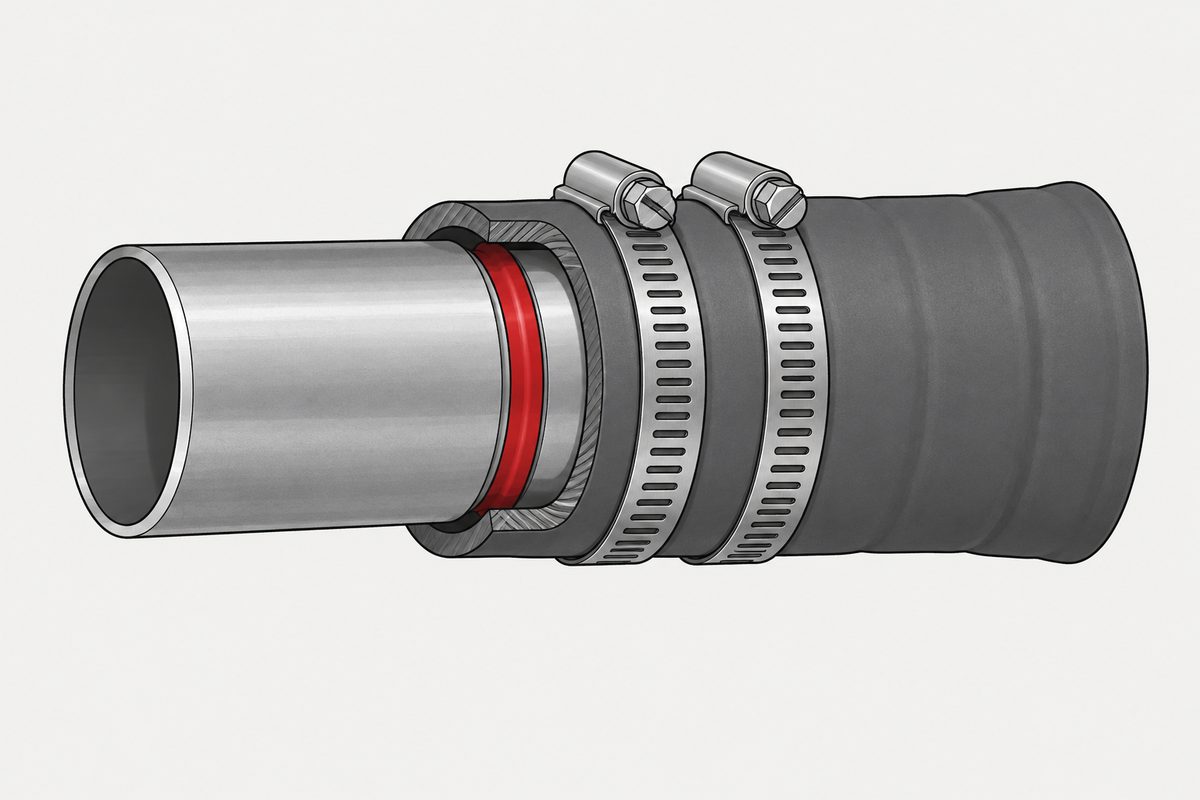
The general machinery section, on systems where flexible hoses are permitted to be clamped: “Two clamps must be used on each end of the hose, or one hose clamp can be used if the pipe ends are expanded or beaded to provide a positive stop against hose slippage.” The nonmetallic piping section, on a narrow class of short low pressure runs, says the two clamps must be “installed beyond the bead or flare or over the serrations of the mating spud, pipe, or hose fitting”.
This page is not marine engineering guidance and this site does not supply hose clamps or marine parts. Anyone installing hose in a system covered by these rules has to read the rules that apply to their own vessel and system. It did not come from a forum question; it comes from scanning fastener families for zero coverage, which is how the site found it had never written the words hose clamp, worm drive or double clamp. The browser tooling we normally use remains unavailable.
Which document, and which version
The part is 46 CFR Part 182, Machinery Installation. This is the first time this site has used anything from title 46, which covers shipping. We read it through the electronic edition as the text in force on 1 August 2026, which came to about seventy three thousand characters once the markup was stripped.
We could not compare it against a second version. The title records its most recent issue date as 30 July 2026, and a request for that date returned an error page rather than a document, so there is one reading here and no cross check. That service was down entirely on our previous attempt at a different title, and is working again now.
We did not read the part that defines which vessels this subchapter covers, so this page does not say what class of vessel the rules apply to. We also did not read the outside standards the part incorporates by reference, so nothing here describes their contents.
Four requirements, and the same rule stated twice
Section 182.410 is headed general requirements, and its paragraph (d) opens “In systems and applications where flexible hoses are permitted to be clamped” and then gives four items:
- “Double hose clamping is required where practicable”
- “The clamps must be of a corrosion resistant metallic material”
- “The clamps must not depend on spring tension for their holding power”
- “Two clamps must be used on each end of the hose, or one hose clamp can be used if the pipe ends are expanded or beaded to provide a positive stop against hose slippage”
The first item and the fourth are the same requirement. What differs is the way out of it. The first is qualified by where practicable, which is a judgement about the installation. The fourth is not qualified at all; its alternative is not difficulty but a feature on the mating part, and the regulation says what that feature has to achieve, a positive stop against hose slippage.
The third item is worth reading slowly too, because of how it is written. It does not set a clamping force or a torque. It rules out a mechanism. A clamp whose holding power comes from spring tension is excluded whatever force it happens to produce. The second item does something similar in a different direction: corrosion resistant is not enough on its own, because the clamp also has to be metallic.
The other place the bead appears
The word bead appears twice in the whole part. The second time is in section 182.720, on nonmetallic piping materials, inside a set of conditions that is narrow in three separate ways at once. It applies “for the purpose of flexibility only”, to hose “installed in lengths of not more than 760 millimeters (30 inches)” and “subject to pressures of not more than 35 kPa (5 psig)”.
Inside that window, hose designed for use with hose clamps may be installed with two clamps, at both ends of the hose, which do not rely on spring tension for compressive force and which “are installed beyond the bead or flare or over the serrations of the mating spud, pipe, or hose fitting”.
So the bead has swapped sides. In the general machinery section it is the thing that lets the second clamp go. Here it is a condition the two clamps have to satisfy as well. The regulation does not explain the difference and we are not going to invent a reason for it.
One piece of context does sit nearby, though. The same section opens its flexible hose requirements by saying that hose “must be complete with factory-assembled end fittings requiring no further adjustment of the fittings on the hose, or field attachable type fittings may be used”. The clamp route in that section is an exception inside a narrow window, not the ordinary way to end a hose.
Where practicable, and where not
The phrase where practicable appears three times in the part, and the word practicable sixteen times. The two clamp idea is stated in four places, and they do not all carry the same weight.
The exhaust pipe section says nonmetallic hose for wet exhaust systems must be “double clamped where practicable”. The keel cooler section says short lengths of approved nonmetallic flexible hose, “fixed by two hose clamps at each end of the hose”, may be used at machinery connections. The first is qualified and the second is flat, with no practicability clause and no bead alternative offered.
That is worth noticing as a habit rather than as a fact about boats. When one requirement turns up in several places in a document, the sentences around it are doing work. The version you happen to read first may be the loosest one there.
Nothing about how tight
We counted words across the part. Torque appears zero times, tighten appears zero times, and worm appears zero times. The rules say how many clamps, what the clamp may not rely on, what it has to be made of and where it has to sit relative to the bead. They do not say how hard it is done up, and they do not name a clamp type.
This is the third article in a row where the absence of the word torque turned out to be the shape of the finding, on three unrelated regulations, so we are flagging the repetition rather than presenting it as a discovery. It is a secondary point here. The bead is the reason this page exists.
What this settles and what it does not
- In the general machinery section, an expanded or beaded pipe end lets one clamp replace two, provided it gives a positive stop against hose slippage
- In the nonmetallic piping section, two clamps must be installed beyond the bead or flare or over the serrations, so the bead is required as well as the clamps
- The same paragraph states the two clamp rule twice, once qualified by where practicable and once not
- Clamps must not depend on spring tension for their holding power, which rules out a mechanism rather than setting a force
- Clamps must be of a corrosion resistant metallic material, so corrosion resistance alone is not enough
- The clamp route in the nonmetallic piping section sits inside a narrow window: for the purpose of flexibility only, not more than 30 inches, not more than 5 psig
- The exhaust section is qualified and the keel cooler section is not
- Torque, tighten and worm appear zero times in the part, by our count
- The regulation does not explain why the bead does opposite work in the two sections, and neither do we
- We read one version only, the text in force on 1 August 2026, with no second version to compare against
- We did not read the part defining which vessels are covered, nor the standards incorporated by reference
- This is not marine engineering guidance
The transferable part is the question, not the answer. A clamp is there to stop movement, and it is rarely the only thing in the joint doing that. Once you know what else is resisting the slip, the number of clamps stops being a fixed quantity and becomes a consequence. Two documents can answer that differently for the same feature, and both can be right about their own case.
This page covers step 4, the drive. The whole order is substrate, thread, head, drive, finish, documentation, and why doing it out of order is rework rather than a tweak is in specifying a screw.
Common questions
Does a beaded pipe end mean fewer hose clamps?
In one section of this part, yes: two clamps must be used on each end of the hose, or one clamp can be used if the pipe ends are expanded or beaded to provide a positive stop against hose slippage. In another section of the same part the bead is not an alternative to a clamp at all, and two clamps must be installed beyond the bead or flare or over the serrations of the mating fitting.
Why do the two sections treat the bead differently?
The regulation does not say, and this page does not guess.
Is double clamping always required?
The wording varies within the part. One item says double hose clamping is required where practicable. Another item in the same paragraph says two clamps must be used on each end, with the beaded or expanded pipe end as the only alternative offered. The exhaust section says double clamped where practicable, and the keel cooler section says fixed by two hose clamps at each end with no qualifier.
What kind of clamp is excluded?
The general requirements say the clamps must not depend on spring tension for their holding power, and the nonmetallic piping section says the clamps must not rely on the spring tension of the clamp for compressive force. That rules out a mechanism rather than setting a force value.
Does the clamp have to be stainless?
The requirement as written is that the clamps must be of a corrosion resistant metallic material. It does not name a material, and this page does not add one.
How tight should the clamps be?
The part does not say. By our count the word torque appears zero times in it, and so does tighten.
Are hose clamps the normal way to end a flexible hose in these rules?
Not in the nonmetallic piping section. That section requires hose to be complete with factory-assembled end fittings requiring no further adjustment, or field attachable fittings, and the clamp option appears only inside a narrow window for the purpose of flexibility, at not more than 30 inches and not more than 5 psig.
Which vessels does this apply to?
This page does not say. We did not read the part that defines the scope of the subchapter.
Is this the current text?
It is the text in force on 1 August 2026 as served by the electronic edition. A request for the title latest issue date returned an error page rather than a document, so there is no second version compared here.
References
The document is machine readable XML served by the electronic edition of the regulations, not a scan, so no character recognition sits in the path. This is the first time this site has used anything from title 46. We read one version only, the text in force on 1 August 2026: a request for the date the title records as its most recent issue returned an error page rather than a document, so nothing here is cross checked against a second version. We did not read the part that defines which vessels the subchapter covers, so this page does not state its scope, and we did not read the outside standards the part incorporates by reference, so their contents are not described. The following are our own counts, not statements in the regulation: that torque, tighten and worm each appear zero times in the part; that bead and spring tension each appear twice; that where practicable appears three times. This is the third article in a row in which counting the absence of the word torque produced the shape of a finding, on three unrelated regulations, which is disclosed here rather than presented as new. The regulation does not explain why the two sections treat the bead differently, and this page does not guess. This article did not come from a forum question; it comes from scanning fastener families for zero coverage. This is not marine engineering guidance, this site does not supply hose clamps or marine parts, and no brand is named. The browser tooling this site normally uses remains unavailable.
Enquiries
If a clamp on your drawing is working alongside a bead, a flare or a set of serrations, that changes what the clamp has to do rather than only how many you need. Tell us what else in the joint is resisting the movement and we will tell you which properties we can evidence for the part.
Request a quotation
Tell us the part and the quantity. We will come back on feasibility, lead time and price.
Or email us directly sales@tigerfasteners.com