 TIGERFASTENERS
An Angled Screw Barely Loses Clamp. It Gains Something Worse.
A question on r/woodworking about a table-top corner brace collected four and a half thousand points and five hundred replies: with the brace against the apron, is it better to drive the screw square to the joint or at an angle? The answer that won said to go perpendicular, to maximise compression and minimise shear. That is right, and the arithmetic underneath it says something the answer does not, which is which of those two things actually decides the outcome.
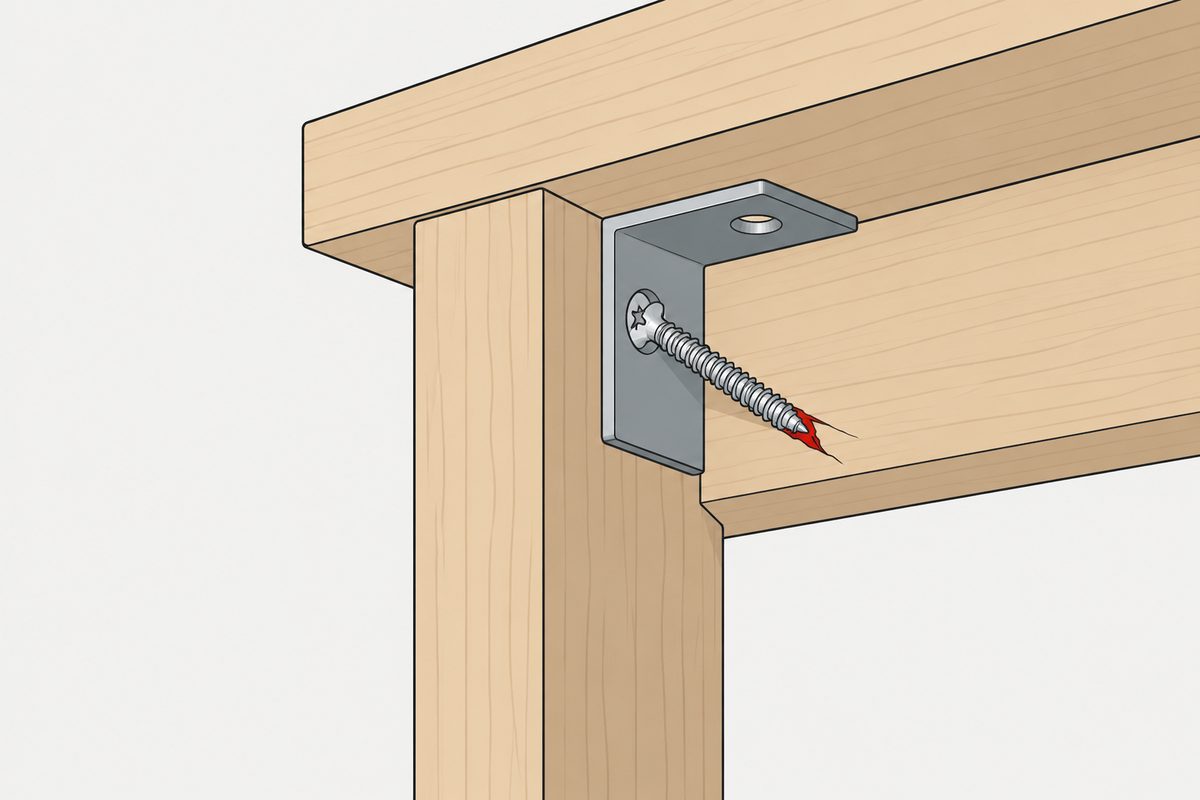
What the thread settled, and what it left open
The reply with 2,560 points is worth quoting because it is correct and compact: you want the screw perpendicular to the joint, to maximise the compressive force across it and to minimise shear, because most things fail in shear.
The reply under it, at 966, adds the part people miss. A screw has two members and they are not doing the same job. The threads bite into the apron and the head pulls the brace tight. The angle in the brace, the piece the screw merely passes through, hardly matters. The angle where the thread is engaged is what changes holding strength. That is the same observation as a screw in a clearance hole is not carrying the load with its shank, arrived at from a workbench.
Both are right. What neither says is how much you lose per degree, and the two quantities move at very different rates.
Resolve the tension and the answer changes shape
A screw pulls along its own axis. Call the tension F and the angle between the screw axis and the normal to the joint face θ. That tension splits into the part that clamps and the part that tries to slide one piece across the other:
clamping = F cos θ in-plane = F sin θ
| Angle off perpendicular | Clamping force kept | Tension pushing the joint sideways |
|---|---|---|
| 0° | 100 % | 0 % |
| 10° | 98,5 % | 17,4 % |
| 15° | 96,6 % | 25,9 % |
| 20° | 94,0 % | 34,2 % |
| 30° | 86,6 % | 50,0 % |
| 45° | 70,7 % | 70,7 % |
Read the first two rows against each other. Fifteen degrees costs you 3,4 per cent of your clamping force and hands 25,9 per cent of the screw’s tension to sliding the joint. Cosine is flat near zero and sine is steep near zero, so the quantity people watch is the one that barely moves.
Which reverses the usual worry. Losing clamp is not what goes wrong at small angles. The joint moving is.
The angle at which the screw slides its own joint
The in-plane component is resisted by friction between the two faces, and friction is proportional to the clamping component. So the screw’s own pull will start sliding the joint when
F sin θ > µ F cos θ, that is, tan θ > µ
F cancels. How hard you tighten does not move the threshold at all, which is worth sitting with, because tightening harder is the instinctive response to a joint that creeps and it cannot work. Only the angle and the friction matter:
| Friction coefficient µ | Angle at which the joint starts to slide |
|---|---|
| 0,3 | 16,7° |
| 0,4 | 21,8° |
| 0,5 | 26,6° |
| 0,7 | 35,0° |
| 0,9 | 42,0° |
For the numbers on the left, the Wood Handbook is the citable source and it is careful about what it is describing. It gives coefficients of kinetic friction for smooth, dry wood against hard, smooth surfaces as commonly 0,3 to 0,5, rising to 0,5 to 0,7 at intermediate moisture content and 0,7 to 0,9 near fibre saturation. It also says coefficients of static friction are generally greater than kinetic ones, and that friction rises with moisture content until the surface is actually flooded, at which point it falls again.
Two honest qualifications follow from that wording. Those figures are wood against a hard smooth surface rather than wood on wood, so they bound the problem rather than solve it. And because static friction is higher than the kinetic values quoted, a real joint holds to a somewhat larger angle than the table suggests. The direction of the result survives both.
Which is why a pocket-hole joint has to be clamped
Pocket-hole screws are driven at a shallow angle, commonly quoted as around fifteen degrees. tan 15° is 0,268, which sits just under the bottom of the 0,3 to 0,5 band and well under it once the higher static value is allowed for. So a pocket screw is engineered to live close to the line rather than far from it, and it works, and the universal advice to clamp the joint while driving is not superstition. It is holding the parts still through the one part of the operation where the screw is pulling them out of line.
Everything that raises µ buys margin here, which is the same reason a higher interface friction is the countermeasure that addresses self-loosening at the cause rather than resisting it. And everything that lowers µ, a waxed or finished face, a wet surface drying out, works the other way.
Three things to take to a drawing
- Perpendicular is not about the clamp. The clamping force is insensitive to modest angles. It is about not asking the fastener’s own tension to move the joint before any service load arrives
- Tightening harder does not fix creep from an angled screw. F cancels out of the threshold. If a joint walks as it is driven, the fix is the angle, the friction, or a clamp, and not more torque
- The two members are not equivalent. The threaded member sets holding strength; the clearance member only sees head load. When a joint has to be angled for access, put the angle where the screw passes through rather than where it engages, if the geometry lets you choose
The general case, where a joint is loaded across the fastener rather than along it and more torque stops helping, is tighter is not always longer. What the tension is worth once it exists, and why the number on the wrench is not the number in the joint, is torque and clamp force.
This is not one of the six steps. It shows up across them, or after assembly. Where the decisions that lead here were made is in specifying a screw, which sets out the order and why doing it out of order is rework.
Common questions
Should a screw be perpendicular to the joint?
Usually yes, and the reason is not the one most people give. The clamping force is the cosine of the angle, so it is remarkably insensitive: fifteen degrees off perpendicular still delivers 96,6 per cent of the clamp. What changes fast is the in-plane component, which is the sine and reaches 25,9 per cent at the same fifteen degrees. Perpendicular matters because it stops the screw pushing the joint sideways, not because it preserves clamping force.
Why does a joint slide sideways as I drive an angled screw?
Because the component of the screw tension parallel to the joint face exceeds the friction the clamping component can generate. The condition is that the tangent of the angle exceeds the coefficient of friction, and the tension cancels out of it entirely, so the angle and the friction are the only two things that decide it. At a friction coefficient of 0,3 the threshold is about 16,7 degrees; at 0,5 it is about 26,6.
Will tightening harder stop the joint creeping?
No, and that is the useful part of the arithmetic. The tension appears on both sides of the sliding condition and cancels, so the threshold angle is the same whether the screw is barely snug or fully tensioned. A joint that walks under an angled screw needs a different angle, a higher friction face, or a clamp holding it while the screw is driven.
What is the coefficient of friction for wood?
The Wood Handbook gives kinetic friction for smooth, dry wood against hard, smooth surfaces as commonly 0,3 to 0,5, rising to 0,5 to 0,7 at intermediate moisture content and 0,7 to 0,9 near fibre saturation, and notes that static coefficients are generally higher than kinetic ones. Read the wording carefully: that is wood against a hard smooth surface rather than wood on wood, so it bounds the question rather than answering it for a particular pair of faces.
Does the angle matter equally in both pieces?
No. The threads engage one member and the head bears on the other, so holding strength is set by the angle where the thread is, and the piece the screw only passes through mostly transmits head load. If access forces an angle somewhere, and the geometry gives you a choice, it costs less in the clearance member than in the threaded one.
References
- Wood Handbook, FPL-GTR-190, Chapter 4, Moisture Relations and Physical Properties of Wood; the Friction Properties section, for the kinetic coefficients and the static-against-kinetic and moisture statements
- r/woodworking — the thread this began in, with the perpendicular answer and the observation that the threaded member is the one that matters
The trigonometry on this page is our own and can be repeated with a calculator; nothing in it is taken from a standard. The friction figures are quoted from the Wood Handbook exactly as that document words them, and the wording matters: they are kinetic coefficients for smooth, dry wood against hard, smooth surfaces, not a wood-on-wood value, and the handbook itself notes that static coefficients are generally higher. Because of that, the threshold angles computed from them sit on the conservative side and a real timber joint will hold to a somewhat larger angle. We read the chapter from a complete copy of the same handbook, because the Forest Products Laboratory chapter URL refused our request; the reference above points at the canonical location. The fifteen-degree figure for pocket-hole screws is the commonly quoted value rather than a standard, and jigs differ. We found no published measurement of joint strength against screw angle in timber that we were willing to cite, so no strength claim is made here: the argument is about which of two quantities moves faster with angle, which is a matter of trigonometry rather than testing.
Enquiries
If a fastener has to be driven at an angle for access, tell us the angle and which of the two members the thread engages. It changes which head style and which point form make sense, and it is the kind of constraint that usually reaches a supplier as a complaint about the screws rather than as a dimension.
Request a quotation
Tell us the part and the quantity. We will come back on feasibility, lead time and price.
Or email us directly sales@tigerfasteners.com