 TIGERFASTENERS
Grip Range and Drill Capacity Are Two Different Numbers
A self-drilling screw usually carries two thickness figures, and they are not two ways of saying the same thing. Reading one when you needed the other is a common way to specify a screw that cannot reach the far side of the joint.
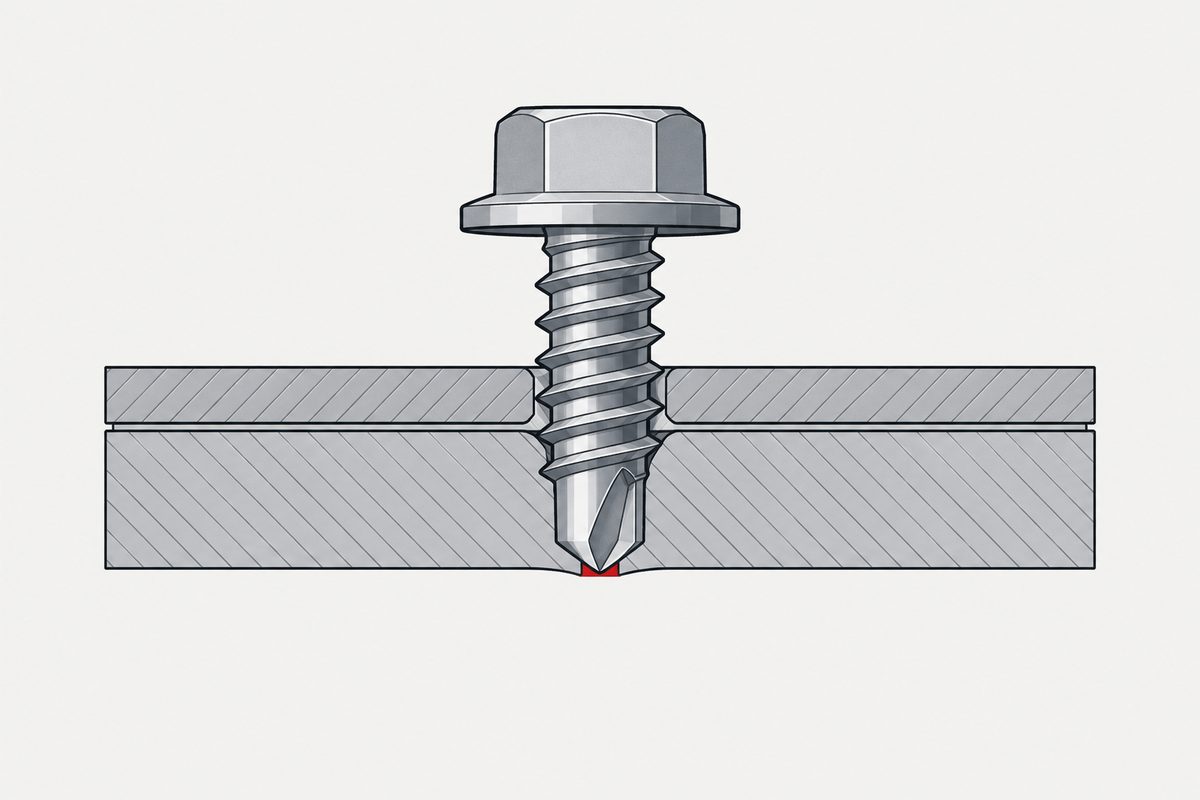
The two numbers, and what each one answers
Drill capacity is the total thickness the point can drill through. Grip range — also called fastening thickness range — is the assembly thickness the screw can clamp, determined by overall length, the under-head dimension, the unthreaded section and the thread protrusion you need.
These can be very far apart on the same product. A screw can be published with a 28 mm grip range and a 3 mm drill capacity. It reaches through the joint; it cannot make the hole through the joint. If the far layer is steel, that screw is only usable where the hole already exists.
There is a detail in the definition worth knowing: drill capacity counts the gaps between layers, not just the metal. ASTM C1513 defines it as the total thickness of material the screw is designed to drill, including inter-layer gaps. Two sheets that measure 2 mm each are not a 4 mm drilling problem if they are standing 3 mm apart.
Both numbers are thicknesses of metal, which is worth saying because sheet is very often ordered by a gauge number instead. That number is not a thickness in the document that defines it, and converting it to one requires a density somebody assumed, so an enquiry that names a gauge has not yet answered either column above.
The point number is not a universal scale
Point numbers look like a standard scale and are not one. One commercial table gives, for mild steel, roughly 0.89–2.79 mm for a #2, 2.79–5.59 mm for a #3, 3.68–7.92 mm for a #4 and 6.35–12.70 mm for a #5. A major manufacturer's own system runs 1–3 mm, 1–4 mm, 2.1–6 mm and 4.6–15 mm across its point designations.
“A number 3 point” is therefore not a specification. It is a designation within one maker's range, and the capacity it implies changes with screw diameter and with the material being drilled. Quote the rated capacity for the actual product, not the point number alone.
Where the rating comes from
The rating is not a marketing estimate; there is a test behind it, and knowing its conditions tells you how far the number travels.
A common mis-citation is worth clearing up first: ISO 15480 is the product standard for hexagon washer head drilling screws in ST2.9 to ST6.3, and it normatively references the functional requirements rather than containing the drilling test itself. The test is in ISO 10666, whose drilling and screwing-in procedure specifies a mild steel test plate, an axial force of 150–350 N, speeds of 1,800–2,500 rpm for the smaller sizes and 1,000–1,800 rpm for ST5.5–ST6.3, and maximum drilling times running from 3 to 13 seconds depending on size. The American equivalent, SAE J78, sets maximum drill-and-thread times of about 2 to 5 seconds.
So the rating is a pass on a specified plate under a specified force and speed. It is not a promise about your material, your gaps, or your tool. That is the honest reason capacities differ between brands that both comply.
Two workshop rules that are not true
“Too fast burns the point, too slow will not drill.” The second half is wrong as physics. Low speed does not prevent cutting; what actually fails is the tool running out of torque, or thrust being too low so the point rubs and dwells instead of cutting, or chips forming badly. Excessive thrust breaks or burns points too. Speed only means something alongside point diameter, material hardness, thrust and chip evacuation.
“Stainless fails because it work-hardens.” True but incomplete, and the missing half is about the screw rather than the plate. Austenitic stainless also has low thermal conductivity, so heat concentrates at the cutting edge, and dwelling work-hardens the surface locally so the next pass is harder still. But also: ordinary A2 and A4 stainless is not as hard as a case-hardened carbon steel point. Some all-stainless self-drilling screws are approved only for aluminium and other soft metals; drilling steel usually calls for a hardened martensitic stainless or a bi-metal screw — stainless body, hardened carbon steel point.
When the assembly is thicker than the capacity
The instinct is to drill a pilot hole and use the same screw. That is not the standard answer, and it is not quite the same operation.
- Use a screw whose rated capacity covers the stack, gaps included.
- Put a clearance hole in the upper layer or layers so the point only has to drill the layer that matters. This is what SAE J78 describes for thick multi-layer assemblies, and it is different from pre-drilling the load-bearing base.
- If the base itself must be pre-drilled, move to a self-tapping system with a specified pilot diameter rather than reusing a drilling screw.
Pre-drilling does not make a drilling screw physically unusable, and the point is not automatically harmful. But whether it forms a sound thread then depends on the pilot diameter, the thickness and the thread form — too large and you lose engagement, too small and the point still cuts and may bind. The rated capacity and any structural approval were established without that hole, so neither carries over automatically. Hole sizing for the deliberate case is in pilot hole sizing, and the mechanism this page builds on is in choosing the screw type.
This page covers step 1, the substrate. The whole order is substrate, thread, head, drive, finish, documentation, and why doing it out of order is rework rather than a tweak is in specifying a screw.
Common questions
My screw says 28 mm grip range. Can it drill 28 mm of steel?
Almost certainly not, and those two numbers answer different questions. Grip range is the assembly thickness the screw can clamp, set by overall length, under-head dimension, unthreaded section and the thread protrusion required. Drill capacity is the total thickness the point can actually drill, and products exist with a 28 mm grip range and a 3 mm drill capacity. Check the drilling figure separately whenever the far layer does not already have a hole.
Do two 2 mm sheets count as 4 mm of drilling?
Only if they are in contact. Drill capacity is defined as the total thickness of material the screw is designed to drill through including the gaps between layers, so two 2 mm sheets standing 3 mm apart present a 7 mm drilling problem rather than a 4 mm one. This is a common way to exceed the rating without exceeding the metal thickness, and it is also why the standard approach for thick stacks is a clearance hole in the upper layer.
Is a number 3 point the same across brands?
No. Point numbering is a designation within a manufacturer range, not a common scale. One commercial table lists roughly 2.79 to 5.59 mm for a #3 in mild steel while a major manufacturer own system spans about 2.1 to 6 mm for its number 3, with different boundaries either side. The capacity also moves with screw diameter and with the material drilled, so specify the rated capacity for the actual product rather than the point number.
Why do stainless self-drilling screws fail so often in steel?
Two separate reasons, and the second is about the screw. Austenitic stainless plate work-hardens and conducts heat poorly, so a point that rubs instead of cutting hardens the surface and overheats its own edge. But ordinary A2 and A4 stainless is also softer than a case-hardened carbon steel point, and some all-stainless drilling screws are approved only for aluminium and other soft metals. Drilling steel generally calls for a hardened martensitic stainless or a bi-metal screw with a stainless body and a hardened carbon steel point.
References
- ISO 15480:2019 — Hexagon washer head drilling screws with tapping screw thread (product standard; references ISO 10666 for point function)
- ISO 10666:1999 — Drilling screws with tapping screw thread: mechanical and functional properties (drilling and screwing-in test, clause 4.2.1)
- SAE J78:2021 — Steel Self-Drilling Tapping Screws (drill-drive test; point selection and multi-layer clearance holes)
- ASTM C1513 — Steel Tapping Screws for Cold-Formed Steel Framing Connections (drill capacity definition and drill-drive requirements)
Point-capacity figures are quoted from specific commercial tables and one manufacturer system to show that they differ; they are not universal values. Clause numbers cited for the drill capacity definition and drill-drive requirement are from ASTM C1513-18; the current edition is C1513-24 and its clause numbering was not verifiable from public sources.
Enquiries
Tell us the full stack — every layer, its material, and the gaps between them — rather than a single thickness. The drilling figure counts the gaps, and it is the number that decides whether the screw can reach the far side at all.
Request a quotation
Tell us the part and the quantity. We will come back on feasibility, lead time and price.
Or email us directly sales@tigerfasteners.com