 TIGERFASTENERS
Why one diameter has more than one pitch
The short version: pitch is almost not a strength decision at all. A fine thread gives the screw about 6–9% more tensile stress area, which is real but small. On the other side of the joint it gives next to nothing — work the standard stripping geometry through and the pitch term cancels exactly in the basic profile, leaving only small tolerance-dependent differences once limit sizes are used. So if a joint is marginal, changing pitch is not the lever. What pitch actually decides is how the thread behaves in a factory: how it survives damage, plating and tapping, and how fast it goes together.
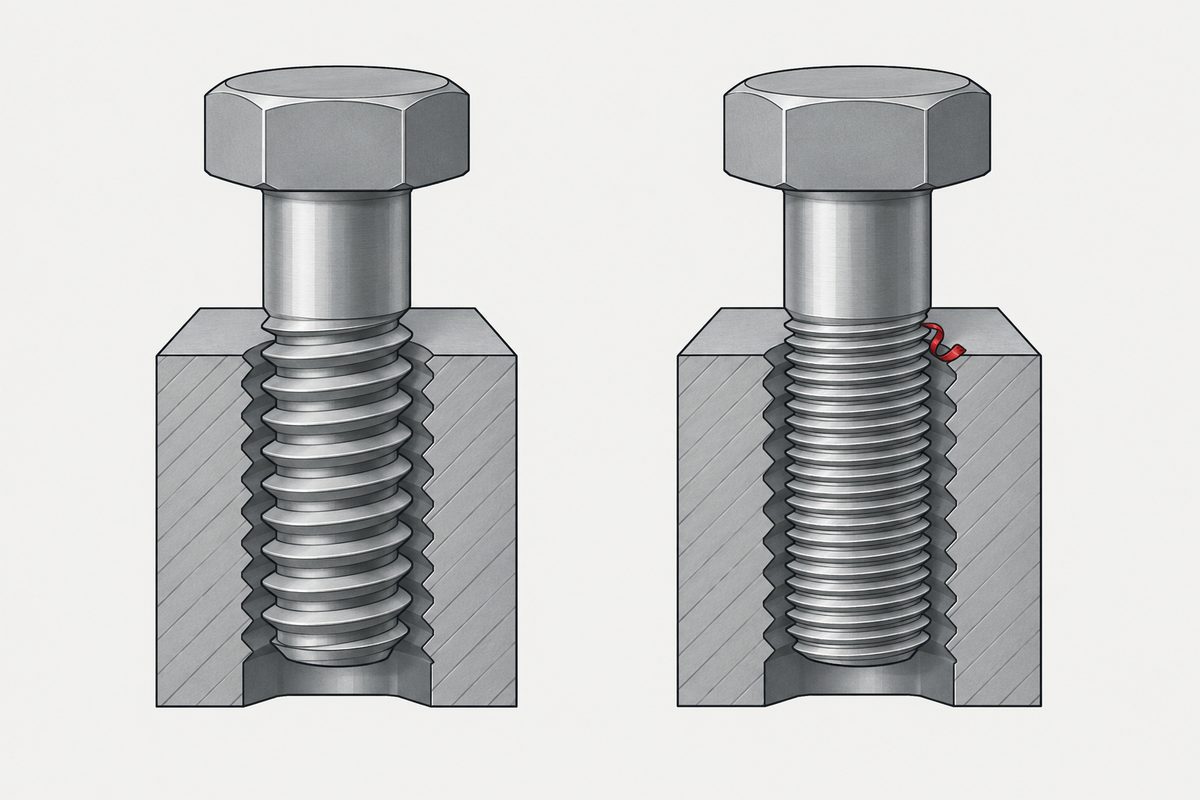
The choice that exists at all
An M8 screw is 8 mm nominal diameter whichever pitch it has. What changes is how far the thread advances per turn: 1.25 mm for the coarse series, 1.0 or 0.75 mm for the fine ones. The pitch diameter, the minor diameter and the thread depth all move with it — which is exactly why the numbers below come out the way they do.
| Size | Coarse | Fine |
|---|---|---|
| M6 | 1.0 | 0.75 |
| M8 | 1.25 | 1.0, 0.75 |
| M10 | 1.5 | 1.25, 1.0, 0.75 |
| M12 | 1.75 | 1.5, 1.25, 1.0 |
Each diameter has one coarse pitch listed, and one or more fine ones. ISO 261 defines the coarse series as the largest pitch in current use at each diameter; it does not say coarse is a default, and the reason coarse usually wins is worked out below rather than read off the standard.
The screw side: fine is slightly stronger
Tensile capacity comes from the stress area, computed from the pitch and minor diameters rather than from the nominal 8 mm. A finer pitch cuts a shallower groove, so both diameters are larger and so is the area.
| Size | Coarse | Fine | Difference |
|---|---|---|---|
| M8 | 36.6 (×1.25) | 39.2 (×1) | +7% |
| M10 | 58.0 (×1.5) | 61.2 (×1.25) | +6% |
| M12 | 84.3 (×1.75) | 92.1 (×1.25) | +9% |
Real, and worth knowing, but single digits. A joint that needs more than that needs a larger diameter or a higher class, not a different pitch.
The nut side: pitch cancels, and this is the part people get wrong
The intuitive argument is that a finer pitch packs more threads into the same depth of hole, so there is more metal to shear and the female thread is stronger. That argument is wrong, and it is wrong in an instructive way.
The standard geometric shear area for an internal thread is A = π·Le·d·[0.5 + (0.57735/P)(d − d2)]. For the ISO basic profile d − d2 = 0.649519 P, so the pitch inside the bracket cancels against the pitch outside it:
0.5 + 0.57735 × 0.649519 = 0.875, for every pitch. So A = 0.875 π·Le·d — 21.99 mm² per mm of engagement on M8 whether the pitch is 1.25, 1.0 or 0.75.
More turns, but each turn thinner in proportion. Counting turns without noticing that the shear width per turn shrinks by the same factor is what produces the wrong answer.
One clarification, because the usual sources appear to say the opposite. They say a fine thread is stronger “in tension and in shear”, and they are not disputing the result above — they mean a different failure. Their shear is the bolt being cut across, which is why they attribute it to the minor diameter. Stripping is the internal thread being pushed off a cylinder. One catalogue makes the split explicit by listing resistance to stripping as a coarse advantage on the same page as “stronger in tension and shear” for fine.
Which of them fine actually wins depends on where the shear plane falls, and the codes do not agree on the area. Eurocode 3 uses the tensile stress area when the plane passes through the threads, worth about 7% to fine, and the gross section when it passes through the shank, worth nothing. AISC works from the nominal unthreaded body area and handles threads through the allowable stress instead, so pitch buys nothing there either. VDI 2230 picks the diameter to suit the plane. So: fine has an edge on bolt shear in some cases and none in others, and on stripping the basic-profile geometric area is the same for every pitch.
This is the basic-profile result. A full calculation uses limit sizes rather than basic ones, which reintroduces a pitch-dependent term through the tolerance classes, and real stripping strength also depends on the relative strength of the two materials, nut dilation and the uneven load sharing that puts most of the force on the first engaged thread. None of that restores a simple “finer is stronger” rule. See thread engagement for how the length is chosen, length and grip for what the rest of the screw is doing, and stripped threads for which side actually fails.
So what is choosing the pitch
If strength is a few percent on one side and nothing on the other, then pitch is settled by manufacturing and service conditions, and those genuinely point both ways.
| Coarse tends to win when | Fine tends to win when |
|---|---|
| Threads get knocked about. For a dent of a given depth, a deeper thread loses a smaller share of its height | The wall or nut is shallow. More turns fit into the axial depth that exists |
| There is swarf, paint or corrosion product. A deeper groove has more room before it binds | The thread is an adjustment. Travel per turn is the pitch, which is why tie rods and micrometers use fine |
| Assembly is fast or blind. Fewer turns per unit travel, and cross-threading is harder to start | The parent is hard or the wall very thin. NASA's fastener manual lists extra-fine threads specifically for tapped holes in hard materials and thin walls; it does not give the mechanism |
| Manufacturing tolerance is loose. A coarse thread carries wider absolute tolerances, so there is more room to place a coating allowance inside them | Conditions are clean and controlled. Machined steel assembly rather than a casting on a line |
One piece of folklore worth dropping. Coarse taps are often said to break less because they have a thicker core. The basic geometry runs the other way: the minor diameter of M8×1 is 6.77 mm against 6.47 mm for M8×1.25, so the fine thread has the larger unfluted envelope. That is not the same as the tap's core: flutes cut into it, and the weakest section depends on flute count, depth and the maker's design. Core section does matter: with material and length it sets torsional stiffness, so it is part of the strength side. What it does not set is the load — chip volume, torque per tooth, hole depth, lubrication and synchronisation drive the torque the tap has to survive, and we have not found data comparing coarse against fine with those held constant.
The coating point, stated properly
Room for a coating is not a fixed clearance shared by all pitches. It is set by the tolerance position — the letter in 6g — which places the tolerance band below basic size deliberately, and by the grade, which sets its width. The plated thread must still stay inside the maximum material limit.
Pitch enters indirectly: tolerances in the ISO system scale with pitch, so a coarse thread's bands are wider in absolute terms and there is more absolute room to work with. That is a real advantage and a different mechanism from the one usually given. See what the tolerance class means and what happens when the allowance runs out.
The vibration claim, with the numbers attached
Fine threads are widely said to resist loosening because the helix angle is shallower. The angles are 3.17° for M8×1.25 and 2.48° for M8×1. Whether that counts as self-locking depends on friction, which the claim usually omits: the equivalent friction angle for a 60° thread is arctan(μ/cos 30°), giving 2.6° at μ = 0.04 and 3.3° at μ = 0.05.
At well-lubricated friction the coarse thread is not comfortably self-locking at all — 3.17° against 3.3° is not a margin. Taking μ = 0.12 as a dry example gives 7.9°, and both pitches are clear of it — but μ varies with material, finish, coating, lubricant and how many times the joint has been done up, so no single value stands for “dry”.
More importantly, the static comparison is not what causes loosening in service. Transverse displacement makes the flanks and the bearing face slip cycle by cycle, shedding preload while the static self-locking condition still holds. A shallower helix helps at the margin; it does not address that mechanism. See why screws loosen.
Where this sits in the decision order
Pitch belongs in step two because it follows from the female side, which was settled in step one. A casting or a plastic boss that cannot hold a thread on its own usually argues for coarse, on tapping and damage grounds — usually, not always, since a hard parent or a shallow wall argues the other way and those do occur together.
What should not decide it on its own is the load, or the turn count. Fine buys single-digit percentages on one side of the joint and, in the basic profile, nothing on the other, so it is rarely enough on its own to rescue a marginal design. Diameter, property class and engagement length are the levers that move. See what the property class numbers mean and the full decision order.
One level up, the same shape of answer applies to how many starts the thread has — and why it is almost always one.
This page covers step 2, the thread. The whole order is substrate, thread, head, drive, finish, documentation, and why doing it out of order is rework rather than a tweak is in specifying a screw.
Common questions
Is a fine thread stronger than a coarse one?
On the screw, yes, by about 6 to 9 percent of stress area for common sizes. On the nut side the pitch term cancels out of the basic stripping geometry, so there is no gain there in that model; using limit sizes reintroduces a small tolerance-dependent difference that can go either way. It is not a lever worth pulling for strength.
Does a finer pitch put more metal in the hole to shear?
It puts more turns in, but each turn is proportionally thinner, and the two effects cancel exactly in the basic profile. The geometric shear area works out at 0.875 times pi times engagement length times diameter regardless of pitch.
Do coarse taps break less because they have a thicker core?
Not for that reason. The basic minor diameter of M8x1 is 6.77 mm against 6.47 mm for M8x1.25, so the fine thread has the larger unfluted envelope, though that is not the tap core itself once flutes are cut. Core section does affect torsional stiffness, but so do chip volume, torque per tooth, hole depth and lubrication, and we found no comparison holding those constant.
Does a fine thread resist vibration loosening?
Only at the margin. The helix angles are 3.17 and 2.48 degrees, and the equivalent friction angle is about 2.6 degrees at a friction coefficient of 0.04, so at low friction the coarse thread has little self-locking margin. Loosening in service is driven by transverse slip shedding preload, which a shallower helix does not address.
When should I specify fine?
When the wall or nut depth is too shallow for enough coarse threads, when travel per turn is being used to adjust something, when the NASA guidance on extra-fine threads for hard materials or thin walls applies, or on clean machined assemblies. Otherwise coarse is the safer default.
Enquiries
Not sure whether a drawing calling for a fine pitch actually needs it? Send the thread callout, the parent material and the wall or nut depth. We will say whether the fine series is doing anything for that joint — and if it is not, what the coarse equivalent costs and leads at.
Request a quotation
Tell us the part and the quantity. We will come back on feasibility, lead time and price.
Or email us directly sales@tigerfasteners.com