 TIGERFASTENERS
Why standard bolt threads are single start
The short version: not because a multi-start thread would unscrew itself. Run the self-locking check and a two-start M8 still passes at ordinary assembly friction. What multi-start actually costs you is about 11% of your preload for the same torque, and — the part that matters more — a thread that cannot be described by diameter and pitch alone, and that will jam in a nut which looks identical to the one it fits.
Thirteen thousand people have asked this
“Why are most standard bolt threads single start?” has been read over 13,000 times on Engineering Stack Exchange. The answer that comes up first, in that thread and everywhere else, is that a multi-start thread has a steeper helix and would therefore back itself out under load.
That answer is checkable, so we checked it. It does not survive.
What self-locking actually requires
A thread does not back-drive under a static axial load while the helix angle stays below the equivalent friction angle:
λ = arctan( n·P / (π·d2) ) versus ρ′ = arctan( μ / cos 30° )
n is the number of starts, P the pitch, d2 the pitch diameter, and the cos 30° is the half-angle correction for a 60° thread form — the flanks are inclined, so the normal force is larger than the axial load and friction rises with it.
| Size | 1 start | 2 starts | 3 starts |
|---|---|---|---|
| M6×1 | 3.40 | 6.79 | 10.12 |
| M8×1.25 | 3.17 | 6.32 | 9.43 |
| M10×1.5 | 3.03 | 6.04 | 9.02 |
| M12×1.75 | 2.94 | 5.86 | 8.75 |
| μ | 0.04 | 0.08 | 0.10 | 0.15 | 0.20 |
|---|---|---|---|---|---|
| ρ′ | 2.64 | 5.28 | 6.59 | 9.83 | 13.00 |
Two-start M8×1.25 sits at 6.32°. At μ = 0.10 the friction angle is 6.59°. It passes. The critical friction coefficient works out at μcrit = tan λ · cos 30° = 0.096, and steel-on-steel assembly friction is normally quoted well above that.
But do not stretch this the way we first wanted to. It shows one thing only: a static axial load will not drive it backwards. It says nothing about vibration, where loosening is caused by transverse slip shedding preload — a mechanism a shallower helix does not address, and one NASA's fastener guidance treats separately. The margin is also thin: 0.096 against an assumed 0.10 is four thousandths, and lubricant, coating or contamination can cross it. At three starts (9.43°) the check already fails at μ = 0.10.
What it does cost: preload per unit torque
Torque splits into three jobs. Only the first one climbs the thread; the other two are spent on friction:
T = F · [ nP/(2π) + μt·d2/(2·cos 30°) + μn·rn ]
Adding starts multiplies the first term and leaves the other two alone. For M8×1.25 at μ = 0.15 that first term is only 12.1% of the total — which is the familiar result that most of your torque is spent on friction, not on tension. Double it and the total grows by about a ninth:
| Friction | 1 start | 2 starts | 3 starts |
|---|---|---|---|
| μ = 0.15 | 100% | 89.2% | 80.5% |
| μ = 0.08 | 100% | 83.0% | 70.9% |
Read that second row carefully, because it is easy to misread — we did. Lower friction does not reduce preload. It raises preload at every start count, because less torque is being burned. What changes is the ratio: with friction out of the way, the lead term is a bigger share of what is left, so multi-start loses relatively more of the advantage. Well-lubricated and coated fasteners are exactly where multi-start is worst off in relative terms — not in absolute ones.
Figures use the linearised VDI-type equation with d2 = 7.188 mm and an assumed head bearing radius rn = 5.5 mm; that radius is an assumption, not a measured bearing diameter. The full power-screw form gives 88.7% and 82.7% for two starts, so the picture does not change.
The real reason is that it needs a second number
Here is the part we got wrong before checking, and it turned out to be the interesting half.
We assumed multi-start metric threads were simply outside the ISO system. They are not. ISO 5408 defines single-start and multistart and separates pitch from lead. ISO 965-1 gives the pitch-diameter tolerance factors for multi-start threads in §9, and §12.3 gives the designation, which looks like this:
M16 × Ph3P1.5 – 6H
Read it: Ph3 is a 3 mm lead, P1.5 a 1.5 mm pitch. Two starts. And the existence of that notation is the argument. An ordinary fastener is fully specified by diameter and pitch. A multi-start one is not — it needs lead as well, or it is ambiguous.
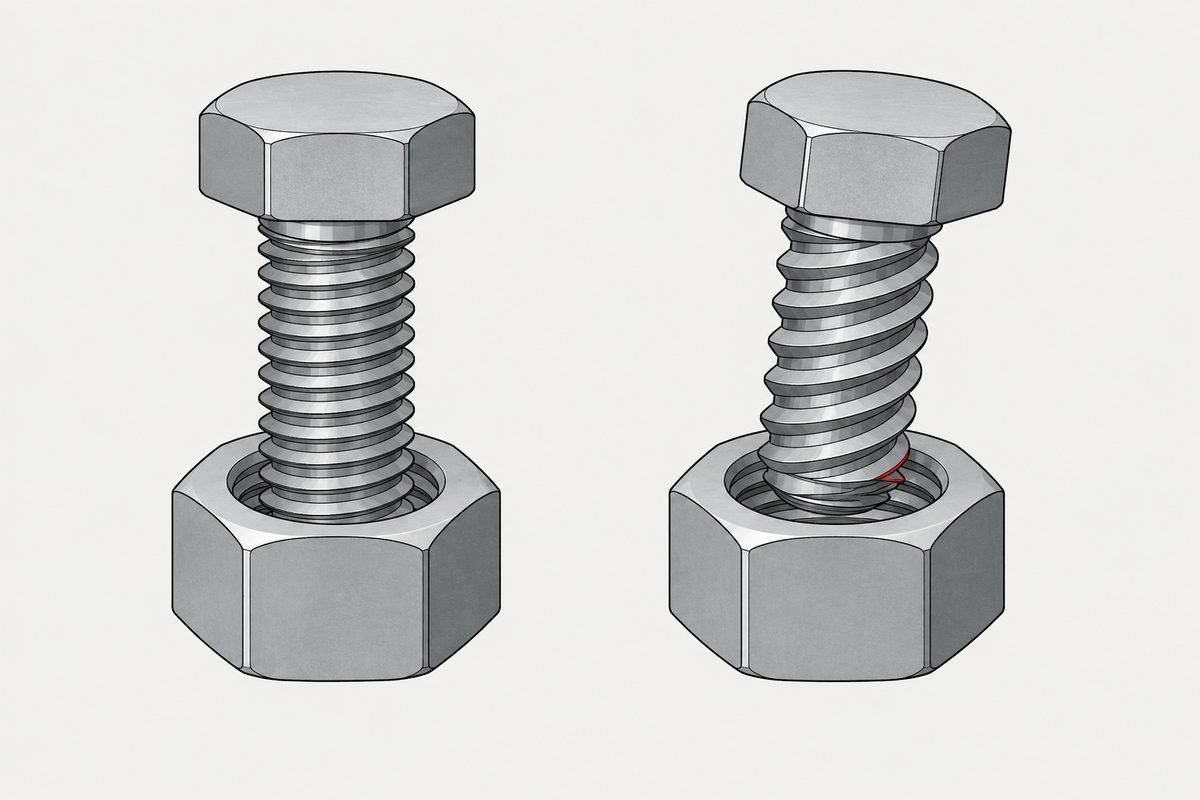
Now consider what happens when that second number goes missing, which in a parts bin it eventually does. Take a two-start M8×1.25 screw and an ordinary single-start M8×1.25 nut. Per turn, the screw demands 2.5 mm of travel and the nut permits 1.25 mm. Those cannot both be satisfied except at zero rotation, so the pair can catch briefly at the mouth and then interferes. It jams. Swapping which side is multi-start changes nothing; the leads still disagree.
What we are not claiming. We wanted to write that it threads in and feels fine while only some threads carry load — the quiet failure. We could not find that supported for normal metric metal threads, and the geometry argues against it. The honest version is blunter: it does not go together. Forcing it is cross-threading, not partial engagement.
So the practical objection is not that multi-start is unavailable or illegal. It is that a fastener's whole job includes being unambiguous months later, in a bin, to someone who did not specify it. Diameter and pitch do that. Diameter, pitch and lead do it only if all three survive the journey.
Where multi-start is the right answer
Multi-start exists to trade force for speed: more travel per turn, fewer turns to engage or release. That is precisely what you want on a bottle cap, where a fraction of a turn should seal or release it, and on lead screws and similar motion hardware, where advancing quickly is the entire point.
A structural fastener wants the opposite trade. It wants as much preload as possible out of the torque you can apply, and it wants to sit still afterwards. Same family of geometry, opposite objective. Which is the general shape of the answer to a lot of “why is it like this?” questions about fasteners — and why the coarse-versus-fine question resolves the same way: the thread is not being chosen for strength.
Loosening in service is a separate mechanism from back-driving, covered in why screws loosen. Where thread choice sits in the wider order of decisions is in specifying a screw.
References
- ISO 5408 — Screw threads: vocabulary (definitions of pitch, lead, single-start and multistart)
- ISO 965-1 — ISO general purpose metric screw threads: tolerances (§9 multi-start pitch-diameter factors; §12.3 designation)
- ISO 68-1 — Basic profile (d2 = d − 0.6495P)
- VDI 2230 Part 1 — linearised torque relation used for the preload table
- Shigley, Mechanical Engineering Design, ch. 8 — power-screw and self-locking treatment
- NASA-STD-5020B — loosening under vibration treated separately from back-driving
- “Why are most standard bolt threads single start?”, Engineering Stack Exchange
This page explains geometry and the reasoning behind a convention. Values for any particular joint are governed by your drawing and the standards it invokes.
This page covers step 2, the thread. The whole order is substrate, thread, head, drive, finish, documentation, and why doing it out of order is rework rather than a tweak is in specifying a screw.
Common questions
Would a multi-start bolt unscrew itself?
Not from a static axial load at ordinary friction. A two-start M8x1.25 has a helix angle of 6.32 degrees against an equivalent friction angle of 6.59 degrees at a friction coefficient of 0.10, so it still self-locks; the critical coefficient is 0.096. That check covers back-driving only, not vibration loosening, which is driven by transverse slip and is not addressed by a shallower helix. At three starts the check already fails at 0.10.
What does multi-start actually cost?
Preload per unit torque. Adding starts multiplies the lead term in the torque equation and leaves both friction terms unchanged. For M8x1.25 at a friction coefficient of 0.15, the same torque yields 89.2% of the single-start preload at two starts and 80.5% at three. Figures use the linearised VDI-type relation with an assumed head bearing radius.
Is a multi-start metric thread allowed by ISO?
Yes. ISO 5408 defines single-start and multistart threads and distinguishes pitch from lead. ISO 965-1 gives pitch-diameter tolerance factors for multi-start threads and the designation format, for example M16 x Ph3P1.5 - 6H, where Ph3 is a 3 mm lead and P1.5 a 1.5 mm pitch. What multi-start is not is interchangeable with an ordinary part of the same diameter and pitch.
What happens if a two-start screw meets a single-start nut?
It does not assemble. Per turn the two-start screw requires 2.5 mm of travel while the single-start nut permits 1.25 mm, and those cannot both hold except at zero rotation. The pair can catch briefly at the mouth and then interferes and jams. Forcing it is cross-threading, not partial engagement.
Does low friction make multi-start worse?
Only in relative terms. Lower friction raises the preload obtained at a given torque for every start count, because less torque is burned on friction. What changes is the proportion: with friction reduced, the lead term is a larger share of what remains, so multi-start gives up relatively more. It is not the case that low friction reduces multi-start preload in absolute terms.
Enquiries
We make single-start threads to ISO, which is most of what anyone needs. If a drawing has reached you with a lead and a pitch called out separately and you are trying to work out whether that was deliberate, send it over — that distinction is worth resolving before anything is cut.
Request a quotation
Tell us the part and the quantity. We will come back on feasibility, lead time and price.
Or email us directly sales@tigerfasteners.com