 TIGERFASTENERS
That 18.75 Is 225 Divided by Twelve
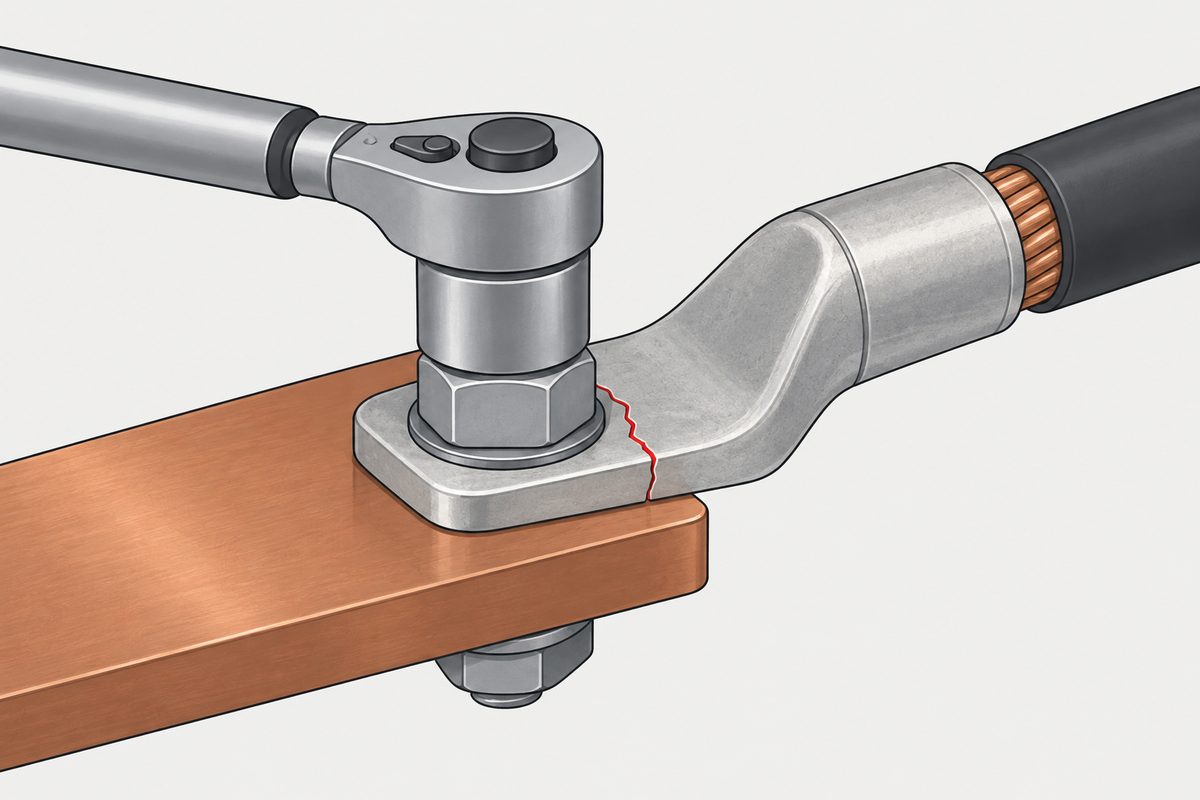
The most-upvoted fastener complaint on r/electricians in a long while is a title, not a post: if you are going to specify that I torque your lugs to 18.75 ft·lbf, at least make them strong enough to survive 18. Fourteen hundred people agreed. The number in that sentence is worth two minutes on its own, because it is not the number anybody designed.
Multiply it by twelve
18.75 × 12 = 225. There are twelve inches in a foot, so a specification of 18.75 ft·lbf is a specification of 225 inch-pounds, which is a round number, and almost certainly the number somebody actually wrote down.
That is an inference from arithmetic rather than something we can show you in a document, and it should be read that way. But it is a strong one. Nobody arrives at 18.75 by engineering. They arrive at it by dividing something tidy by twelve, and 225 is tidy in exactly the unit that terminal torque values are normally published in.
Which reframes the complaint. The two decimal places look like precision, and precision is what invites the objection: if the specification is fussy enough to name a quarter of a foot-pound, the part had better be good to a quarter of a foot-pound. The decimals were never a claim about precision. They are what happens to a round number when it changes units and nobody rounds it back.
What could actually deliver two decimal places
Suppose you wanted to hit 18.75 rather than 18.7 or 19. The first question is whether any tool is entitled to that, and the torque tool standard answers it. ISO 6789 Part 1, Table 4, gives the maximum permissible relative deviation for setting tools: 6 % up to 10 N·m and 4 % above it for classes A, B and C.
18.75 ft·lbf is 25.4 N·m, comfortably above the threshold, so the 4 % band applies:
| Quantity | Value |
|---|---|
| The specification | 18.75 ft·lbf = 25.4 N·m |
| Permitted deviation, conforming setting wrench | ±4 % = ±0.75 ft·lbf |
| The fractional part of the specification | 0.75 ft·lbf |
A wrench that fully conforms to the standard may read 0.75 ft·lbf away from its setting. The digits after the decimal point in that specification are the entire tolerance band of the instrument being asked to hit them.
And the tool is the smallest error in the chain by a long way. What torque control actually delivers as clamp force is a spread the tool’s few per cent disappears into, which is how badly your tightening method controls preload, and the friction the number silently assumes is a torque spec assumes a friction condition. The rest of what ISO 6789 does and does not require of a wrench, including the storage rule it never contains, is the torque wrench standard has no storage rule.
The test to run on any odd-looking specification
This generalises, and it takes about five seconds. When a number carries decimals that look too fine for the job, try converting it back:
| If the number is in | Try | Looking for |
|---|---|---|
| ft·lbf | × 12 | A round inch-pound value |
| N·m | × 8.851 | A round inch-pound value |
| N·m | ÷ 1.3558 | A round foot-pound value |
| mm | ÷ 25.4 | A round inch or a common fraction |
If one of those lands on something round, you have learned two useful things. The unit the number was engineered in, which tells you whose document it started life in. And that the trailing digits carry no information, so arguing about them, or building a process around them, is arguing with a conversion. The same pattern in dimensions rather than torque is how to tell metric from inch when nobody wrote it down, and the case where two systems of callout meet on one drawing is two callout systems.
One small thing while we are on units. The complaint is written “ft/lbs”, which is how almost everyone writes it. Torque is a force multiplied by a length, not divided by one, so the honest form is ft·lbf or lbf·ft. It rarely causes trouble because context saves it, and it is worth noticing on a page about a number that was damaged in translation.
The other half of the complaint, which we cannot settle
The sentence has a second claim in it: that the lug did not survive being tightened below its own specification. We have no terminal, no test and no way to check that, and one person’s experience with one batch is not evidence about a product. This page records the complaint and stops there.
What can be said generally is that a torque figure is an instruction to the person assembling, and the capacity to survive it belongs to whichever half of the joint is weaker, which is usually not the screw. That asymmetry is the nut has one number, and the case where the tapped hole rather than the fastener sets the limit is the reason is the tapped hole.
What to write instead
- Publish the number in the unit it was engineered in. If it was 225 inch-pounds, say 225 inch-pounds. Converting it for the reader’s convenience is how a round number acquires decimals it cannot justify
- If you must convert, round to the precision the process has. Against a ±4 % instrument band, 19 ft·lbf and 18.75 ft·lbf are the same instruction, and only one of them invites an argument
- State the tolerance next to the value. A bare number implies exactness that nothing in the chain supplies, and the tool is the smallest contributor to the spread
- Say which unit the digits are in. A torque written without a unit, or with a unit written as a division, is the same class of problem as a number next to a bolt that turns out to be a drive size
This is not one of the six steps. It shows up across them, or after assembly. Where the decisions that lead here were made is in specifying a screw, which sets out the order and why doing it out of order is rework.
Common questions
Why do torque specifications have strange decimals?
Usually because they are round numbers in a different unit. 18.75 ft·lbf multiplied by twelve is 225 inch-pounds, which is round, and inch-pounds is the unit terminal torques are commonly published in. Try multiplying a foot-pound figure by twelve, or dividing a newton metre figure by 1.3558, and see whether something tidy appears. If it does, the decimals are a conversion artefact rather than a statement about precision.
Can a torque wrench even hit 18.75 ft·lbf?
Not to that resolution. ISO 6789 Part 1 Table 4 permits a conforming setting tool of class A, B or C a maximum relative deviation of 4 per cent above 10 N·m, and 18.75 ft·lbf is 25.4 N·m. Four per cent of 18.75 is 0.75, so the permitted deviation of a fully conforming wrench is exactly the fractional part of the specification. Note this is the ISO standard; a wrench built to another standard has its own band, and we have not read those.
Is the tool the main source of error in a torqued joint?
No, it is the smallest one. The tool contributes a few per cent, while the relationship between torque and the clamp force you actually get is dominated by friction and by the tightening method, and the spread there is far larger. That is why arguing about the second decimal place of a torque figure is arguing about the least significant term in the problem.
Should I round a converted torque specification?
Round it to the precision the process can deliver, and say what unit and what tolerance you mean. Against a four per cent instrument band, 19 and 18.75 are the same instruction. Publishing the unrounded conversion does not add accuracy; it adds an implied claim the joint cannot support, and it invites people to treat a limit as a target.
Is ft/lbs the right way to write torque?
Not strictly. Torque is a force multiplied by a distance, so the form is ft·lbf or lbf·ft rather than a division. In practice context resolves it and nobody is misled, but it belongs to the same family of problems as a number published without a unit at all, which is the one that actually breaks parts.
References
- ISO 6789-1:2017 — hand torque tools, design and quality conformance testing; Table 4, maximum permissible relative deviation for setting tools, read for our earlier page on this standard
- r/electricians — the complaint this began in, 1,464 points, where the 18.75 figure appears
- r/electricians — the access thread, whose most-upvoted reply says plainly that a stubby key and a box wrench is not precision torque and is the best available
The arithmetic here is our own and takes a calculator: 18.75 multiplied by twelve is 225 exactly, and four per cent of 18.75 is 0.75 exactly. The claim that the specification began life as 225 inch-pounds is an inference from that arithmetic, not something we can show in a document, and it should be read as a strong inference rather than a fact. The tolerance figures are from ISO 6789-1 Table 4 as read for our earlier page on that standard, which was written from the standard’s own preview. ISO 6789 is an International Standard for hand torque tools; a wrench built to a North American standard has its own permissible deviation and we have not read those documents, so the comparison is made against ISO and labelled as such. We take no position on the manufacturer named in the source thread, on whether any lug failed below its specification, or on the quality of any product: that part of the complaint is one person’s experience, we hold no test data, and nothing here should be read as a finding about a component. No clause of the electrical code or of any wire-connector standard is cited, because we have not read them.
Enquiries
If a torque figure reaches us with decimals, tell us the unit it was originally written in and the tolerance that goes with it. A converted number carries digits nobody intended, and the difference between a target and a limit is the part that decides whether a joint is assembled correctly.
Request a quotation
Tell us the part and the quantity. We will come back on feasibility, lead time and price.
Or email us directly sales@tigerfasteners.com