 TIGERFASTENERS
Galvanized high-strength bolts: torque coefficients all in spec, and Japan still requires turn-of-nut
Japan’s bridge design codes have a specific rule for hot-dip galvanized high-strength bolts: do not tighten them by torque; use turn-of-nut, snugging first and then turning the nut a set angle. A 2020 survey by members of the Japan Society of Civil Engineers compiled the mill certificates of 1,038 galvanized F8T bolts from seven bridge fabricators and a railway agency. Torque coefficients averaged 0.126 to 0.129, ranged from 0.115 to 0.143, and all fell within the specified 0.110 to 0.150. The certificates pass; what the codes guard against is not on them. About 6 minutes to read.
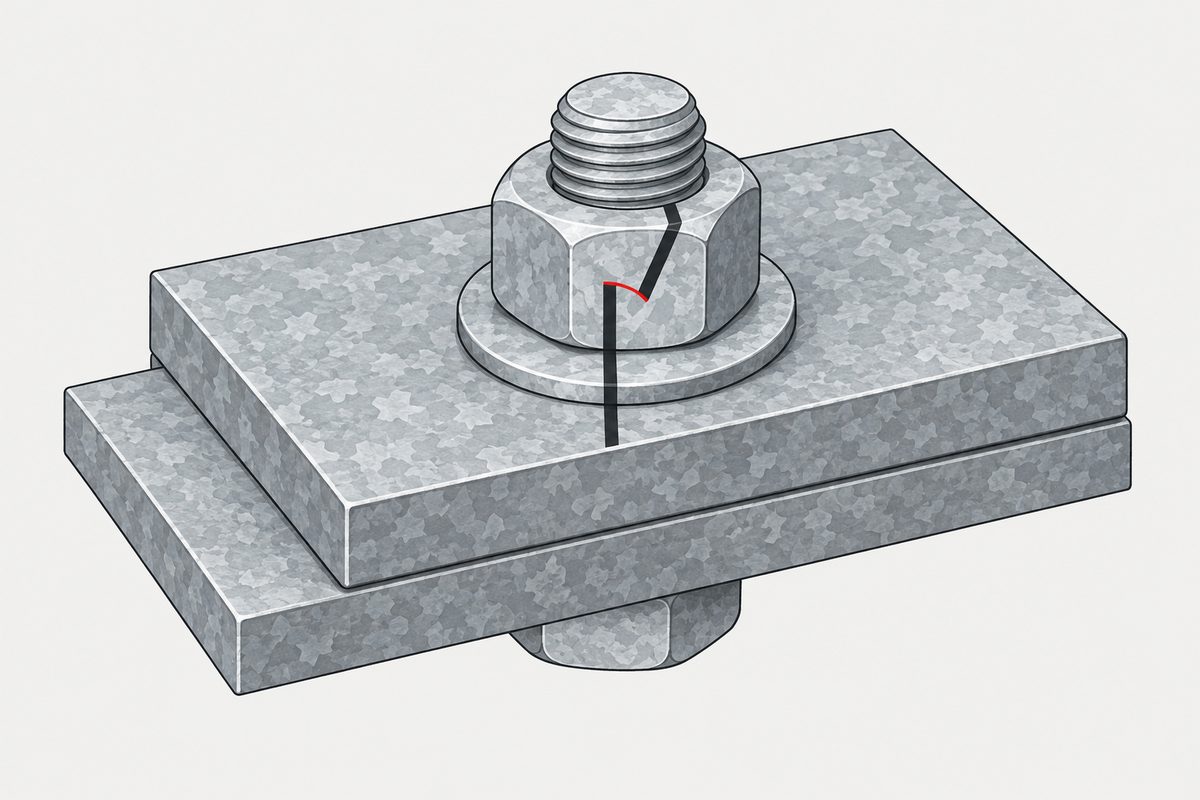
Galvanized F8T has no JIS of its own
F8T is a Japanese grade of high-strength hexagon bolt for friction joints, standardised in JIS B 1186. Hot-dip galvanized F8T has no separate JIS: the paper states that it applies the JIS B 1186 values, with each maker selling under approval from the Minister of Land, Infrastructure, Transport and Tourism. The values include proof stress at least 640 N/mm², tensile strength 800 to 1000 N/mm², torque coefficient 0.110 to 0.150 and zinc of at least 550 g/m² (HDZ55). Washers lose hardness from annealing during galvanizing, so their lower limit is set separately.
Why the codes want turn-of-nut
Japan’s Specifications for Highway Bridges and the railway structures design standard both require turn-of-nut for galvanized F8T, controlling the bolt in its plastic range rather than by torque in its elastic range. The paper gives two reasons: variation in coating thickness on the galvanized members and bolts scatters the preload, and preload loss from relaxation is large.
The procedure snugs the joint first (the railway standard gives 100 N·m for M16, 150 for M20 and M22, 200 for M24), marks it, then turns the nut 120° ± 30° for bolts up to five diameters long; longer bolts need a preliminary test. Where the angle comes from is in Torque plus angle.
Torque coefficients of 1,038 bolts
The survey covered product inspection certificates for bolts used on the railway agency’s and seven fabricators’ projects plus test bolts: 346 records, each the mean of three bolts.
| Size | Records | Mean | Min | Max | SD |
|---|---|---|---|---|---|
| M16 | 72 | 0.127 | 0.116 | 0.143 | 0.0047 |
| M20 | 33 | 0.129 | 0.119 | 0.142 | 0.0047 |
| M22 | 178 | 0.126 | 0.115 | 0.142 | 0.0058 |
| M24 | 63 | 0.128 | 0.118 | 0.135 | 0.0032 |
The means sit mid-range; the minimum is 0.005 above the lower limit and the maximum 0.007 below the upper. No clear relation to bolt length. And: one maker’s torque coefficient was below 0.120 at every size.
Tidy numbers, translated into clamp force
At a given torque, clamp force is inversely proportional to the torque coefficient. Between the certificate minimum and maximum, 0.143 ÷ 0.115 = 1.24: a batch at 0.115 reaches 24% more clamp force than one at 0.143 for the same torque. For M22 alone, mean 0.126 and SD 0.0058, two standard deviations either side is 0.114 to 0.138, about ±9%. These conversions are this site’s, from certificate values only.
The certificate value is the product inspection figure for that bolt set. The coating variation the codes worry about, on the bolts and on the galvanized members, and the relaxation after tightening, are not in it. Tidy certificates do not show torque control would be accurate enough; the codes chose to control by angle instead (A torque figure assumes a friction condition).
For anyone specifying the bolts
Decide the tightening method first. If torque control will be used, set the torque from the galvanized bolt’s own coefficient, not a table for plain bolts; the scatter from coating and relaxation remains (Right torque, wrong clamp force).
Read the certificate for that lot. Within the same range, makers can sit systematically low or high. A new supplier or lot is a reason to recheck the torque.
The galvanized nut is its own issue. Its thread is cut after galvanizing (A hot dip galvanized nut has its thread cut after the zinc goes on).
What this page cannot conclude
These are certificate statistics for Japanese F8T under JIS B 1186 and do not transfer directly to ISO classes or other national codes. The clamp-force conversion uses certificate coefficients only, without field coating variation or relaxation. Hydrogen embrittlement of galvanized high-strength bolts is not discussed in this paper (The rust-proofing that breaks the screw).
This is not one of the six steps. It shows up across them, or after assembly. Where the decisions that lead here were made is in specifying a screw, which sets out the order and why doing it out of order is rework.
Common questions
Can hot-dip galvanized high-strength bolts be tightened by torque?
Japan’s highway bridge and railway structure codes require turn-of-nut for galvanized F8T, snugging first and then turning 120° ± 30° for bolts up to five diameters long, citing coating thickness variation and large relaxation losses.
What is the torque coefficient of galvanized high-strength bolts?
A 2020 survey of certificates for 1,038 galvanized F8T bolts found means of 0.126 to 0.129, a minimum of 0.115 and a maximum of 0.143, against a specified 0.110 to 0.150. One maker was below 0.120 at every size.
References
- Komine et al. (2020) — Investigation of torque coefficient and mechanical property on hot dip galvanized high strength bolts, JSCE Journal A1 76(1):174–179 (J-STAGE, open access, in Japanese)
- Torque plus angle
The paper was read in full; specified values, record counts, torque coefficients and mechanical properties are as published. Its tables print the torque coefficient unit as kN; the coefficient is dimensionless and is shown without a unit here. The clamp-force ratio and two-standard-deviation range are this site’s arithmetic.
Enquiries
For galvanized high-strength bolts, give the grade, size and length, the intended tightening method, and whether lot torque-coefficient certificates are needed.
Request a quotation
Tell us the part and the quantity. We will come back on feasibility, lead time and price.
Or email us directly sales@tigerfasteners.com