 TIGERFASTENERS
The Zero Point of the Most Reliable Pretensioning Method Is the Full Effort of an Ironworker
Structural steel bolting has a method that is generally accepted as better than torque, and it works by counting turns. Counting turns from what, though. The document that defines it answers that question in its glossary, and the answer is not a number. It is a person, a named hand tool, and the phrase full effort. That is not sloppiness. The specification tried something more precise once, found it broke the method, and put the old wording back.
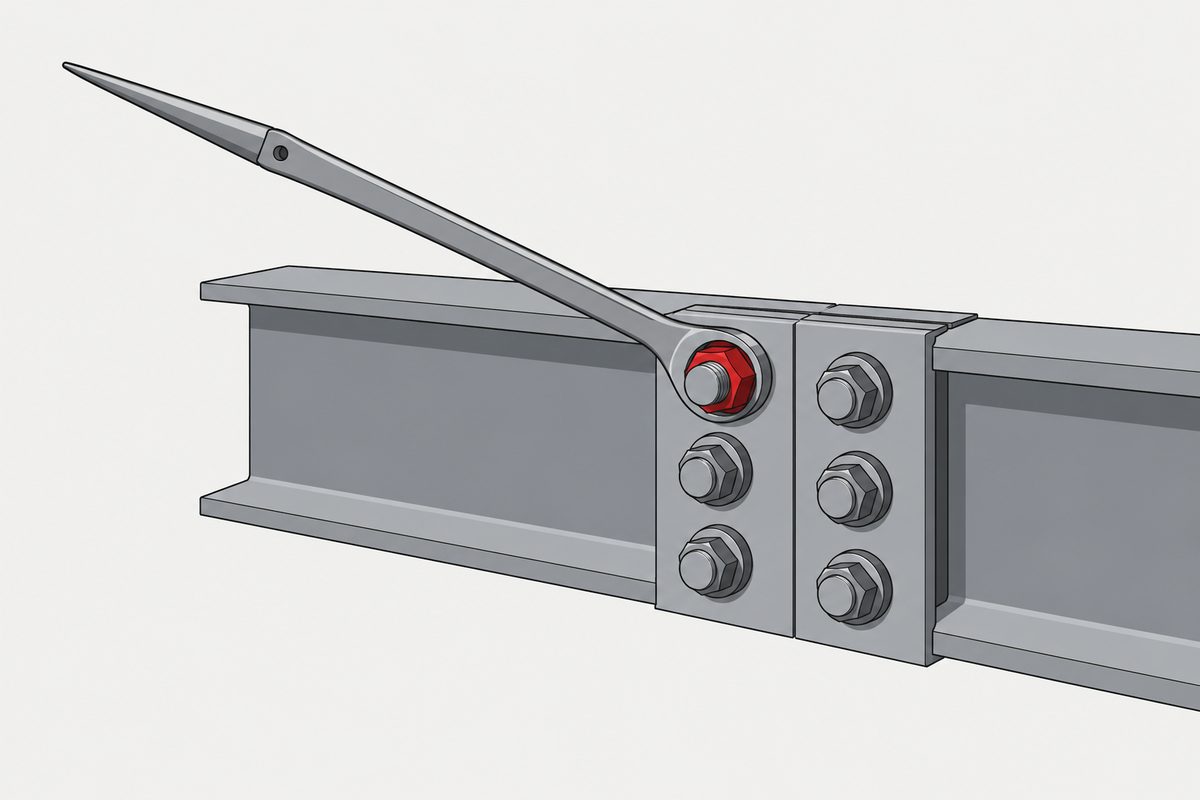
From the glossary of the 2020 RCSC Specification for Structural Joints Using High-Strength Bolts: “Snug-Tight Condition. The joint condition in which the plies have been brought into firm contact and each bolting assembly has at least the tightness attained with either a few impacts of an impact wrench, resistance to a suitable non-impacting wrench, or the full effort of an ironworker using an ordinary spud wrench.” No torque, no force, no angle. And that condition is the zero from which turn-of-nut counts, the method the same document calls more reliable than torque control.
The document is a hundred and eighteen pages, dated 11 June 2020, published by the Research Council on Structural Connections, and available in full at no charge. It supersedes the 2014 edition. It governs structural steel joints in the United States; it is not an international standard and it does not cover ordinary machine screws, so nothing here should be carried across to a different kind of joint.
What makes it worth reading beyond its own field is how often it says out loud what it does not know, and this page is mostly about those places.
The definition that was changed and changed back
Section 8.1 lists four requirements for a snug-tightened joint, and none of them is a number. Holes aligned so the bolts go in without undue damage to the threads. Bolts in all holes, washers positioned, nuts threaded on. Compacting the joint progressing systematically from the most rigid part of the joint. And the joint installed to the snug-tight condition with sufficient thread engagement.
The commentary adds the practical version, which is the same list of human actions plus one more: application of an electric torque wrench until the wrench begins to slow. And a warning that more than one cycle through the bolt pattern may be required.
Then comes the paragraph that explains the whole thing.
“The definition of a snug-tightened joint was temporarily changed in the 2009 specification and, in the 2014 edition, reverted back to the same definition specified in 2004. While the 2009 definition was suitable for inspection of snug-tightened joints and shear/bearing joints installed with other methods, that definition was found to be inadequate to define a suitable starting point for the turn-of-nut method.”
So the committee did try to tighten the wording. It held for five years. The problem was that snug tight is not only a condition to be inspected, it is the origin of a measurement, and a definition good enough for one of those jobs was not good enough for the other. Turning half a turn from an ambiguous start gives an ambiguous pretension. The wording that survives is vague about torque on purpose and specific about the physical state: the plies in firm contact, and a defined amount of human effort applied.
The same commentary is candid about what firm contact does not mean. In thick material or material with large burrs, “it may not be possible to achieve faying surface contact at all bolt hole locations… This is generally not detrimental to the performance of the joint.” Gaps are allowed to remain, and the document says so rather than leaving it to be discovered on site.
The turn table is a grid in sixths
Table 8.1 gives the nut rotation required from the snug-tight condition. Three bolt length bands, three descriptions of how parallel the outer faces are.
| Bolt length | Both faces normal to bolt axis | One normal, one sloped up to 1:20 | Both sloped up to 1:20 |
|---|---|---|---|
| Not more than 4db | 1/3 turn | 1/2 turn | 2/3 turn |
| More than 4db, not more than 8db | 1/2 turn | 2/3 turn | 5/6 turn |
| More than 8db, not more than 12db | 2/3 turn | 5/6 turn | 1 turn |
Read it as a grid and it is one rule, which is our own observation rather than the standard’s. Start at one third of a turn. Add one sixth for each length band you go down, and one sixth for each step of slope you go across. Every cell in the table is a sixth away from its neighbours in both directions.
Now read footnote a. The tolerance on all required nut rotations is plus 60 degrees, which is one sixth of a turn, and minus zero.
So the permitted overshoot is exactly one cell of the table. Turn one cell too far and you are still inside the tolerance. Turn one cell short and you are outside it, with no allowance at all. The whole scheme is built on a single unit, and it is generous in one direction and unforgiving in the other, which is the correct shape for a method whose failure mode is not enough pretension.
Two other footnotes matter. The nut rotation is relative to the bolt regardless of which element is turned, so it does not matter whether you hold the head or the nut. And the table is applicable only to joints in which all material within the grip is steel. Put anything else in the stack and the table does not apply.
The table stops at twelve diameters because the research does
There is no fourth row. Footnote c says that when the bolt length exceeds twelve diameters, the required nut rotation shall be determined by actual testing in a suitable bolt tension measurement device. The commentary says why, without decoration.
“As indicated in Table 8.1, there is no available research that establishes the required nut rotation for bolt lengths exceeding 12db.”
The table does not stop because long bolts are rare or because the committee ran out of room. It stops where the evidence stops, and it hands you a procedure instead: test three samples of each combination of bolt and nut lot to be used in the work, in a tension measuring device, and establish the rotation yourself.
The same commentary states the case for the method plainly, and it is the sentence to quote at anybody who thinks a torque wrench is the more scientific instrument.
“The turn-of-nut method of pretensioning results in more reliable bolt pretensions than are generally provided with torque-controlled pretensioning methods. Strain-control that reaches the inelastic region of bolt behavior is inherently more reliable than a method that is completely dependent upon torque control.”
Strain control that reaches the inelastic region. The turns are counted precisely because the bolt is being taken past yield in a controlled way, and length is a quantity you can control by rotation. Torque is not, because it is spent mostly on friction. That argument appears on this site from the other direction, and it is the same argument.
The reuse test you can do with your hand
Section 2.11 is new in the 2020 edition, moved out of the commentary and expanded. It is three sentences.
- Plain finish Group 120 heavy hex bolts may be reused, in snug-tightened joints without the Engineer of Record’s approval, and in pretensioned and slip-critical joints with it
- Galvanized or coated bolts of any Group or grade, galvanized or coated spline end assemblies of any Group or grade, and Group 150 heavy hex bolts shall not be reused
- Touching up shall not be considered a reuse
And then the commentary gives the reason and a field test in one paragraph. Pretensioned installation involves the inelastic elongation of the portion of the threaded length between the nut and the thread run-out. A plain finish Grade A325 bolt has enough ductility to take more than one of those. Grade A490 has enough for one and is not consistently ductile enough to undergo a second. Galvanizing reduces the nut rotation capacity, which is why coated bolts are out.
“As a simple rule of thumb, a plain finish Grade A325 bolt is suitable for reuse if the nut can be run all the way up the threads by hand.”
A hand test, printed inside a specification, for a property that would otherwise need a tension measuring device. It works because the failure it is looking for is permanent stretch in the threads, and stretched threads bind. Nothing else in this document is that easy to apply.
Where the washers actually are required
Section 6 begins by removing an assumption. Washers are not required in snug-tightened joints, and they are not required in pretensioned or slip-critical joints either. Then it lists the exceptions, and the exceptions are the interesting part because they are tied to the method rather than to the load.
- A slope greater than 1:20 on an outer face calls for a bevelled washer to make up the lack of parallelism
- A slotted hole in an outer ply calls for a washer big enough to cover the hole completely
- The calibrated wrench method requires a washer under the nut
- The twist-off tension-control bolt method requires one under the nut as part of the assembly
- The combined method requires one under the nut
- The direct tension indicator method, when the indicator sits under the turned element, requires a washer between the turned element and the indicator
Three of those six are there because a method needs a controlled friction surface to turn against. The washer is not protecting the steel. It is part of the instrument.
Why this is worth reading outside structural steel
Very little of it transfers. The grades are American, the joint types are structural, and the turn table is explicitly limited to grips that are entirely steel. Nothing on this page should be applied to a metric bolt in a machine.
One idea does transfer, and it has its own page now. The same specification defines a slip-critical joint and a shear/bearing joint side by side, and the slip equation multiplies by the pretension, so a bolt with no pretension leaves a joint with no slip resistance at all rather than a weakened one. That is a statement about load paths, not about American grades, and it holds wherever two plates are clamped together.
The word this specification defines is not the word the American workplace safety standard uses when it says how much has to be bolted before a crane releases a member. That standard asks for wrench-tight, never defines it anywhere, and hands the definition to the engineer who sealed the drawings, which is a different document arriving near the same place by a different route.
What does transfer is the shape of the document. Three times in the sections above it tells you something a specification usually hides: that a definition was changed and had to be changed back, that a table ends where the research ends, and that the practical test for one of its rules is whether a nut will spin down by hand. A specification that says those things out loud is easier to use correctly than one that presents a smooth surface, because you can see which parts are measurement and which parts are convention.
And the sentence that starts it all is still the best one. The most reliable pretensioning method available begins at a condition defined as the full effort of an ironworker using an ordinary spud wrench.
The washer also carries a type. The specification requires that the type, Type 1 or Type 3, of such washers be the same as the bolt, and if nobody states the bolt type, either may be supplied.
This is not one of the six steps. It shows up across them, or after assembly. Where the decisions that lead here were made is in specifying a screw, which sets out the order and why doing it out of order is rework.
Common questions
What does snug tight actually mean?
The RCSC Specification defines the snug-tight condition as the joint condition in which the plies have been brought into firm contact and each bolting assembly has at least the tightness attained with either a few impacts of an impact wrench, resistance to a suitable non-impacting wrench, or the full effort of an ironworker using an ordinary spud wrench. There is no torque value in the definition.
Why is snug tight not defined by a torque?
Because it is the starting point of the turn-of-nut method as well as a condition to be inspected. The commentary records that the definition was temporarily changed in the 2009 specification and reverted in 2014 to the 2004 wording, because the 2009 version, while suitable for inspection, was found inadequate to define a suitable starting point for turn-of-nut.
How much do you turn the nut for turn-of-nut?
Table 8.1 gives one third of a turn for bolts up to four diameters long with both faces normal to the bolt axis, rising to one full turn for bolts between eight and twelve diameters with both faces sloped. Reading the table as a grid, which is our own observation, every step in either direction adds one sixth of a turn.
What is the tolerance on the turn?
Plus 60 degrees, which is one sixth of a turn, and minus zero degrees. By our own comparison that means the permitted overshoot is exactly one cell of the table, while there is no allowance at all for turning short.
Why does the turn-of-nut table stop at twelve bolt diameters?
The commentary says why: there is no available research that establishes the required nut rotation for bolt lengths exceeding twelve diameters. Beyond that, footnote c requires the rotation to be determined by actual testing in a suitable bolt tension measurement device, and the commentary suggests testing three samples of each combination of bolt and nut lot.
Is turn-of-nut better than a torque wrench?
The specification says so directly. Its commentary states that turn-of-nut results in more reliable bolt pretensions than are generally provided with torque-controlled methods, because strain control that reaches the inelastic region of bolt behaviour is inherently more reliable than a method completely dependent on torque control.
Can a structural bolt be reused?
Under Section 2.11, plain finish Group 120 heavy hex bolts may be reused in snug-tightened joints without the Engineer of Record approving it, and in pretensioned or slip-critical joints with approval. Galvanized or coated bolts of any group or grade and Group 150 heavy hex bolts shall not be reused. Touching up is not considered a reuse.
Is there a quick test for whether a bolt can be reused?
The commentary gives one. As a simple rule of thumb, a plain finish Grade A325 bolt is suitable for reuse if the nut can be run all the way up the threads by hand. The reason is that pretensioning inelastically elongates the threaded length between the nut and the thread run-out, and stretched threads bind.
Are washers required on structural bolts?
Not generally. Section 6 states that washers are not required in snug-tightened joints, nor in pretensioned or slip-critical joints, and then lists the exceptions. A slope over 1:20 needs a bevelled washer, a slotted hole in an outer ply needs one large enough to cover it, and the calibrated wrench, twist-off and combined methods each need one under the nut, as does the direct tension indicator method when the indicator is under the turned element.
References
- Specification for Structural Joints Using High-Strength Bolts, 11 June 2020, Research Council on Structural Connections. Glossary, Sections 2.11, 6, 8.1 and 8.2.1, Table 8.1
- The Research Council on Structural Connections document page, where the specification is published in full at no charge
This is a complete free PDF of 118 pages published by the Research Council on Structural Connections, not a preview. It is dated 11 June 2020 and supersedes the 2014 edition. It is a United States specification for structural steel joints. It is not an international standard, it does not cover ordinary machine screws, and nothing on this page should be applied to a different kind of joint or to metric fasteners. The following are our own observations, not statements by the specification: that Table 8.1 is a single grid in sixths of a turn, that every step in either direction adds one sixth, and that the plus 60 degree tolerance in footnote a is therefore exactly one cell of the table. Table 8.1 was checked against a rendered image of the printed page, because the fraction glyphs do not survive text extraction. Nothing is quoted from ASTM F3125, F1852, F2280, F3148, F436 or F959 beyond the sentences of the RCSC Specification that name them. Table 5.2, the minimum bolt pretensions, is not quoted, nor is Section 7 on pre-installation verification or Section 9 on inspection; those were not read closely. This page describes a document. It is not an installation or inspection instruction. Unlike most articles in this series it does not start from a forum question: the structural and construction subreddits carried no suitable fastener question this month, so the topic was chosen from the site’s own coverage gaps, where RCSC, direct tension indicator, load indicating, F959, A325 and F3125 all returned nothing.
Enquiries
If a joint on your drawing is to be pretensioned, say which method, because the washer requirements and the inspection follow from the method rather than from the load. If it is to be turn-of-nut, say what counts as the starting condition on site, since that is where the measurement begins.
Request a quotation
Tell us the part and the quantity. We will come back on feasibility, lead time and price.
Or email us directly sales@tigerfasteners.com