 TIGERFASTENERS
A Structural Bolt Has a Weathering Version, and If You Do Not Ask, Either One May Arrive
Somebody building in weathering steel asked what bolts to specify with it, and added the honest observation that they had never seen a fastener made of the stuff. There is a weathering version, it has been in the structural bolting standards for a long time, and the specification that governs its use contains one sentence that is worth the whole page: if the type is not stated, either kind may be supplied, and the choice belongs to the manufacturer.
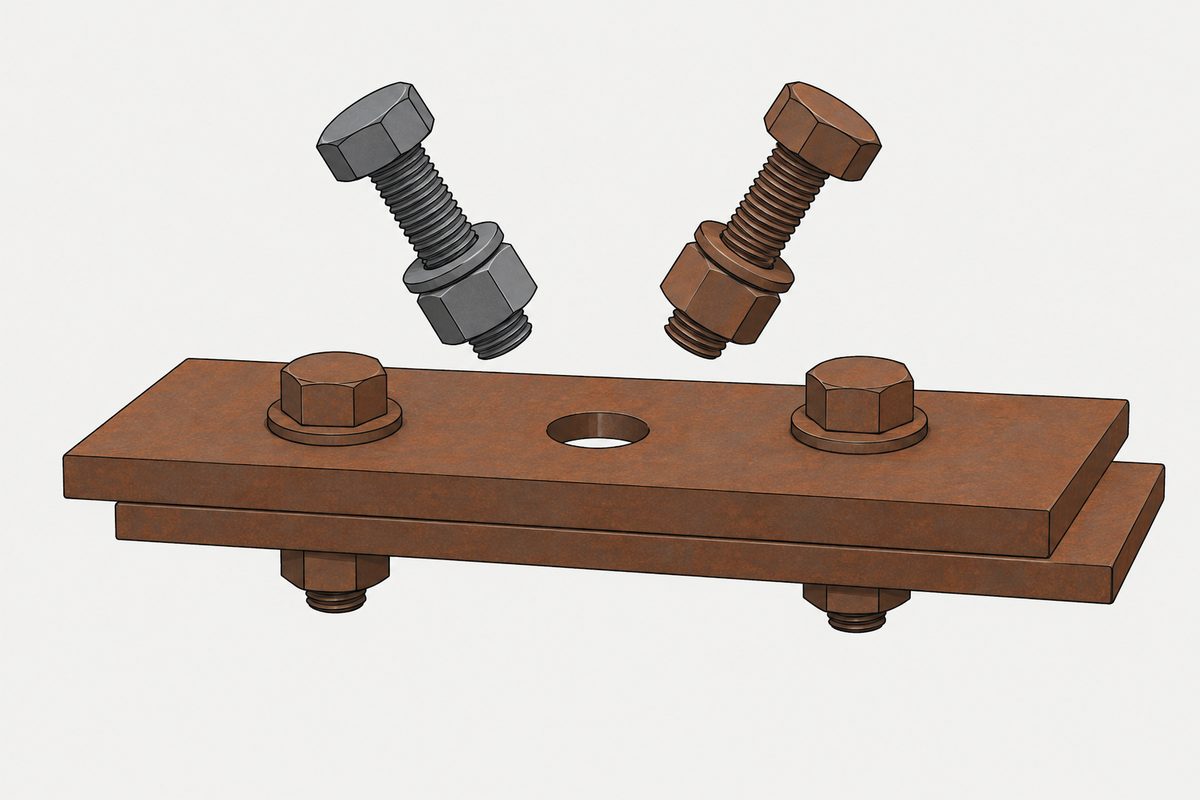
From the commentary to the section on bolting components: “Type 3 bolts have improved atmospheric corrosion resistance and weathering characteristics. When the bolt type is not specified, either Type 1 or Type 3 may be supplied at the Manufacturer's option.”
This page does not tell anyone which type to specify, and it gives no corrosion advice. It reports what one specification requires, and in particular who it makes responsible for saying. The other half of the original question, about mixing metals and accelerated corrosion, is not answered here either; that territory is covered on a separate page about the compatibility table everyone cites. The question came from a public engineering question site through its open interface, the browser tooling this site normally uses being unavailable again. We read the question and not its answers, and no username appears here.
Two types, by metallurgy
The document is the structural bolting specification published on 11 June 2020, and the relevant part is its second section, on bolting components and assemblies. This is the fifth time this site has read that specification, and the second section was untouched by the previous four. Nothing from them is repeated here.
Its commentary explains that the fastener standards provide for two types of high-strength bolt, according to metallurgical classification. Type 1 may be made from medium carbon steel, carbon boron steel, alloy steel, or alloy steel with added boron. Type 3 is the one with improved atmospheric corrosion resistance and weathering characteristics.
Then the sentence quoted above. Read it as a procurement clause rather than a metallurgy note and it says something sharp: the type is not a default, it is an omission. A drawing that names a grade and a coating and says nothing about type has left one attribute of the fastener open, and the specification hands that opening to the supplier rather than resolving it.
The word that names the problem appears twice
Something worth counting before going further. By our count the word weathering appears twice in the whole 119 page specification. Once in the sentence that defines Type 3, and once in the title of a 1981 paper on bolted friction connections in weathering steel, listed in the bibliography. We did not read that paper.
More striking, and also our own count: the specification never names a weathering steel. The common designations for the plate material do not appear anywhere in it, nor does the trade name the person asking used. A document that will be reached for precisely when somebody is bolting weathering steel refers to the whole material family exactly once, adjectivally, inside a commentary.
That is not a criticism. A bolting specification is entitled to govern bolting and leave the plate to the steel specifications. It does explain why the question gets asked: the connection between the two sits in the gap between two documents, and neither of them is obliged to build the bridge.
The type does not stop at the bolt
The reason this matters more than a single line item is that the type propagates, and the specification says so in the body rather than the commentary.
- Washers. Flat circular and bevelled washers must meet the requirements of the washer standard, and “the type (Type 1 or Type 3) of such washers shall be the same as the bolt.” Not compatible with. The same as
- Direct tension indicators. Compressible washer type indicators must meet the requirements of their own standard, and the type is set by a table that pairs a bolt type with an indicator type: for the 120 ksi group a Type 1 bolt takes a 325-1 indicator and a Type 3 bolt takes a 325-3; for the 144 and 150 ksi groups the pairs are 490-1 and 490-3
- Matched bolting assemblies. For spline end assemblies the specification states that the Engineer of Record shall specify the designation, grade, type, and coating to be used, and for the fixed spline end group, the grade, type and coating
So the attribute that has no default at the bolt is written into the requirements for the washer and the tension indicator, and the duty to state it is placed on one named role. By our count that is three separate places in one section where the type has to be carried forward, against zero places where it resolves itself.
The tension indicator point is the one most likely to be missed on a drawing, because a direct tension indicator feels like a tool rather than a part. It is not; it stays in the joint, and here it has a metallurgical type that has to match the bolt it is compressed against. Installation methods and what each of them needs under the nut is covered separately here.
What the section does give you
For completeness, the same section sets out the group structure, and it has one asymmetry worth noting. Bolts are organised by tensile strength into three groups: 120 ksi, 144 ksi and 150 ksi. Each group names a matched bolting assembly. Two of them also name a plain bolt.
The 144 ksi group does not. Its bolt column carries a dash, and only a matched bolting assembly is listed against it. Whatever else that means, it means the middle strength is not available as a loose bolt within this specification.
The commentary also bounds the range: structural bolts covered here are supplied in diameters from half an inch through one and a half inches, and “not all styles are available in all diameters.” And it notes that bolts, nuts and washers are required by the fastener standards to be distinctively marked, with the mandatory marks illustrated in a figure. We did not verify that figure against a page image and so do not reproduce what it contains.
What this settles and what it does not
- There is a weathering version of the structural bolt. It is called Type 3 and its commentary describes it as having improved atmospheric corrosion resistance and weathering characteristics
- If the type is not specified, either type may be supplied at the manufacturer's option. There is no default that favours one
- The washer type shall be the same as the bolt, stated in the body of the specification
- The direct tension indicator has a type too, paired to the bolt type by table
- The specification places the duty to state grade, type and coating on the Engineer of Record for matched bolting assemblies
- By our count the word weathering appears twice in 119 pages, and no weathering steel is named anywhere in the document
- The 144 ksi group lists no plain bolt, only a matched assembly
- We did not read the fastener standards this specification refers to, so nothing here describes what Type 3 actually is metallurgically, or how it is tested
- Nothing here tells anyone what to specify, and the dissimilar metal half of the original question is not answered on this page
The residue is a habit rather than an answer. When a component has a variant that exists precisely for your situation, check whether the specification makes it the default or merely makes it available. Here it is available, it is not the default, and the document says in one sentence who ends up choosing when nobody writes it down.
The same shape appears in a welding standard, where compliance is ordering information supplied if the purchaser demands it.
This is not one of the six steps. It shows up across them, or after assembly. Where the decisions that lead here were made is in specifying a screw, which sets out the order and why doing it out of order is rework.
Common questions
Is there a weathering version of a structural bolt?
Yes. The structural bolting specification describes two types of high-strength bolt by metallurgical classification, and says Type 3 bolts have improved atmospheric corrosion resistance and weathering characteristics.
What happens if the drawing does not say which type?
The commentary answers directly: when the bolt type is not specified, either Type 1 or Type 3 may be supplied at the manufacturer’s option. There is no default in favour of either.
Does the washer have to match?
Yes, and this is in the body of the specification rather than the commentary. Flat circular and bevelled washers must meet the requirements of the washer standard, and the type, Type 1 or Type 3, of such washers shall be the same as the bolt.
Does anything else carry the type?
The direct tension indicator does. Compressible washer type indicators must meet their own standard, and a table pairs the bolt type with the indicator type: 325-1 with a Type 1 bolt and 325-3 with a Type 3 bolt in the 120 ksi group, and 490-1 and 490-3 in the 144 and 150 ksi groups.
Who is responsible for stating the type?
For matched bolting assemblies the specification says the Engineer of Record shall specify the designation, grade, type and coating to be used, and for one group the grade, type and coating.
Does the specification name the weathering steels themselves?
No. By our count the common plate designations do not appear anywhere in it, and the word weathering appears twice in 119 pages, once defining Type 3 and once in a bibliography entry.
What strengths are covered?
Three groups by tensile strength: 120 ksi, 144 ksi and 150 ksi. Each names a matched bolting assembly; the 144 ksi group lists no plain bolt, only the assembly.
What sizes?
The commentary states that the structural bolts addressed are supplied in diameters from half an inch through one and a half inches, and that not all styles are available in all diameters.
So should I use Type 3 with weathering steel?
This page does not answer that. It reports that the type exists, that it has no default, that it propagates to the washer and the tension indicator, and that the specification assigns the duty to state it. Selection is not something we advise on.
References
- Research Council on Structural Connections, Specification for Structural Joints Using High-Strength Bolts, 11 June 2020, 119 pages, free and complete. Section 2, Bolting Components and Assemblies, and its commentary
- The question, on a public engineering question site. Eight votes, four answers
Section 2 and its commentary were read in full, and the group table, the passage describing the two types, the washer and indicator clauses and the indicator table were each checked against rendered page images. That mattered: text extraction rendered the diameter range as 2 in. through 12 in., and the page image shows half an inch through one and a half inches. This is the fifth time this site has used this document, after pages on the definition of snug-tight, on joint types, on its historical commentaries and on its arbitration section. Section 2 was untouched by all four and nothing from them is repeated. The passage about the two types is in the commentary rather than the specification body, and the washer and indicator requirements are in the body; that distinction is kept in the text above. The following are our own counts, not statements by the specification: that the word weathering appears twice in 119 pages; that no weathering steel designation or trade name appears anywhere in it; and that the type is carried forward in three separate places in this section. The figure illustrating the mandatory marks was not verified against a page image, so nothing it contains is reproduced here. The fastener standards this specification refers to were not read, so this page says nothing about what Type 3 is metallurgically, how it is produced or how it is tested, and it does not summarise the 1981 paper the bibliography cites. This page gives no selection, corrosion or specification advice, does not answer the dissimilar metal half of the question, and names no brand. The question came from a public engineering question site rather than the forum tooling this site normally uses, which remains unavailable. We read the question and not its answers, and no username appears here.
Enquiries
If your bolt callout names a grade and a coating but not a type, that is a real gap rather than a pedantic one, and it is the kind that only shows up after delivery. Send the line as written and we will tell you which attributes we would have to ask you to add before we could quote it as a single defined item.
Request a quotation
Tell us the part and the quantity. We will come back on feasibility, lead time and price.
Or email us directly sales@tigerfasteners.com