 TIGERFASTENERS
One Fastener Standard Sets a Maximum Strength, Because the Part Has to Be Welded
Every strength figure this site has written about has been a floor. A property class is a minimum. A proof load is a minimum. A withdrawal equation gives you what you get, not what you must not exceed. Then there is a fastener that is not screwed in but welded on, and its standard does something no ordinary fastener standard does: for one type it gives a maximum tensile strength, and for two more it gives a range that is closed at both ends.
From the table of materials and mechanical characteristics, for the insulation pin: mild steel, copper coated, Rm < 450 N/mm², or austenitic stainless steel, Rm < 700 N/mm². Less than. Not at least.
This page gives no welding, process or selection advice, and we are not a supplier of welding consumables. It reports what one standard specifies. It also did not come from a forum question: searches for stud welding and welded stud strength returned nothing relevant, so this one starts from a gap in our own coverage, found by scanning fastener families for zero hits. Before this page the site had never used the words weld stud, ceramic ferrule or shear connector. The browser tooling we normally use remains unavailable.
A fastener standard that is filed under welding
The document is titled Welding, studs and ceramic ferrules for arc stud welding, third edition, 2017. This is the first time this site has used it. Its introduction places it broadly: the range of stud types specified “represents customary applications” and the document “can be used in all fields of the metal-working industry.”
Its normative references are the giveaway that this is a fastener standard wearing a welding title. It points at the property class standard for carbon and alloy steel fasteners, the stainless fastener standard, the electroplated coatings standard and the fastener tolerance standard, alongside welding positions, a materials grouping technical report, a stainless composition standard and a wire rod standard. The stud inherits the ordinary fastener apparatus and then has welding requirements laid on top.
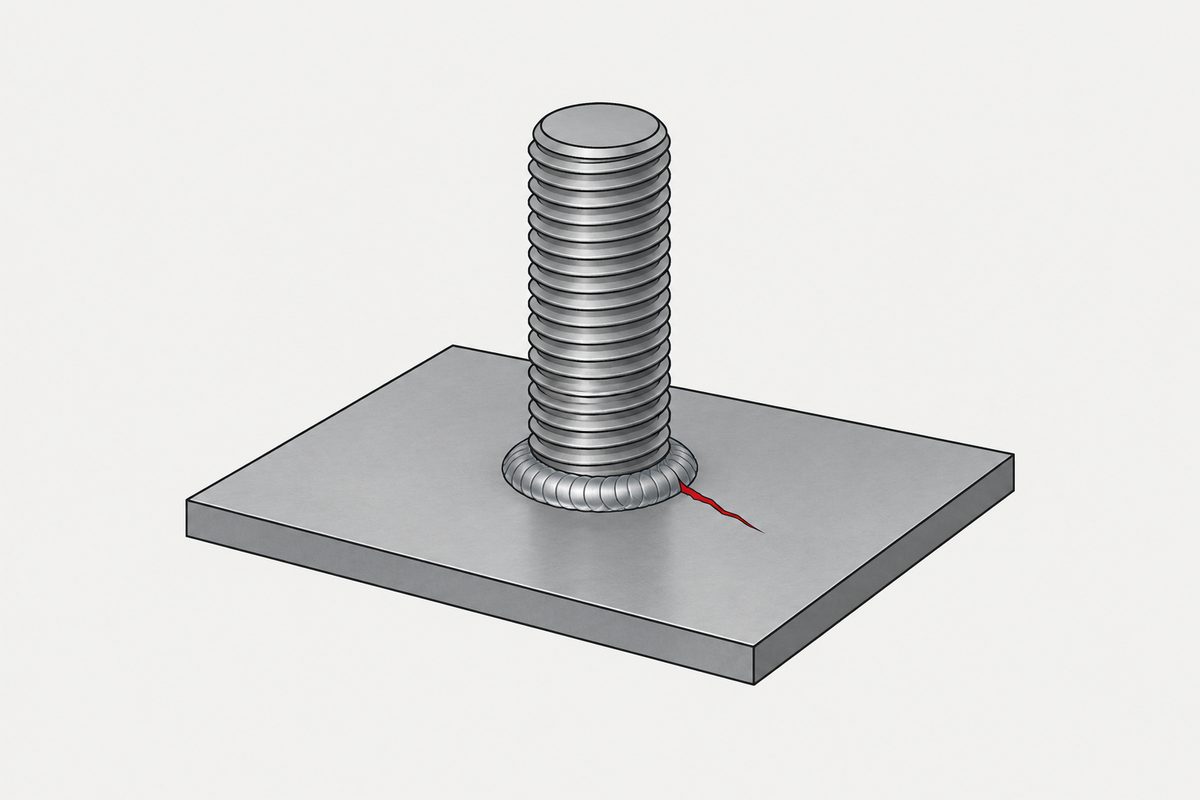
Two small features are worth recording before the substance. Its terms clause reads, in full: “No terms and definitions are listed in this document.” A clause that exists to say it is empty. And in the symbols list, between the diameters and the heights, sits cd, the depth of the crack in the head. A dimensional symbol assigned to a crack, which tells you the crack is an expected feature with a size rather than a defect.
Thirteen types, three processes, and a ferrule column that is mostly empty
The first table sets out what the document covers, and it is organised by welding technique rather than by fastener shape. By our count there are three techniques and thirteen stud types.
- Drawn arc stud welding with ceramic ferrule or shielding gas, covering eight types: fully threaded, virtually fully threaded, partially threaded, threaded with reduced shaft, unthreaded, insulation pin or nail, stud with internal thread, and shear connector
- Short cycle drawn arc stud welding, covering three: threaded with flange, unthreaded, and stud with internal thread
- Stud welding with tip ignition, covering the same three shapes again under different symbols
Each type has a two letter symbol, and each row also has a column for the symbol of its ceramic ferrule. That column is filled in for the first technique and carries a dash for the other two. One of the two things named in the title of the standard applies to one third of the processes inside it.
The shear connector is the one row where the ferrule column holds two symbols rather than one. And a footnote leaves the list open: “Further types of stud and ceramic ferrules can be specified as required for special applications.”
Four different shapes of requirement in one table
Then the materials table, which is where this page gets its title. By our count it states mechanical requirements in four different shapes, and only the first is the shape a fastener buyer expects.
- By reference. The threaded and unthreaded drawn arc types are property class 4.8 to the carbon steel fastener standard, or one of six stainless designations to the stainless fastener standard, and the mechanical properties are simply those documents
- A ceiling only. The insulation pin is mild steel, copper coated, with tensile strength less than 450 newtons per square millimetre, or austenitic stainless with tensile strength less than 700
- A floor only. The first shear connector grade requires tensile strength at least 450, yield at least 350 and elongation at least 15 percent
- A closed range. The second shear connector grade requires tensile strength from 400 to 550, with elongation at least 20 percent; the third, in two named stainless compositions, requires from 500 to 780, with elongation at least 25 percent
A maximum strength on a fastener is a genuinely unusual thing to find. Everywhere else on this site, strength is a floor and exceeding it is at worst wasted money. Here exceeding it puts the part outside the specification, and the reason is in the same table: the shear connector grades also carry chemistry limits, including a carbon content of not more than 0,2 percent and a carbon equivalent of not more than 0,38 for one grade and not more than 0,35 for the other.
Those are weldability limits. The part is not being asked to be as strong as possible. It is being asked to melt into the parent metal predictably, and strength bought through chemistry works against that. We are not explaining how the carbon equivalent is calculated, because the standard does not give the formula and the document it points to for materials grouping was not read.
Two metals in one stud, and a shear property proved in tension
The same clause contains a construction that is worth knowing about. “Studs may consist of two different materials combined by friction welding (dual-material stud).” And the note explains why: the welding part corresponds to the parent metal, to avoid problems with dissimilar materials in fusion welding, while the rest is generally high alloy steel for enhanced corrosion resistance.
So one fastener, two metals, joined by a third process, precisely so that the end which becomes weld matches what it is being welded to. The usual worry about putting two metals together is what happens afterwards; here the design point is what happens during.
Immediately after it comes a single line under the heading shear strength: “Shear strength shall be checked by testing the minimum tensile strength of the studs.” The property the shear connector is named for is verified by a tensile test. That is a familiar move, and the same instinct appears wherever a test result has to be attributed carefully to what it actually measures.
Compliance is a thing the purchaser asks for
One last passage, from the ordering clause. At the time of order the manufacturer must obtain four things, and the first is stated conditionally: “a reference to this document if the purchaser demands compliance”, then the quantities, the complete product designation, and other requirements as agreed, with low temperature requirements given as the example.
Conformity to the standard is an item of ordering information, supplied when the buyer asks for it. That is the same shape as the default this site found in the general requirements standard for bolts, where an unstated attribute is resolved by the manufacturer rather than by the document.
Two more provisions in the same clause are worth having. Tolerances on coated threaded studs apply before coating. And unless otherwise specified, the six short cycle and tip ignition types in property class 4.8 shall be supplied with an electroplated copper coating, which is a default finish stated positively rather than left open.
What this settles and what it does not
- There is an international standard for arc stud welding studs and their ceramic ferrules, third edition 2017, and this site had never used it
- It covers three welding techniques and thirteen stud types by our count, with ferrule symbols given only for the first technique and a dash for the other two
- The insulation pin has a maximum tensile strength, not a minimum, at less than 450 or less than 700 newtons per square millimetre depending on material
- Two shear connector grades have tensile ranges closed at both ends, 400 to 550 and 500 to 780
- The shear connector grades carry chemistry limits including carbon and carbon equivalent maxima, which are weldability constraints rather than strength ones
- A stud may be two materials friction welded together so that the welded end matches the parent metal
- Shear strength is verified by a tensile test, in one sentence
- Compliance with the standard is ordering information supplied if the purchaser demands it
- We did not read the dimensional clauses or anything after them, and no stud dimension appears on this page. None of the referenced standards were read for this page, and the carbon equivalent formula is not given here
- No welding, process or selection advice is given
The thing worth carrying away is the reversal. A fastener that is installed by melting has to be specified so that it melts well, and that turns strength from something to maximise into something to keep inside a band. It is a useful reminder that a property class is an answer to a question, and the question is not always how strong.
This page covers step 1, the substrate. The whole order is substrate, thread, head, drive, finish, documentation, and why doing it out of order is rework rather than a tweak is in specifying a screw.
Common questions
Is there a standard for weld studs?
Yes. An international standard on studs and ceramic ferrules for arc stud welding, third edition dated 2017. It specifies requirements, dimensions, materials and mechanical properties, and its introduction says it can be used in all fields of the metal-working industry.
Does any fastener standard set a maximum strength?
This one does. For the insulation pin type it gives tensile strength less than 450 newtons per square millimetre in mild steel with copper coating, or less than 700 in austenitic stainless. Those are ceilings rather than floors.
Why would a maximum exist?
The same table carries chemistry limits for the shear connector grades, including carbon of not more than 0,2 percent and carbon equivalent of not more than 0,38 or 0,35 depending on grade. Those are weldability constraints. This page does not give the carbon equivalent formula, which the standard does not state.
Do any grades have a range rather than a limit?
Two shear connector grades do. One requires tensile strength from 400 to 550 newtons per square millimetre with elongation of at least 20 percent, and another, in two named stainless compositions, from 500 to 780 with elongation of at least 25 percent.
How many types of stud are covered?
By our count thirteen, across three welding techniques: drawn arc welding with ceramic ferrule or shielding gas, short cycle drawn arc welding, and stud welding with tip ignition. Each type has a two letter symbol.
Do all of them use a ceramic ferrule?
No. The ferrule symbol column is filled in for the drawn arc technique and carries a dash for the other two, so one of the two things named in the standard title applies to one third of the processes in it.
Can a stud be made of two materials?
Yes. The standard says studs may consist of two different materials combined by friction welding, and notes that the welding part corresponds to the parent metal to avoid problems with dissimilar materials in fusion welding, while the rest is generally high alloy steel for enhanced corrosion resistance.
How is shear strength checked?
The standard says in one sentence that shear strength shall be checked by testing the minimum tensile strength of the studs.
Does ordering to the standard happen automatically?
It is listed as ordering information. The manufacturer shall obtain a reference to the document if the purchaser demands compliance, along with quantities, the complete product designation and other requirements as agreed.
References
The terms clause, the symbols list and the table of materials and mechanical characteristics were each checked against rendered page images. This is the first time this site has used this standard, and before this page the words weld stud, ceramic ferrule and shear connector appeared nowhere on it. The dimensional clauses and everything after them were not read, and no stud dimension appears here. None of the referenced standards were read for this page, including the property class, stainless, coating, tolerance, wire rod, stainless composition and materials grouping documents; where the table points at them, this page reports only that it does. The carbon equivalent formula is not given, because the standard does not state it and the document it refers to for materials grouping was not read. The following are our own counts, not statements by the standard: that it covers three welding techniques and thirteen stud types; that the ferrule symbol column is populated for one technique and dashed for the other two; and that the materials table states mechanical requirements in four different shapes. The second edition of 2008 was downloaded but nothing from it is quoted. This article did not come from a forum question; searches for stud welding and welded stud strength returned nothing relevant, so it starts from a gap found by scanning fastener families for zero coverage. No welding, process or selection advice is given and no brand is named. The browser tooling this site normally uses remains unavailable.
Enquiries
If a part on your drawing has to be joined by a process rather than tightened, the properties that matter change shape, and a maximum can appear where you expected a minimum. Send the callout as written and we will tell you which of its properties we could evidence and which belong to the joining process instead.
Request a quotation
Tell us the part and the quantity. We will come back on feasibility, lead time and price.
Or email us directly sales@tigerfasteners.com