 TIGERFASTENERS
The Spark Plug Gasket Is Specified After One Tightening, Not Before
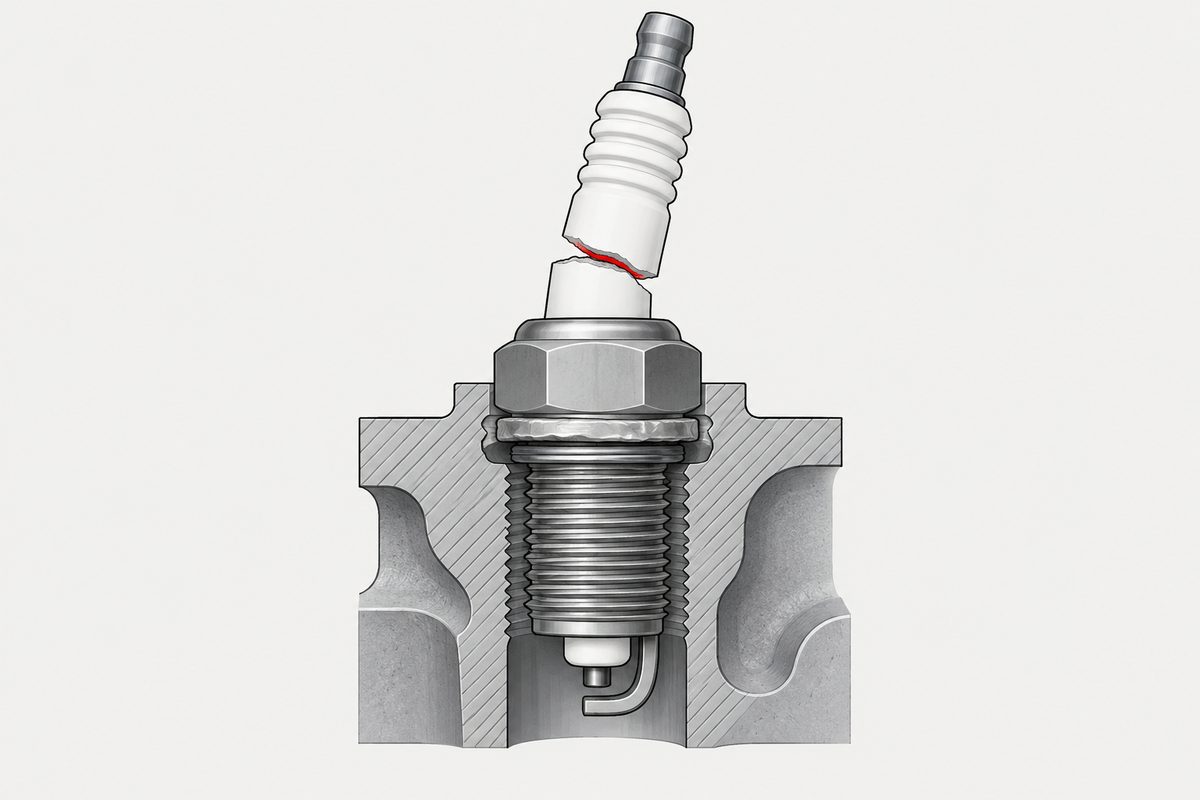
Somebody changed a spark plug for the first time, set a torque wrench, did not hear the click, turned the setting down, kept pulling, and broke the plug in half. Six hundred and thirty six upvotes and three hundred and sixty one replies later it was marked solved. We are not going to give you a torque number, because the clause that contains it sits one page past the end of the free preview. What the readable part contains is better: the standard says in its own definitions that over-torquing damages plugs, and it names the four things that move the right number.
ISO 28741:2023, clause 5.2, in full: “When unused spark plugs with flat seating have been tightened once with a torque, as specified in Clause 7 and Table 3, on threads that are clean, smooth, and dry, the gasket thickness shall be as specified in Table 3.” Count the conditions. Unused. Once. At the specified torque. Clean, smooth and dry. The thickness in the table is the thickness after the plug has been pulled down, not the thickness of the part in the box.
We cannot give you a torque figure and we are not going to try. Clause 7 is titled Installation torque and it is on printed page 7. The publicly available preview of this standard stops at printed page 6. The document is twenty four pages and we can read six of them, which is a quarter. Table 3, which holds both the torques and the gasket thicknesses, is on the other side of that line.
That limit is worth stating loudly, because a torque figure for a spark plug is exactly the sort of number that gets copied off a page like this one into somebody’s hands. The number for your engine belongs to the plug maker’s instruction and the engine maker’s manual. What follows is the reasoning around it.
The standard warns about over-torquing in its definitions
Most standards keep advice out of clause 3. This one does not. The entry for installation tightening torque carries a note that reads like it was written after reading a forum thread.
“The value of the correct installation tightening torque can vary from conditions that affect the friction between the spark plug threads and the cylinder head threads. These include cylinder head material, spark plug shell plating, thread lubrication, and contamination from combustion deposits. It is advisable to ensure that spark plugs are not over-torqued during installation, as this can damage spark plug integrity and can result in engine damage. Spark plugs with smaller thread sizes require a lower installation tightening torque.”
Four named conditions, and not one of them is a property of the plug on its own. The head material, the plating on the shell, whatever is on the threads, and what the last few thousand miles left in the hole. A torque figure is a statement about a bolt and what it is going into, which is the same argument this site has made about what a torque spec assumes in general. Here the standard says it about spark plugs specifically, and it says it in the definitions rather than burying it in a note at the back.
The last sentence is the plain one. Smaller thread, less torque. A plug is not a plug: the thread sizes in this standard run from M10 to M18, and the number that suits one is not the number that suits another.
Two seats, and only one of them has a gasket
Before any of that matters, there is a question about the plug in your hand that the standard answers in two definitions.
- Conical seating is a conical section of the shell used as the seal interface. The note says “There is typically no gasket used between the conical mating surfaces.”
- Flat seating is a flat surface perpendicular to the plug axis. The note says “This seal typically uses a gasket between the flat seat of the spark plug and the mating flat surface of the cylinder head.”
Two entirely different sealing mechanisms living under the same word. One squeezes a crushable ring flat; the other pulls two cones together and seals on the taper. Clause 8 of the standard splits its dimension tables the same way, one subclause for each, and so does clause 9 for the cylinder head housings. We cannot read either, but the table of contents makes the split visible.
This is the same distinction that decides whether a joint seals on the thread or beside it, which this site looked at from the pipe thread side. A tapered seat seals by wedging. A flat seat seals by crushing something. They do not behave the same way when you keep pulling.
A crush gasket is a one shot dimension
Now back to clause 5.2, and to the definition that goes with it. The installed height in clause 3.1 is the distance from the contact point of the cylinder head to the top of the terminal, “including the compressed gasket thickness with the spark plug installed at the specified installation torque”.
So the standard has two states in mind for the same part, and it specifies the second one. The gasket goes on as a formed ring and ends up as a crushed one, and it is the crushed dimension that appears in the table. Everything about the plug’s position in the head, and therefore about where the electrode sits in the chamber, depends on that crush having happened once, in the specified way.
Which means the conditions in that sentence are not decoration.
- Unused. A plug that has been in an engine already has a gasket that is part way through its one deformation. It will not take the same amount of turning to arrive at the same place
- Once. The specification describes a single tightening, not a tighten, check, loosen, re-tighten sequence
- At the specified torque. The thickness and the torque come from the same table, so quoting one without the other is meaningless
- Clean, smooth and dry. The same friction conditions the definitions clause listed, restated as a precondition for the dimension to hold
The gasket’s job is set out in the sentence before: “to ensure a gas tight interface between the cylinder head and the spark plug under all operating conditions possible”, with the test conditions in ISO 11565, which we have not read. A gas tight interface, made by crushing a ring, once.
The thread is not quite an ordinary metric thread
Clause 3.2 defines the spark plug thread size and adds a note that is easy to miss: these are standard metric threads according to the ISO 965 series, “with the exception of the M14 × 1,25 thread”. The most common spark plug thread in the world is the one that is not in the general plan.
Table 1 then gives limiting dimensions for four sizes, and the tolerance classes are where it gets interesting. The tapped hole in the cylinder head is 6H throughout. The plug thread is 6e at M18 × 1,5, M14 × 1,25 and M12 × 1,25, and 6g at M10 × 1.
| Thread | Plug class | Pitch dia. clearance | Major dia. clearance |
|---|---|---|---|
| M18 × 1,5 | 6e | 0,067 mm | 0,067 mm |
| M14 × 1,25 | 6e | 0,063 mm | 0,063 mm |
| M12 × 1,25 | 6e | 0,063 mm | 0,063 mm |
| M10 × 1 | 6g | 0,026 mm | 0,026 mm |
Clearances are ours, taken as the tapped hole minimum minus the plug maximum in Table 1.
Three things fall out of that, and all three are our arithmetic rather than statements by the standard.
- The clearance at the pitch diameter and at the major diameter is the same number in every size. Four sizes, four exact matches
- The M10 plug is held to less than half the clearance of the others. 0,026 mm against 0,063 and 0,067
- The hole is allowed a wider pitch diameter tolerance than the plug, by about a third, in all four sizes. The part you throw away is controlled more tightly than the part you keep
Why the small size gets the tighter class the standard does not say, and we are not going to claim a reason. What can be said is what the allowance is for. A plug goes into a hot hole full of combustion deposits and comes out again, repeatedly, and a generous class gives that room. It is the same allowance that makes the friction unpredictable, which is the friction the definitions clause warned about.
What the wrench did and did not do
The forum post contains its own diagnosis: the click was not heard, so the setting was turned down and the pull continued. That is a torque wrench question rather than a spark plug question, and this site has covered the part of a torque wrench that is not specified and what its standard does and does not say elsewhere. Two things from those pages apply here without any need to know the numbers.
A click wrench signals, it does not stop. Nothing in the tool prevents the next degree of rotation. And a range that starts above zero means the bottom of the scale may not be inside the specified range at all, so turning a setting down to chase a click can move the tool out of the part of its scale the standard covers.
We do not know what wrench that was, we have not seen the plug, and we are not diagnosing an engine we cannot inspect. What ISO 28741 adds is the other half: even a wrench that clicked exactly on the number would have been reporting a torque, and the torque is only a proxy for the thing that actually matters, which is that a gasket got crushed by the right amount, once.
One document instead of many
A note on what this standard is, because its introduction explains its own existence unusually clearly. The purpose is “to provide a compact and concise specification on spark plugs and their cylinder head housings, which has replaced the large number of existing individual International Standards on each type of spark plug”, so that “the user can work with one comprehensive International Standard… instead of a number of International Standards, each of which is specified for one type only”.
It is a consolidation, and it is still moving. This is the third edition, from August 2023, replacing the 2013 second edition. Its own foreword lists the changes: a new subclause for additional terminal options, and the implementation of M18 spark plugs. The M18 row in the table above is three years old. ISO already lists the document at stage 90.92, to be revised, with a working draft of the next edition under development.
One more line from the foreword worth noticing, because it is rare in a dimensional standard: “As of the date of publication of this document, ISO had received notice of patents which may be required to implement this document.” A document about the basic dimensions of a spark plug, with a patent declaration attached.
What to take from it
- The gasket thickness in the standard is the crushed thickness, specified for an unused plug tightened once, at the specified torque, on clean, smooth and dry threads
- The installed height includes the compressed gasket, so where the electrode ends up depends on that crush having happened as specified
- Flat seats use a gasket; conical seats typically do not. Two different sealing mechanisms under one name
- The standard names four things that change the correct torque: head material, shell plating, thread lubrication, and combustion deposits. None is a property of the plug alone
- It says plainly that over-torquing can damage plug integrity and result in engine damage, and it says it in the definitions clause
- Smaller thread, lower torque. The sizes here run M10 to M18 and they are not interchangeable numbers
- M14 × 1,25 is not in the general metric plan, and M10 × 1 is the only size specified 6g rather than 6e, at less than half the thread clearance
- We give no torque figure. Clause 7 and Table 3 are outside the free preview, and the number for a given engine belongs to its manual
The thing the poster was reaching for with a wrench was never a torque. It was a gasket arriving at a thickness, once. The torque is how the standard tells you to get there when the threads are clean, smooth and dry, and it says so in the same sentence.
This page covers step 2, the thread. The whole order is substrate, thread, head, drive, finish, documentation, and why doing it out of order is rework rather than a tweak is in specifying a screw.
Common questions
What torque should a spark plug be tightened to?
This page gives no figure and cannot. ISO 28741 puts the installation torques in Clause 7 and Table 3, which are one page past the end of the free preview we read. The number for a given engine belongs to the plug maker’s instruction and the engine maker’s manual, and the standard itself says the correct value varies with friction conditions.
What changes the correct spark plug torque?
The standard names four conditions that affect friction between the plug threads and the cylinder head threads: cylinder head material, spark plug shell plating, thread lubrication, and contamination from combustion deposits. It adds that spark plugs with smaller thread sizes require a lower installation tightening torque.
Does the standard warn about over-torquing?
Yes, and unusually it does so in the definitions clause. The note on installation tightening torque says it is advisable to ensure that spark plugs are not over-torqued during installation, as this can damage spark plug integrity and can result in engine damage.
Why does the gasket thickness have conditions attached?
Because it is a crushed dimension. Clause 5.2 specifies the thickness for unused plugs with flat seating that have been tightened once, at the specified torque, on threads that are clean, smooth and dry. Clause 3.1 confirms this by defining installed height to include the compressed gasket thickness at the specified installation torque.
Can a spark plug gasket be reused?
The standard does not address reuse and neither do we. What it does say is that the thickness it specifies applies to an unused plug tightened once. A plug that has already been installed is not the plug that sentence describes, and this page draws no further conclusion from that.
What is the difference between a flat seat and a conical seat plug?
Flat seating is a flat surface perpendicular to the plug axis, and the standard notes that this seal typically uses a gasket between it and the mating flat surface of the head. Conical seating is a conical section of the shell used as the seal interface, and the standard notes that there is typically no gasket between the conical mating surfaces.
Are spark plug threads standard metric threads?
Mostly. Clause 3.2 says they are standard metric threads according to the ISO 965 series, with the exception of the M14 by 1,25 thread. The threads and the tapped holes are required to conform to ISO 68-1, ISO 261, ISO 965-1 and ISO 965-3, none of which we have read.
Why is the M10 spark plug thread class different?
Table 1 gives 6e for M18 by 1,5, M14 by 1,25 and M12 by 1,25, and 6g for M10 by 1, against 6H for the tapped hole in every case. By our own arithmetic on that table the resulting clearance is 0,063 to 0,067 mm on the larger sizes and 0,026 mm on the M10, less than half. The standard gives no reason and we do not offer one.
My torque wrench did not click. What does that mean?
That is a question about the tool rather than the plug, and this page does not answer it from ISO 28741, which says nothing about wrenches. Two general points hold: a click wrench signals rather than stops, and its specified range starts above zero, so turning the setting down can take the tool below the part of its scale the wrench standard covers.
References
- ISO 28741:2023, Road vehicles, spark-plugs and their cylinder head housings, basic characteristics and dimensions. Third edition, 24 pages, ISO/TC 22/SC 32. Foreword, introduction, scope, clause 3, clause 4, subclauses 5.1 to 5.3 and Table 1 read from the publicly available preview
- r/MechanicAdvice, where a first spark plug change and a torque wrench that was not heard to click produced the question
ISO 28741:2023 was read from the publicly available preview, which reaches printed page 6 of a 24 page document, roughly a quarter of it. Clause 7, Installation torque, and Table 3, which holds both the torque values and the gasket thicknesses, are on the next page and outside the preview. No torque figure and no gasket thickness appears anywhere on this page, and none should be inferred from it. Table 2, clauses 6, 8 and 9, and Annexes A, B and C are also outside the preview and nothing from them is quoted or characterised. Catalogue facts were read from ISO’s own page in a browser: third edition, August 2023, twenty four pages, ISO/TC 22/SC 32, ICS 43.060.50, published at stage 90.92 to be revised, superseding the withdrawn 2013 second edition, with a working draft of the next edition under development. The following are our own arithmetic, not statements by the standard: the four thread clearances taken as the tapped hole minimum less the plug maximum, the observation that the pitch diameter and major diameter clearances are identical in all four sizes, the observation that the M10 clearance is less than half the others, the observation that the tapped hole is allowed a pitch diameter tolerance about a third wider than the plug in every size, and the proportion of the document the preview covers. The standard gives no reason for specifying M10 as 6g while the larger sizes are 6e, and we offer none. ISO 11565, ISO 68-1, ISO 261, ISO 965-1, ISO 965-3, ISO 3412, ISO 3895 and ISO 3896 are referenced by this standard and have not been read. We do not diagnose the engine in the forum thread, which we have not seen, and we name no vehicle, component or retail brand. We read the post and not its replies. Clause 5.2 and Table 1 were checked against rendered images of the printed pages rather than extracted text. What a torque wrench does and does not guarantee is covered on an earlier page and is not restated here.
Enquiries
We do not supply spark plugs, and this page exists because the reasoning around the standard is useful for any threaded joint that seals by crushing something. If you have a sealing washer or a crush gasket on a drawing, tell us whether the thickness you have quoted is the free thickness or the installed one, because on a crush joint those are two different dimensions and only one of them is checkable after assembly.
Request a quotation
Tell us the part and the quantity. We will come back on feasibility, lead time and price.
Or email us directly sales@tigerfasteners.com