 TIGERFASTENERS
The First Bolt Specification Was a Rule for Replacing Rivets, One for One
Somebody watched archive footage of the Empire State Building going up, men driving hot rivets with cigars in their mouths and no harness, and asked whether hot rivets are still used outside specialised industries. Four thousand points, a hundred and forty six replies. We are not going to survey who still rivets. What is worth reading is the document where the handover is actually written down, because the first bolting specification was not a design method at all. It was a swap.
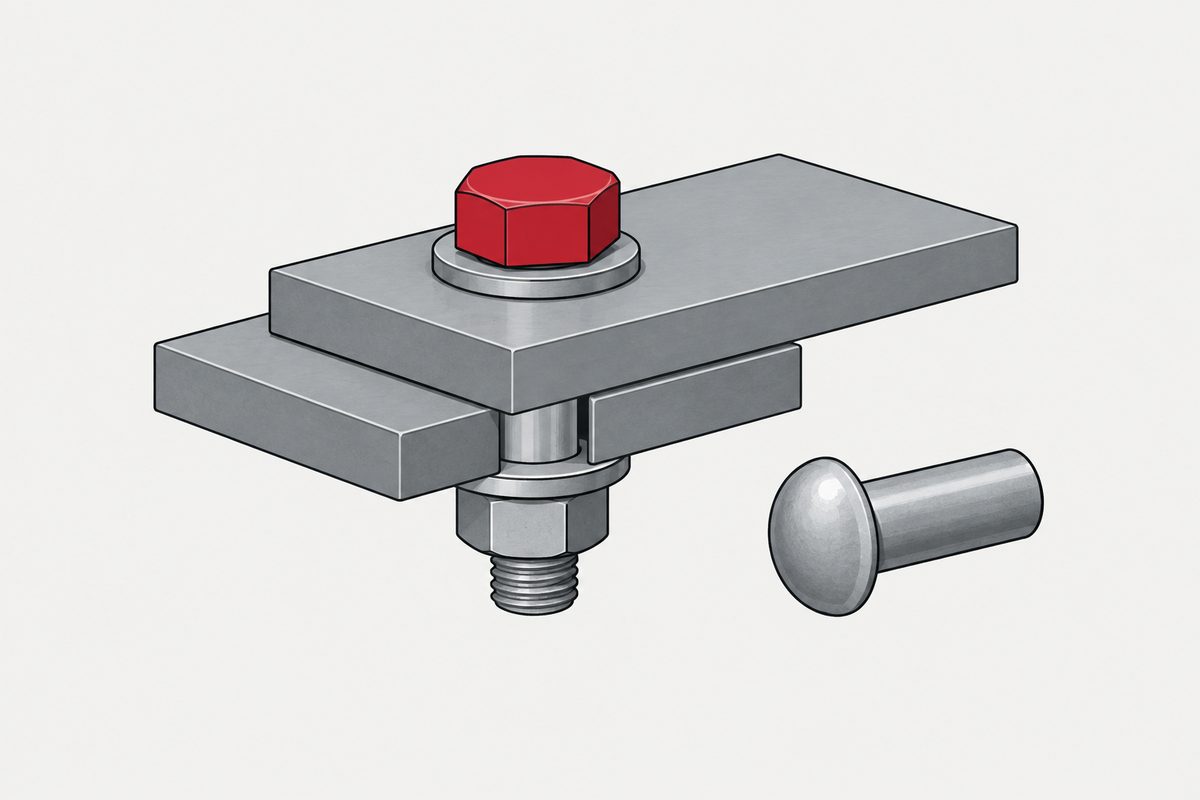
The commentary to the current specification, on how the first edition worked: when first approved in January 1951, it “merely permitted the substitution of a like number of ASTM A325 bolts for hot-driven ASTM A141 steel rivets of the same nominal diameter”. Same count, same diameter, in place of the rivets.
This page does not survey who still uses rivets, and it gives no construction or design advice of any kind. What it does is read the paper trail of one replacement, in a specification that is free to download and whose commentary keeps the dates.
The bolt arrived as a substitution rule
Read that first sentence again for what it does not contain. No strength calculation. No load path. No new joint category. Three constraints and nothing else, which is our counting of it: a like number of bolts, of the same nominal diameter, in place of a named rivet steel. Whatever the riveted joint had been designed to do, the bolted one was allowed to do by looking the same.
That is a remarkably modest way for a fastener to enter an industry. It is also, on reflection, the only way it could have. Nobody had to be persuaded that the joint worked. They had to be persuaded that the new thing could stand where the old thing stood.
Two more requirements came attached, and they matter more than they look. All bolts were to be pretensioned, and all faying surfaces were to be free of paint, which the commentary points out means the 1951 rule was “satisfying the requirements for a slip-critical joint by the present-day definition”. In its first edition, every single bolted joint the specification allowed was what we would now call the strict kind.
Three years later the default moved
As revised in 1954, the paint-free requirement applied only to “joints subject to stress reversal, impact or vibration, or to cases where stress redistribution due to joint slippage would be undesirable”. The commentary gives the reason in one line: the relaxation recognised that in many applications, “movement of the connected parts that brings the bolts into bearing against the sides of their holes is in no way detrimental”.
So the joint split into kinds, and they were given names. Bearing type. Friction type. Direct tension.
Those names lasted until 1985, when the same specification changed them to shear/bearing, slip-critical and direct tension respectively, and at the same moment snug-tightened installation was permitted for many shear/bearing joints.
Put the two ends of that together, which is our arithmetic rather than the document’s. In 1951 every bolted joint had to be pretensioned onto bare steel. By 1985, thirty four years later, a large class of them could be tightened by hand effort and left. What those two conditions mean in detail is covered elsewhere on this site, in the definition of snug-tight and in what a slip-critical joint actually is, and neither is repeated here.
The torque table lasted three years
The first edition came with something else, and its life is documented to the year.
“In the first edition of this Specification, which was published in 1951, a table of torque-to-pretension relationships for bolts of various diameters was included. It was soon demonstrated in research that a variation in the torque-to-pretension ratio as high as ±40 percent must be anticipated unless the relationship is established individually for each bolt lot, diameter, and bolting component condition. Hence, in the 1954 edition of this Specification, recognition of relationships between torque and pretension in the form of tabulated values or equations was withdrawn.”
Published, then withdrawn three years later, on evidence. The commentary also lists what makes the relationship move. Seven items, and the sixth is the one worth staring at.
- The finish and tolerance on the bolt and nut threads
- The uniformity, degree and condition of lubrication
- Shop or job-site conditions contributing dust, dirt or corrosion on the threads or the mating nut and washer surfaces
- The friction between the turned element and the supporting surface
- The variability of air supply on pneumatic impact wrenches, from air-line length or the number of wrenches on one source
- The condition, lubrication and power supply for the torque wrench, “which may change within a work shift”
- The repeatability of any wrench that senses or responds to the level of applied torque
The method itself had a longer and stranger life. Recognition of the calibrated wrench method was retained until 1980, on condition that the installation torque be determined for the specific bolts on a daily basis. Then it was withdrawn in 1980, and the commentary is unusually blunt about why: “because of the continuing controversy that resulted from the failure of users to adhere to the requirements for the valid use of the method”, during both installation and inspection. In 1985 it was reinstated, with five separate triggers for recalibration: daily, on any change of component lot, on any relubrication, on significant differences in the surface condition of threads, nuts or washers, and on any alteration to a major part of the wrench including its lubrication, hose and air supply.
A method withdrawn not because it was wrong but because people would not follow it, and brought back five years later with the conditions written out harder. That is a rare thing to find said out loud in a specification. It is also the same suspicion of a torque reading that turns up in a completely different body of rules, where the federal electrical standard never gives a torque figure at all.
The rivet steel has a date on it
The rivets in that 1951 sentence were a named material, and a footnote on the same page follows them to the end.
“ASTM A141 (discontinued in 1967) became identified as ASTM A502 Grade 1.”
Sixteen years, by our subtraction, between the rule that let a bolt stand in for that rivet and the discontinuation of the standard that defined the rivet steel. We did not manage to confirm the current status of the successor designation. The publisher’s page for it would not load for us, and rather than repeat what is said about it elsewhere we are leaving it as a gap.
The word appears once in a hundred and eighteen pages
We searched the whole of the current specification for the word. This count is ours.
Rivet, as a fastener: one occurrence, in the sentence about January 1951.
The word riveted appears three more times, and all three are the title of a 1987 textbook, the Guide to Design Criteria for Bolted and Riveted Joints, once in the glossary, once in a commentary and once in the bibliography.
A hundred and eighteen pages, eighteen successive editions since 1951, and the thing the whole enterprise was originally defined against survives in one historical sentence and a book title. That is not evidence that nobody drives rivets, and we are not claiming it is. It is a statement about one document: the specification that began as a permission to replace rivets no longer has a working relationship with them.
One small thing the document does not agree with itself about
The Preface names the 1951 document the Specification for Assembly of Structural Joints Using High Tensile Steel Bolts. The Section 4 commentary, quoting the same first edition, names it the Specification for Assembly of Structural Joints Using High-Strength Bolts.
Two names for one document, forty four pages apart, in the same file. We do not know which was the historical title and this page does not guess. It is worth recording because anyone tracing the 1951 edition by name will find different things depending on which sentence they read first.
What to take from it
- The first specification, January 1951, permitted a like number of A325 bolts of the same nominal diameter in place of hot-driven A141 rivets. That was the whole of it
- It also required every bolt pretensioned and every faying surface free of paint, which the commentary says met the present-day definition of a slip-critical joint
- 1954 narrowed that to joints subject to stress reversal, impact or vibration, or where stress redistribution from slippage would be undesirable, and the three joint names appeared
- 1985 renamed them and permitted snug-tightened installation for many shear/bearing joints, thirty four years after the strict default
- The 1951 torque-to-pretension table was withdrawn in 1954 after research showed variation as high as plus or minus forty percent unless established per lot, diameter and component condition
- Seven variables affect that relationship, one of which is the torque wrench itself, which may change within a work shift
- The calibrated wrench method was withdrawn in 1980 because users would not follow its conditions, and reinstated in 1985 with five recalibration triggers
- The rivet steel standard was discontinued in 1967 and became a grade of a successor designation whose current status we could not confirm
- In the 2020 edition the word rivet appears once, in the sentence about 1951
The question was whether hot rivets are still driven. The document cannot answer that and neither can we. What it can tell you is something better: the bolt did not win an argument about which fastener is stronger. It was allowed, one for one, to stand where a rivet stood, and then spent thirty four years working out what it was actually allowed to be.
The same specification is unusually willing to describe its own limits elsewhere too. Its section on settling a dispute about an installed bolt sets out a procedure and then lists the reasons it may reject good bolts and accept bad ones.
This is not one of the six steps. It shows up across them, or after assembly. Where the decisions that lead here were made is in specifying a screw, which sets out the order and why doing it out of order is rework.
Common questions
What did the first high-strength bolting specification actually say?
The commentary to the current edition describes it. When first approved in January 1951, the specification merely permitted the substitution of a like number of ASTM A325 bolts for hot-driven ASTM A141 steel rivets of the same nominal diameter. It also required that all bolts be pretensioned and that all faying surfaces be free of paint.
Why does that matter?
Because it is not a design method. It is a permission to put the same number of bolts, at the same diameter, where the rivets would have gone. The bolted joint inherited its justification from the riveted one it replaced rather than being argued for on its own terms.
Were all early bolted joints slip-critical?
In effect, yes. The commentary says the 1951 requirements for pretension and paint-free faying surfaces satisfied the requirements for a slip-critical joint by the present-day definition. The 1954 revision narrowed the paint-free requirement to joints subject to stress reversal, impact or vibration, or where stress redistribution from slippage would be undesirable.
When did the joint names change?
Joints were designated bearing type, friction type and direct tension after the 1954 revision. With the 1985 edition those became shear/bearing, slip-critical and direct tension respectively, and snug-tightened installation was permitted for many shear/bearing joints.
Did the specification ever publish a torque table?
Yes, in the first edition of 1951, giving torque-to-pretension relationships for bolts of various diameters. It was withdrawn in the 1954 edition after research showed that variation in the torque-to-pretension ratio as high as plus or minus forty percent must be anticipated unless the relationship is established individually for each bolt lot, diameter and bolting component condition.
What makes torque and pretension vary that much?
The commentary lists seven things: thread finish and tolerance, the uniformity and condition of lubrication, dust dirt and corrosion from shop or site conditions, friction between the turned element and the supporting surface, air supply variability on pneumatic impact wrenches, the condition lubrication and power supply of the torque wrench which may change within a work shift, and the repeatability of any wrench that senses applied torque.
Why was the calibrated wrench method removed and then brought back?
It was retained until 1980 with the requirement that installation torque be determined for the specific bolts daily. Recognition was withdrawn in 1980 because of the continuing controversy that resulted from the failure of users to adhere to the requirements for its valid use, during both installation and inspection. It was reinstated in 1985 with more emphasis on the detailed requirements, including five separate triggers for recalibration.
What happened to the rivet steel?
A footnote in the specification says ASTM A141 was discontinued in 1967 and became identified as ASTM A502 Grade 1. We were not able to confirm the current status of that successor designation and this page does not assert one.
Does the current specification still cover rivets?
No. We searched all 118 pages: the word rivet as a fastener appears once, in the sentence about January 1951. Three further occurrences of riveted are all the title of a 1987 textbook. That is a fact about the document, not evidence about whether anyone still drives rivets.
References
- Research Council on Structural Connections, Specification for Structural Joints Using High-Strength Bolts, 11 June 2020, 118 pages, free and complete. The Preface, and the commentaries to Section 4 and Section 8
- r/Tools, where archive footage of hot riveting raised the question of when it stopped
The 2020 specification was downloaded complete and the Preface, the Section 4 commentary on joint type and the Section 8 commentary on the calibrated wrench method were read in full. This is the third time this site has used this document, after the definition of snug-tight and the difference between a slip-critical and a shear/bearing joint; the passages used here are historical commentary that neither of those pages touched, and nothing from them is repeated. Every date, quotation and figure taken from it was checked against a rendered image of the page rather than extracted text. The following are our own searching and counting, not statements by the specification: that the word rivet as a fastener appears once in the 118 pages while the three occurrences of riveted are all a 1987 book title; the count of three constraints in the substitution sentence; the intervals of three years, five years, sixteen years and thirty four years between the dated events; and the observation that the Preface and the Section 4 commentary give two different names for the 1951 edition. We do not know which of those two names was the historical title and this page does not guess. We could not confirm the current status of the successor rivet designation, because the publisher’s page for it did not load for us in this session, and rather than repeat a second-hand claim we have left it as a stated gap. This page does not survey which industries still drive rivets, gives no construction or design advice, and names no manufacturer or product. The ASTM standards named in the quoted passages have not been read, and the specification’s own design provisions are not summarised here. We read the forum post and not its replies, and no forum username appears on this page.
Enquiries
If a drawing still calls for something the standard behind it has moved on from, the useful thing to send is the callout exactly as written, with the standard number and the edition if it is on there. We will tell you what that designation maps to now, and what we would need from you before substituting anything for anything.
Request a quotation
Tell us the part and the quantity. We will come back on feasibility, lead time and price.
Or email us directly sales@tigerfasteners.com