 TIGERFASTENERS
There Is a Procedure for Checking a Bolt After the Fact, and the Standard Lists Why It Does Not Work
Somebody asked why anyone would want to measure torque while loosening a bolt. Twenty three votes, five answers. The structural steel world has a written answer to the neighbouring question, what a wrench on an already tight bolt can tell you, and it is worth reading for an unusual reason: the specification sets out the procedure in four numbered steps and then uses its own commentary to say that the procedure can accept the wrong bolts and reject the right ones.
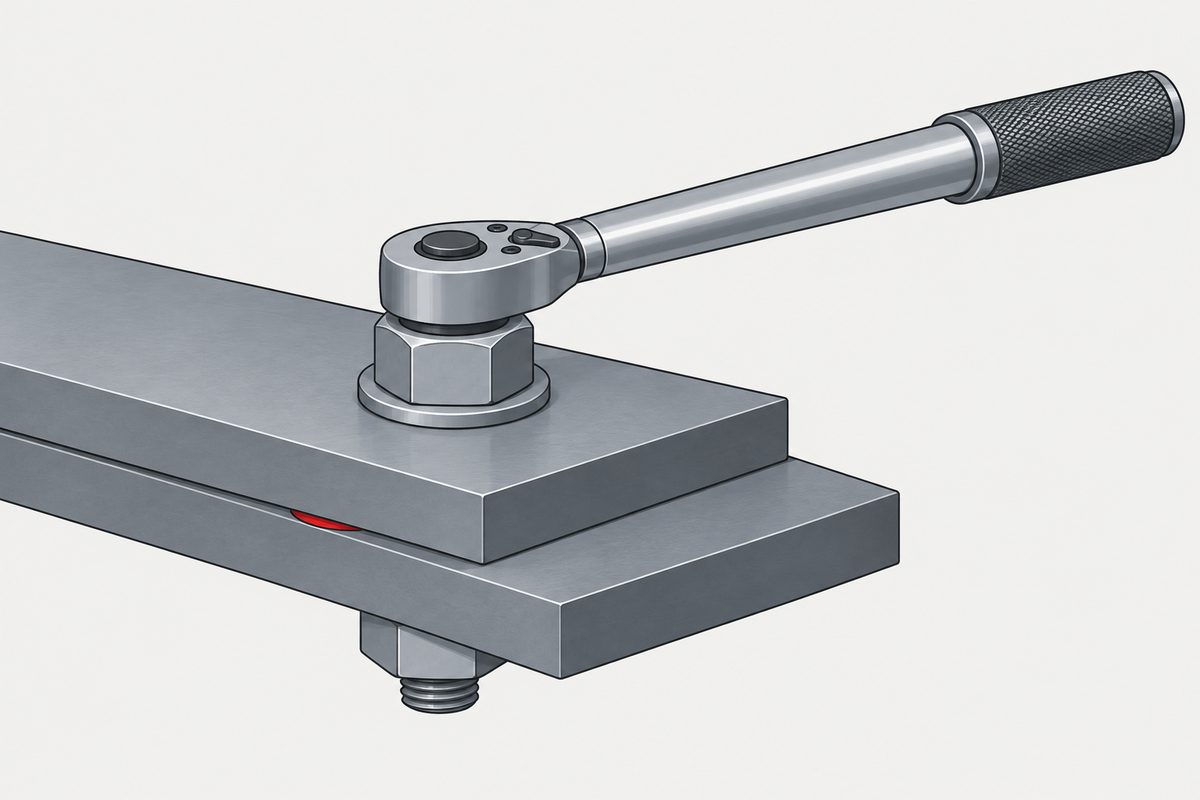
From the commentary to the arbitration section: “Ultimately, such arbitration may wrongly reject bolting assemblies that were subjected to a properly implemented installation procedure or accept bolting assemblies that were not properly installed. The arbitration procedure contained in this Specification is provided, in spite of its limitations, as the most feasible available at this time.”
This page gives no inspection, tightening or acceptance advice. It reads one section of one specification. The question came from a public mechanics question site through its open interface, the browser tooling this site normally uses being unavailable again. We read the question and not its answers, and no username appears here.
The arbitration torque is not a number you look up
The section is short and it is conditional. It applies “when it is suspected after inspection… that bolts in pretensioned or slip-critical joints do not have the proper pretension”, and even then the procedure is permitted rather than required. What follows is four numbered steps, and the first thing to notice is that none of them starts with a torque figure.
- Five bolt and nut assemblies of each combination of diameter, length, grade and lot in question go into a bolt tension measurement device. The material under the turned element must be the same as in the actual installation, structural steel or hardened washer
- Each is partially tightened to about 15 percent of the specified pretension, then pretensioned to the specified minimum
- A torque wrench is applied, and the quantity recorded is the torque necessary to rotate the nut or bolt head five degrees relative to its mating component
- The arbitration torque is then the average of the middle three, after rejecting the highest and the lowest
- That torque is applied to 10 percent of the assemblies, but no fewer than two, chosen at random in each joint in dispute. If nothing turns, the joint is accepted
So the number is manufactured, on the day, from the actual lot, under the actual material, and then thrown at the joint. It is not a property of the bolt that could have been printed in a table.
Three small pieces of arithmetic, ours rather than the standard’s. Discarding the high and low of five and averaging the rest means forty percent of the sample is thrown away. The five degrees is glossed in the text as approximately one inch at a twelve inch radius, and one twelfth of a radian is 4,77 degrees, so the parenthesis is about four and a half percent smaller than the figure it explains. And ten percent with a floor of two means that for any joint of fewer than twenty bolts the floor is what governs.
The direction is the tightening direction
This is the part that speaks to the question. The torque recorded in step two, and the torque applied in step four, are both explicitly in the tightening direction. The written procedure never measures a loosening torque at all.
What it measures is the resistance to going further on. A bolt that is properly pretensioned will not move five degrees under the arbitration torque, and one that is slack will. The test is not asking how tight the bolt is. It is asking whether the bolt can be pushed past a threshold that a correctly installed one would not have crossed.
That is a different question from the one a loosening measurement answers, and the difference matters because breaking a joint loose and running it on again are not symmetrical. This site has been through the reason that torque and tension correlate badly in either direction: a structural specification withdrew its own torque table in 1954 after finding variation as high as forty percent, and the power tool standard states plainly that static residual torque measurements give poor correlation to joint condition. Neither of those is repeated here.
The commentary lists what is missing
Most specifications, having set out a procedure, stop. This one turns round and itemises the reasons to distrust it. After noting that the arbitration inherits all the uncertainties of torque controlled installation, it says the reliability is further reduced by the absence of many of the controls that keep the torque to pretension relationship in check, and names three.
(1) The use of hardened washers;
(2) Careful attention to lubrication; and
(3) The uncertainty of the effect of passage of time and exposure in the
installed condition.
Then it adds that in many cases the arbitration torque has to be built from bolts that “can only be assumed to be representative” of the ones in the job, or from bolts removed from completed joints. And then the sentence at the top of this page, which is as clear an admission of two sided error as a specification is ever likely to print.
There is one more provision worth having. If pretension has to be verified after the passage of a period of time and exposure, the section says an alternative arbitration procedure appropriate to the situation shall be used. The four steps are for a dispute on a fresh joint, not for an audit of an old one.
The accurate method is a loosening measurement, and it consumes the bolt
The commentary then describes what to do if you actually want the pretension rather than a proxy for it. An ultrasonic extensometer, or a mechanical one that can measure changes in bolt length, “can produce a very accurate measurement of the actual pretension”.
And here is how. “The method involves measurement of the change in bolt length during the release of the nut”, combined with either a load calibration of the removed assembly or a calculation of the force corresponding to the measured elastic release.
So the one method that does look in the loosening direction reads the bolt by letting it go. And the consequence is stated immediately: “Reinstallation of the released bolting assembly or installation of a replacement bolting assembly is required. The required release suggests that the direct use of extensometers as an inspection tool be used in only the most critical cases.”
An accurate answer costs you the joint you asked about. The commentary even notes that reinstallation may force replacement unless torque can be applied slowly enough to restore the original elongation. Which is the shape of the whole problem in one paragraph: the cheap measurement is in the wrong direction and is admitted to be unreliable, and the reliable one is destructive.
What to take from it
- There is a written procedure for arbitrating an installed bolt, and it is permitted rather than required, and only after an inspection has raised a suspicion
- The arbitration torque is produced on the day from five assemblies of the lot in question, under the same material as the job, not looked up
- It is the torque to move the nut or head five degrees, and the standard glosses that as about one inch at a twelve inch radius, which is 4,77 degrees by our arithmetic
- High and low are discarded and the middle three averaged, so forty percent of the sample is thrown away
- Both the measurement and the test are in the tightening direction. The procedure never measures a loosening torque
- Ten percent of a joint is tested, with a floor of two, so below twenty bolts the floor governs
- The commentary names three controls that are missing from an after the fact test: hardened washers, attention to lubrication, and the effect of time and exposure
- The specification says the procedure may reject good bolts and accept bad ones, and offers it as the most feasible available
- The accurate alternative measures length change during release of the nut, and requires reinstallation or replacement afterwards
The question was why anyone would measure torque while loosening. The written answer from this corner of the industry is that they mostly do not, that the accepted check pushes in the other direction, and that the document defining it would rather tell you its limits than let you mistake it for a measurement.
This is not one of the six steps. It shows up across them, or after assembly. Where the decisions that lead here were made is in specifying a screw, which sets out the order and why doing it out of order is rework.
Common questions
Is there a standard procedure for checking a bolt that is already installed?
In structural steel bolting there is one, in the arbitration section of the specification. It applies when an inspection has raised a suspicion that bolts in pretensioned or slip-critical joints do not have the proper pretension, and even then the procedure is permitted rather than required.
What is an arbitration torque?
A number produced by test rather than looked up. Five bolt and nut assemblies of the diameter, length, grade and lot in question are pretensioned in a bolt tension measurement device, with the same material under the turned element as in the actual installation, and the torque needed to rotate the nut or head five degrees is recorded for each. The highest and lowest are discarded and the remaining three averaged.
Is it measured while loosening?
No. Both the measurement on the sample and the test on the joint are specified in the tightening direction. The procedure records the torque needed to move an already pretensioned fastener further on, not the torque needed to break it loose.
How many bolts get tested?
Ten percent of the bolting assemblies, but no fewer than two, selected at random in each joint in dispute. By our arithmetic that means the floor of two governs for any joint with fewer than twenty bolts. If nothing turns under the arbitration torque the joint is accepted; if anything turns, all bolts in the joint are tested.
How reliable is it?
The specification answers that itself. Its commentary says such arbitration may wrongly reject assemblies that were properly installed or accept assemblies that were not, and that the procedure is provided in spite of its limitations as the most feasible available at this time.
What controls are missing from an after the fact check?
The commentary names three: the use of hardened washers, careful attention to lubrication, and the uncertainty of the effect of passage of time and exposure in the installed condition. It also notes that the arbitration torque often has to come from bolts that can only be assumed to be representative, or from bolts removed from completed joints.
Is there a more accurate method?
The commentary describes measuring the change in bolt length with an ultrasonic or mechanical extensometer, which it says can produce a very accurate measurement of the actual pretension. The measurement is taken during the release of the nut, and reinstallation of the released assembly or installation of a replacement is required afterwards.
Why is that method not used routinely?
Because of the release. The commentary states that the required release suggests the direct use of extensometers as an inspection tool be used in only the most critical cases, and notes that reinstallation may force replacement unless torque can be applied slowly enough to restore the original elongation.
Does this apply to an old joint?
The four steps are not written for one. The section says that if verification of pretension is required after the passage of a period of time and exposure of the completed joints, an alternative arbitration procedure appropriate to the specific situation shall be used. It does not say what that procedure is.
References
- Research Council on Structural Connections, Specification for Structural Joints Using High-Strength Bolts, 11 June 2020, 118 pages, free and complete. Section 10, Arbitration, and its commentary
- The question, on a public mechanics question site. Twenty three votes, five answers
The 2020 specification was downloaded complete and Section 10 with its commentary was read in full; the quoted passages were checked against rendered images of the two printed pages they occupy. This is the fourth time this site has used this document, after the definition of snug-tight, the difference between joint types and the historical commentaries. Section 10 was untouched by all three and nothing from them is repeated here. The following are our own arithmetic, not statements by the specification: that one inch at a twelve inch radius is 4,77 degrees and therefore about four and a half percent smaller than the five degrees it is offered as a gloss for; that discarding the high and low of five discards forty percent of the sample; and that a floor of two out of ten percent governs for any joint with fewer than twenty bolts. Table 5.2 and its pretension values are deliberately not reproduced here, as on an earlier page using the same document. Sections 9.1 to 9.3 were read only far enough to establish what triggers arbitration, and their inspection methods are not summarised. The commentary to Section 8.3.2, which this section refers to for the uncertainties of torque controlled installation, is the passage this site quoted separately for its seven variables. No inspection, tightening or acceptance advice is given here, no equipment manufacturer is named although the commentary mentions that several produce suitable equipment, and this page takes no position on whether a loosening measurement is worth making. The question came from a public mechanics question site rather than the forum tooling this site normally uses, which remains unavailable. We read the question and not its answers, and no username appears here.
Enquiries
If a specification asks us to certify something about an installed joint rather than about the parts we supplied, that is a different obligation and it is worth separating on paper. Send the clause as written and we will tell you what we can evidence about the fasteners themselves, and what would have to be measured on site by someone else.
Request a quotation
Tell us the part and the quantity. We will come back on feasibility, lead time and price.
Or email us directly sales@tigerfasteners.com