 TIGERFASTENERS
A Palm-Sized Nut at Fifty Inch-Pounds Is Not Clamping Anything
An aircraft mechanic posted a picture of the gear-reduction setup needed to put fifty inch-pounds into a two-and-an-eighth-inch nut, and fourteen hundred people upvoted it. The most-upvoted reply is a question rather than an answer: can you explain why such a large nut has so little force applied? The person who posted it answered underneath that he does not know either. That is a good thread to write about, because the arithmetic does know.
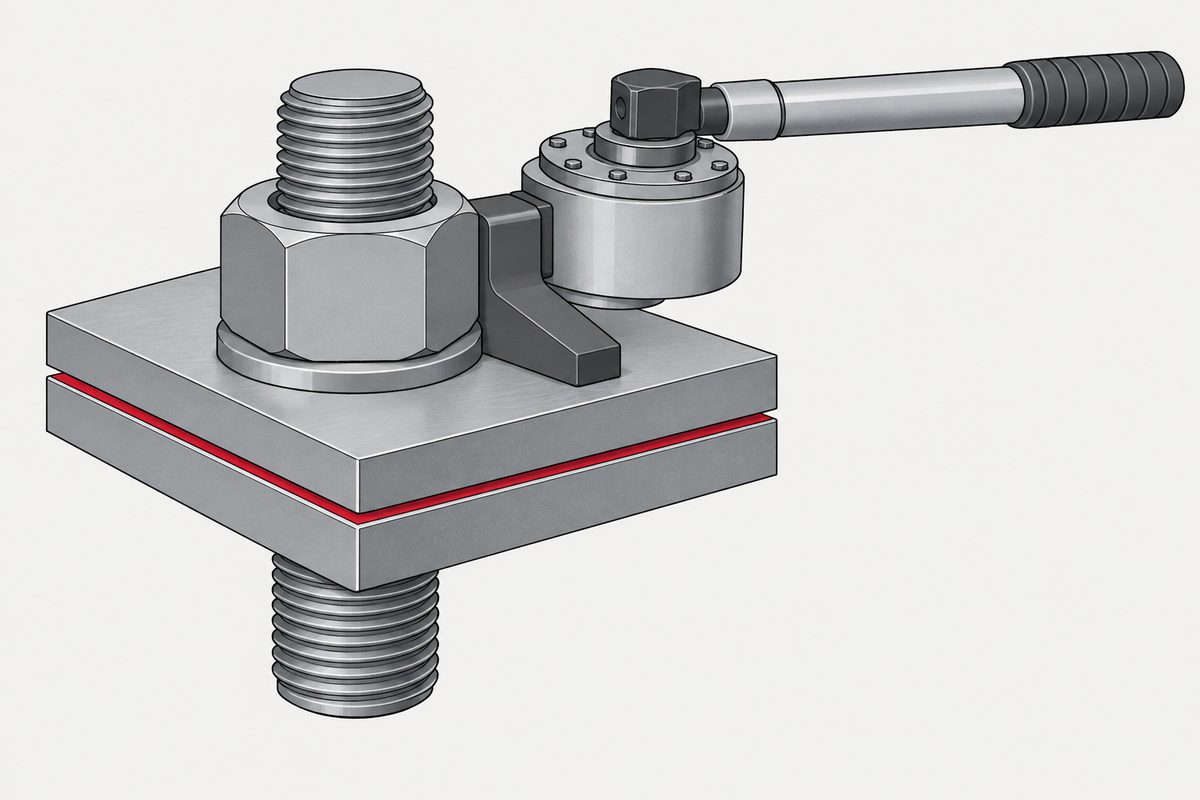
The thread contains two completely different numbers
Read down it and the same class of joint, a main landing gear wheel nut, collects figures that do not belong to the same problem:
| Reported in the thread | Figure |
|---|---|
| The nut in the photograph | 50 in·lbf on 2⅛ in |
| A King Air main gear wheel nut | about 35 in·lbf |
| A 737-700 main gear wheel | 600 ft·lbf, then 300 ft·lbf final |
Between the smallest and the largest of those is a factor of roughly two hundred, and nobody in the thread could say why. That is not a failure of the mechanics involved. It is what happens when a single unit, the torque figure, is used for two jobs that have nothing to do with each other.
What fifty inch-pounds on that nut actually buys
Torque reaches clamp force through a relation of the form T = K · d · F, where the diameter is in it directly. Rearranged, and with 2⅛ in as 53,97 mm and 50 in·lbf as 5,65 N·m:
| Assumed K | Clamp force | In pounds |
|---|---|---|
| 0,15 | 698 N | 157 lbf |
| 0,20 | 523 N | 118 lbf |
| 0,25 | 419 N | 94 lbf |
Put that beside a small screw. ISO 898-1 gives an M6 in class 8.8 a proof load of 11 600 N. The nut in that photograph, which will not fit in one hand, is being asked to produce under six per cent of what a single M6 will hold.
K is an assumption rather than a measurement, which is why the table gives a range, and what that coefficient actually contains is torque and clamp force. But the conclusion does not hang on it. Triple the friction and the answer is still a clamp force a hand can generate.
And what it would take for that nut to behave like a bolted joint
Run the same relation forwards. Ask that 53,97 mm nut for the sort of preload a joint of that size would normally carry, say 50 kN, at K of 0,2:
T = 0,2 × 0,05397 × 50 000 = 540 N·m = 398 ft·lbf
Which is the other number in the same thread. Three hundred to six hundred foot-pounds is what a nut that size looks like when it is clamping. The fifty inch-pounds is about a ninety-sixth of it.
So the thread was never comparing two settings of one thing. It was comparing a clamping joint with something else that happens to be threaded, and the two were written in the same unit.
What a torque that small can be doing instead
When the number is two orders of magnitude below what the diameter would justify, it has stopped being a proxy for preload, and it is controlling one of the other things a threaded ring can control. We do not know which one applies to that aircraft, and neither did the thread, so what follows is general engineering and not a diagnosis of anything.
- A position. The nut is being run to a defined place rather than a defined force, and the torque is only there to say when to stop turning. The clearest version of that is a castellated nut, where the final answer is not the torque at all but whichever position the pin hole allowed
- A drag. The specification is about how much resistance something has once assembled, and the torque is being used to reach a rolling or sliding condition rather than to squeeze a stack
- A displacement. Something elastic in the stack converts the last part of the turn into a distance rather than a force, which is the model in that spring turns a torque problem into a length problem
The two-stage pattern reported for the larger aircraft, a high figure and then a lower final one, belongs to the same family: a torque that is followed by an instruction to back off is a seating operation, not a preload. The first number beds the stack down; the second is the one the joint lives at. Reading the first as the working tightness is a straightforward way to over-tighten something.
The check this gives you
You can run it on any specification in about a minute, and it needs only the diameter and the fastener’s own strength.
Work out roughly what torque would develop the fastener’s proof load, using T = K · d · F with K around 0,2. Then compare the specification with it. A specification at a few per cent of that number is not a preload instruction, and treating it as one, or judging it against a torque table, will mislead you about what the joint is for.
The same reasoning in reverse is how a class-indexed torque table gets built, and why two figures for one thread size can differ by exactly the class ratio and nothing else: the torque came from the class, not from your joint. What a torque figure is worth once the friction is unknown, and why the wrench is the smallest error in the chain, is how badly your tightening method controls preload.
This is not one of the six steps. It shows up across them, or after assembly. Where the decisions that lead here were made is in specifying a screw, which sets out the order and why doing it out of order is rework.
Common questions
Why would a very large nut have a very small torque specification?
Because torque only stands in for clamp force when the joint is a clamping joint. Torque scales with diameter, so a large nut needs a large torque to reach an ordinary preload. Fifty inch-pounds on a 2⅛ inch nut produces roughly 400 to 700 newtons depending on the friction assumed, which is under six per cent of what a single M6 screw holds at proof load. A number that small is controlling something other than clamp force.
How can I tell whether a torque figure is a preload instruction?
Compare it with the torque that would develop the fastener’s own proof load, using torque equals roughly 0,2 times diameter times force. If the specification is a few per cent of that, it is not asking for preload, and judging it against a torque table for that thread size will tell you nothing useful. If it is the same order of magnitude, it is a clamping joint and the usual concerns apply.
What does an initial torque followed by a lower final torque mean?
A torque that is followed by an instruction to back off to a smaller value is a seating operation. The first figure beds the stack down, takes up clearances and settles the components; the second is the condition the joint is meant to live at. The mistake is reading the larger number as the working tightness, which over-tightens the assembly and misses the point of the two-step procedure.
Does the friction assumption change the conclusion?
Not here. The coefficient in the torque to clamp force relation is an assumption rather than a measurement, and the honest thing is to quote a range: at 0,15 to 0,25 the answer for that nut moves between about 700 and 420 newtons. That is a large relative spread and it does not matter, because the number is two orders of magnitude away from a preload either way.
Which aircraft was it and why is its torque so low?
We do not know, and the thread did not either. The person who posted the picture said so directly. This page has no maintenance manual for any aircraft and diagnoses none. The arithmetic says what fifty inch-pounds on that diameter can and cannot produce; what the specification is actually controlling is a question for the document that issued it, which is the only thing that governs.
References
- ISO 898-1:2013 — mechanical properties of fasteners of carbon steel and alloy steel; Table 5 proof loads, the source of the M6 comparison figure
- r/aviationmaintenance — the thread this began in, including the top reply asking why and the poster answering that he does not know
The arithmetic on this page is our own and can be repeated: 2⅛ inches is 53,97 mm, fifty inch-pounds is 5,65 N·m, and the clamp force follows from the torque, the diameter and an assumed friction coefficient. That coefficient is an assumption rather than a measurement, which is why a range is given rather than a single value; the conclusion is insensitive to it because the gap is two orders of magnitude. The M6 proof load of 11 600 N is from ISO 898-1 Table 5, read from the publicly available preview. The torque figures for particular aircraft are what people in the thread reported, quoted as reports rather than verified: we hold no maintenance manual for any aircraft, we do not know why any specific type specifies what it does, and this page diagnoses nothing and says nothing about whether any quoted figure is correct. The three possible roles listed for a small torque are general engineering, offered because the arithmetic rules out preload rather than because we know which one applies. The two-stage seating pattern is likewise described as a general pattern; the maintenance document that issued a specification is the only thing that governs it.
Enquiries
If a torque figure on an enquiry looks small for the thread it sits on, say what the nut is doing rather than only what it is tightened to. Setting a position, reaching a drag and clamping a stack put quite different demands on thread finish, on the bearing face and on the locking feature, and the torque number alone does not distinguish them.
Request a quotation
Tell us the part and the quantity. We will come back on feasibility, lead time and price.
Or email us directly sales@tigerfasteners.com