 TIGERFASTENERS
The lot failed inspection. Now what?
Incoming inspection sampled the delivery and rejected it. The line is waiting, sales are chasing, and the supplier says they will sort it. Somebody puts a form in front of you to sign.
A rejection is a fork, not an ending. Which road that form describes decides whether, three months from now, you have evidence or a blank.
This page is about the difference between those roads. The most important pair differ by one clause at the end of their definitions — and what that clause decides is not whether the parts conform, but whether the word has answered that for you.
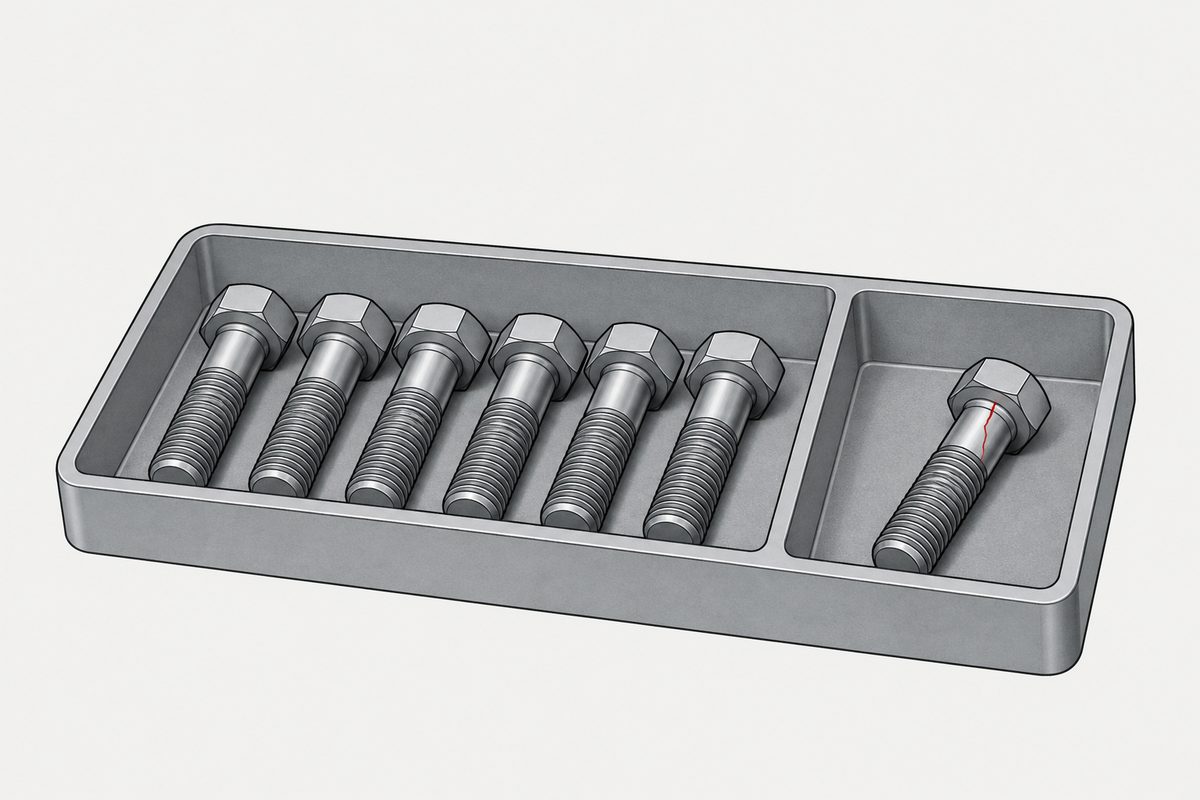
The lot failed, and it is probably still fine
Most nonconformities are not safety problems. A dimension is a few microns out, a coating is thinner than specified in one place, a certificate is missing a line. Often the parts will work.
So the practical instinct is to use them and get on with it. Sometimes that is right — and a few microns can also decide fit, fatigue, sealing or corrosion life, which is why the instinct is not a decision. What matters is which of five different routes you use to get there, because they end in different places.
So use it anyway — and the five ways of doing that are not equivalent
ISO 9000, the quality management vocabulary standard, defines the ways a nonconforming product can be dealt with as separate terms. Shop-floor usage maps onto them roughly — and the places where it maps badly are exactly the places that cause trouble:
| Disposition | What was done to the parts | Do they conform afterwards? |
|---|---|---|
| Concession | Not necessarily nothing — can accompany a repair | Still judged nonconforming against the requirements, but released |
| Rework | Worked on until they conform | Yes |
| Repair | Worked on until they are usable | Not guaranteed — the standard says a repair does not necessarily make it conform |
| Regrade | Reassigned to different requirements | Conforms to a different set, not the original |
| Scrap | Prevented from being used as intended | Not applicable |
On the source. These are the ISO 9000:2015 vocabulary definitions from the clause covering nonconformity dispositions: regrade 3.12.4, concession 3.12.5, deviation permit 3.12.6, rework 3.12.8, repair 3.12.9, scrap 3.12.10. Mind the edition — ISO 9000:2026 has superseded 2015 and renumbers these into the 3.6 group, so cite the year alongside the clause. Check a first-hand copy before quoting them in a formal document.
The clause that matters: rework conforms, repair only works
These two get used interchangeably on the floor. Their definitions differ by one phrase, and that phrase carries a lot.
- Rework: action on a nonconforming product to make it conform to the requirements.
- Repair: action on a nonconforming product to make it acceptable for the intended use.
The word “conform” does not appear in the definition of repair. And the standard's note under repair is more explicit still: a successful repair does not necessarily make the product conform to the requirements, and may need a concession alongside it.
Do not take that one step further, as we first did. “Not guaranteed to conform” is not “guaranteed not to conform”. A repaired part may also happen to meet the original requirement — the word simply does not promise it. Our first version of this page said a repaired lot is a nonconforming lot, and that was wrong.
So the useful conclusion is that the word “repaired” does not tell you whether they do. Rework answers the question; repair leaves it open — so you have to ask it.
The question is simple: was anything re-measured after the repair, which characteristic, and what was the result. If it was measured and is inside tolerance, the lot is in the same state as a reworked one by a different route. If it was not re-measured, or was and is still out, it has to be handled as nonconforming and accepted — which means a concession note.
The cost of not separating those: without a record, your drawing and your stock may disagree and nobody knows. Three months later something fails, and you go looking with an inspection record marked passed, against a lot whose actual status was never established.
A concession is after the fact; a deviation permit is before it
The other commonly conflated pair, and the difference is timing.
- Deviation permit: granted before the product is realised, allowing departure from the specified requirements. The standard says it is generally limited to a quantity or a period, and to a specific use — not that all three are always bounded.
- Concession: permission to use or release product that already does not conform. It does not rewrite the requirement — the parts are still judged nonconforming against it, and have been granted an exception.
The risk is not comparable. Before production you still have time to calculate, ask and refuse, and nothing has been made yet. Afterwards you are deciding against a finished fact, almost always with schedule pressure attached: the container is at the dock and the line is idle.
Which is the practical argument for spending time on the enquiry. Saying the difficult things early turns a lot of would-be concessions into deviation permits — or stops them arising.
“We are under the AQL, so you cannot reject it” is wrong
The most common pushback after a rejection runs like this: this lot came out at 0.8%, we agreed an AQL of 1.0%, so it is within limits and you cannot reject.
That treats AQL as a permitted defect rate, which it is not. AQL is a parameter used in designing a sampling plan; acceptance is decided by the plan's acceptance and rejection numbers, not by comparing a sample defect rate against the AQL figure. The full explanation is on the sampling page. Here it means one thing:
The basis for rejection is the sampling plan's decision rule, not either party's reading of AQL. If the two of you understand that differently, the problem happened when the order was placed, not when the goods arrived.
What the AQL is instead, and why a lot that is three times worse still passes about one time in four, is in why five pieces.
Five things that need to be on paper before you sign
A concession is not a failure. Taking a lot on concession to keep a line running is often correct commercially. An unrecorded concession is the failure, because it turns a defensible decision into an untraceable blank.
- Which characteristic is nonconforming, and its measured value. “Dimensional deviation” records nothing.
- The quantity and lot numbers covered. Without them it is hard to establish later what the note actually covered, or to answer “you allowed it last time”. Some supplier quality terms state explicitly that a concession does not extend to later deliveries — the point is to say which, not to assume a rule exists.
- This once, or for a stated period. Left unsaid, the default becomes forever.
- Where the material will be used. This is the only column that lets you trace the affected population later.
- The authority who decided the disposition. Not to assign blame — so that in three months there is someone to ask why.
- Customer approval, where it is required. ISO 9001's clause on nonconforming outputs covers recording concessions obtained and, where applicable, obtaining the customer's agreement. Skipping it means releasing without the proper authority.
Corrective action — chasing the cause so it does not recur — does not have to accompany every concession, but ISO 9001 requires evaluating whether it is needed. Repeated or high-impact nonconformities usually mean it is.
And one thing that should have been written far earlier: who bears sorting or rework cost on a rejection, and how the schedule is counted. Disputes here almost always trace back to an order that said only “conform to drawing”. Negotiating it with a container at the dock is negotiating from the worst position available, which is why it belongs in the enquiry and not in the incident.
Common questions
What is the difference between a concession and rework?
A concession is permission to release product that already does not conform; it does not rewrite the requirement. Rework physically brings parts into conformity. And a concession does not imply the parts were untouched — a repair may need one alongside.
Are rework and repair not the same?
No. Rework makes it conform; repair makes it acceptable for the intended use, and the standard notes a successful repair does not necessarily make it conform. That is not the same as saying it does not — so ask what was re-measured after the repair.
Is a concession the same as a deviation permit?
No — timing. A deviation permit precedes production; a concession follows it. Before, you can still evaluate and refuse. After, you are deciding against a finished fact under schedule pressure.
Who pays for sorting?
No standard answer, but a standard remedy: agree it at order placement. Disputes trace back to orders that said only “conform to drawing”.
Is “under the AQL so you cannot reject” correct?
No. AQL is not a permitted defect rate; acceptance follows the sampling plan's acceptance and rejection numbers. A disagreement here started at the order, not at goods-in.
Related
- Sampling inspection and AQL — where the rejection decision comes from
- The samples arrived and they fit — what you actually approved
- What to put in a fastener enquiry — where rejection cost belongs
- Reading a mill test certificate — when the documents disagree
- The order in which to specify a screw — what “conform to drawing” actually covers
Enquiries
Our quotations state how a rejection gets handled and who carries the cost, rather than leaving it to be argued about later. Below M6 we run wire, forming, rolling and inspection in house, so what happens to a questionable lot is a question we can answer ourselves.
Request a quotation
Tell us the part and the quantity. We will come back on feasibility, lead time and price.
Or email us directly sales@tigerfasteners.com