 TIGERFASTENERS
A 304 stainless bolt fails first under the nut: the crevice turned to pH 3 to 4
Inspecting a stainless bolt for rust, the only part you can see is the part outside the nut. A 2023 experiment in npj Materials Degradation measured the two parts of a 304 bolt separately: the crevice under the nut and the region exposed to the solution. After 30 days the crevice solution had fallen to pH 3 to 4, the potential difference between the two reached about 0.40 V, and the crevice region stayed the anode throughout. On real bolts the exposed thread showed only mild change while the engaged thread pitted at flanks and roots. About 6 minutes to read.
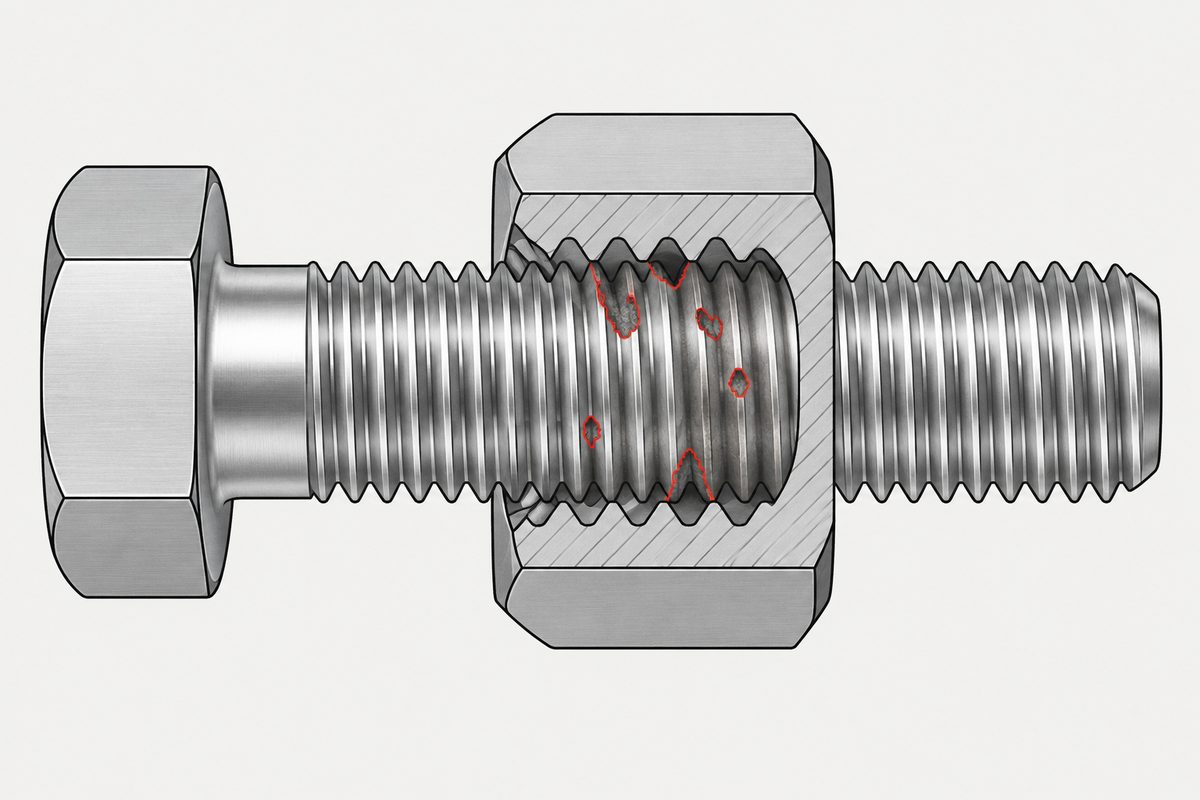
How the experiment was set up
The researchers used M22 bolts and nuts in 304 stainless steel. Some pairs were immersed as assembled. From the bolts they also cut planar specimens and made two electrodes of equal area: one inside an artificial crevice formed with a 250 µm PTFE gasket, so only a little solution reached it, and one exposed to the bulk solution. Wired together, the current between them was measured.
| Item | Condition |
|---|---|
| Material | 304 stainless, M22 bolt and nut |
| Solution | 0.06 M NaCl, pH 6.8 ± 0.2 |
| Artificial crevice | 250 µm PTFE gasket |
| Duration | 30 days |
0.06 M works out to about 3.5 g of salt per litre, roughly 0.35%, a tenth of the 3.5% salt solution often used to stand in for seawater. That comparison is this site’s arithmetic, not the paper’s.
After 30 days, the crevice was acid
Both electrodes started in the passive region, about −0.20 V against Ag/AgCl. The exposed one then rose slowly as its passive film grew; the crevice one fell over the first 5 days and then levelled. The largest potential difference was about 0.40 V, which the paper judges enough to drive galvanic corrosion: crevice as anode, exposed region as cathode, with the current direction unchanged for the whole test.
The crevice solution fell from pH 6.8 to 3 to 4. Oxygen cannot get in, dissolved metal ions hydrolyse, chloride migrates in to balance the charge, and acidification feeds itself. The paper adds that hydrogen ions reduced in the crevice form hydrogen and “may lead to hydrogen embrittlement”; that is an inference, not something this test measured.
Surface analysis agrees: on the exposed surface the film was 55% oxide and 30% hydroxide; in the crevice it was 41% oxide and 55% hydroxide. Less oxide means a thinner, less protective film.
What the real bolts looked like
On the immersed bolt and nut pairs, the exposed thread showed only faint streaks and no obvious pits. The thread engaged by the nut showed local corrosion at crests, flanks and roots, shallow elliptical pits larger than 10 µm. A 304 bolt that looks clean from outside can be damaged where you cannot see it until the nut comes off.
The valve bolt failure analysis written the same day is a field case: cracks started in the crevice between head and washer, where salt from the marine air collected. Under the nut and under the head are the same geometry.
What this means for anyone specifying fasteners
Inspection cannot stop at the exposed thread. No rust outside does not mean none in the engagement; to know, take the nut off.
A crevice is geometry, and material only changes the degree. The paper’s three drivers, uneven oxygen, different solution inside and out, and active versus passive surfaces, all come from part of the bolt being covered. Only 304 was tested; this site does not infer how much better A4 would be (A2 or A4?).
What this page cannot conclude
This is a 30-day laboratory result in dilute salt water with an artificial crevice and cannot be converted into service life. pH 3 to 4 is the artificial crevice solution, not a measurement from a real bolt’s engagement. Only 304 was tested, and no protective measure was. “May lead to hydrogen embrittlement” is the paper’s inference.
This page covers step 5, the finish. The whole order is substrate, thread, head, drive, finish, documentation, and why doing it out of order is rework rather than a tweak is in specifying a screw.
Common questions
Why does a stainless bolt start corroding inside the nut?
Because that is a crevice. In the 2023 experiment by Daniel et al., oxygen could not reach the part of a 304 bolt covered by the nut, its passive film weakened, and the solution acidified to pH 3 to 4 within 30 days. The potential difference to the exposed region reached about 0.40 V, making the crevice the anode.
If the outside of a bolt is not rusty, is it fine?
Not necessarily. In this experiment the exposed thread showed only faint streaks, while the engaged thread had pits larger than 10 µm at flanks and roots. Checking the thread means taking the nut off.
References
- Daniel et al. (2023) — Synergistic effect of crevice corrosion and galvanic coupling on 304SS fasteners degradation in chloride environments, npj Materials Degradation 7:11 (open access)
- Stainless screws do rust: three kinds, one material problem
The paper was read in full; test conditions, potentials, pH and XPS proportions are as published. The 3.5 g/L conversion and the seawater comparison are this site’s arithmetic. Found by a paper collector run on 2026-10-02 (fastener corrosion, open access).
Enquiries
If fasteners will see chlorides, tell us whether water can stand at the joint, what other metals they touch, and the steel grade required.
Request a quotation
Tell us the part and the quantity. We will come back on feasibility, lead time and price.
Or email us directly sales@tigerfasteners.com