 TIGERFASTENERS
The cracked "stainless" valve bolts: 9% chromium, 16% manganese, and a spec field reading Not available
In the fire protection system of a petrochemical plant, the bonnet bolts of a deluge valve cracked and broke in service. A failure analysis published in Scientific Reports in 2025 put them through a spectrometer: 15.8% manganese, 9.10% chromium, 1.70% copper, no nickel, and unused bolts from the same supply matched. ISO 3506-1 defines stainless steel as having at least 10.5% chromium. In the paper’s service conditions table, the material of the bolts, nuts and washers reads “Not available”. About 6 minutes to read.
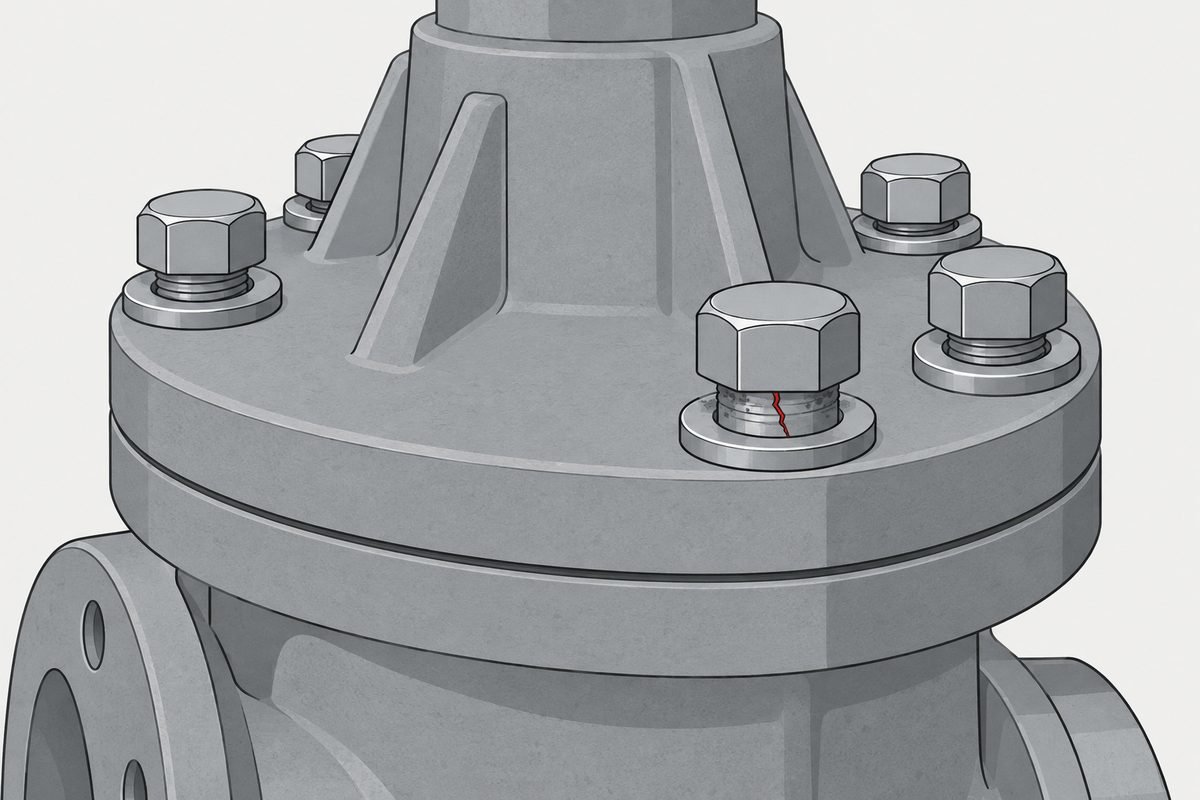
Seven bolts
The bolts held the bonnet of a 6-inch OS&Y gate valve in the plant’s deluge fire-protection system. The valve body was ASTM A126 Class B grey cast iron, with four bonnet bolts. The surroundings were a humid, salty marine atmosphere, and chloride in the cooling water was close to its 300 ppm limit.
The investigators received seven: two broken at the head-to-shank fillet, two cracked at the same place, three apparently intact. Heads, washers and nuts were painted red; the shanks carried a layer of dark brown rust.
Four numbers in the composition
| C | Mn | Si | P | S | Cr | Cu | Fe |
|---|---|---|---|---|---|---|---|
| 0.035 | 15.8 | 0.24 | 0.06 | 0.005 | 9.10 | 1.70 | bal. |
No nickel is listed. The nuts were 14% Mn and 11% Cr, the washers 14% Mn and 13% Cr. The paper classifies the material as a TWIP steel, a high-manganese austenitic steel strengthened by deformation twinning.
ISO 3506-1:2020, clause 3.5, defines stainless steel as steel with at least 10.5% chromium and at most 1.2% carbon. 9.10% falls short. The nut and washer clear the line; the bolt does not. The same paper’s recommendations still call such parts “high strength stainless steel components”.
The spec field: Not available
Table 1 of the paper lists service conditions. Its first row, the material of bolts, nuts and washers, reads Not available, and so does the row for stresses. The investigators had parts, not a specification, and the only basis for identifying the material was their own analysis. New bolts showing the same composition means this was how the bolts were bought, not something that happened in service.
For purchasing, that is the useful part. An order that names no standard or grade cannot be wrong about what arrives, because there is nothing to compare it with. On a Chinese-language page this site traced how the shop-floor name for stainless already points at more than one material (in Chinese); this paper is a bolt that looks the part and sits outside the definition.
Where the cracks started
All cracks were in the same place, the head-to-shank fillet and neck, starting from corrosion pits. The pits formed in the crevice between the head and the washer and nut beneath it, where salt from the air collected; the paper also notes galvanic corrosion of the less noble cast-iron body. Cracks grew perpendicular to the tensile stress from tightening.
The fillet is also the hardest place. Cold formed and not heat treated, the head surface was about 435 HV, the fillet about 470 HV, the shank core about 225 HV. Fracture surfaces showed dimples, quasi-cleavage and intergranular cracking, and the paper concludes hydrogen embrittlement-assisted chloride stress corrosion cracking. Tensile testing gave 514 MPa yield and 690 MPa tensile strength.
Crevice, fillet and hardest zone all coincide. In the VW steering bolt recall written the same day, the reported break was also at the head, also after moisture got in around the bolt.
The paper’s three recommendations
One: in marine environments, consider the effect of NaCl on high-strength stainless components when selecting materials. Two: put an appropriate preload on each bolt; without control, fatigue cracks, fretting and over-tightening follow. Three: consider bolts with a larger head-to-shank radius.
A buyer can add a fourth: put the standard and grade on the order, for example ISO 3506-1 A4-70, ask for a material certificate on receipt (How to read a mill test certificate), and test the composition when in doubt. That one is not in the paper; it follows from the Not available field.
What this page cannot conclude
The paper does not name the maker or source of the bolts, and this page does not guess. The 690 MPa is not compared with any stainless property class, because the paper does not say what grade the bolts were bought to. It is one case and says nothing about the composition of stainless fasteners in general. Only clause 3.5 of ISO 3506-1 is quoted; its composition table is outside the public preview.
This page covers step 6, the documentation. The whole order is substrate, thread, head, drive, finish, documentation, and why doing it out of order is rework rather than a tweak is in specifying a screw.
Common questions
Is a bolt with 9% chromium stainless steel?
Not under ISO 3506-1:2020 clause 3.5, which defines stainless steel as at least 10.5% chromium and at most 1.2% carbon. The failure analysis classes the material as a high-manganese TWIP steel (15.8% Mn, 1.70% Cu, no nickel), although its recommendations still refer to high-strength stainless components.
Why did the valve bolts crack?
According to the paper, cracks started from corrosion pits in the crevice between the bolt head and the washer and nut, at the head-to-shank fillet and neck, where salt from the marine air collected, with galvanic corrosion from the cast-iron body. The fillet was the hardest zone at about 470 HV. The conclusion was hydrogen embrittlement-assisted chloride stress corrosion cracking.
References
- El-Zomor et al. (2025) — Failure analysis of bolts in deluge valve bonnet in cooling tower system in petrochemical plant, Scientific Reports 15:14133 (open access)
- ISO 3506-1:2020 — Mechanical properties of corrosion-resistant stainless steel fasteners, Part 1. Clause 3.5 (public preview)
- A 304 stainless bolt fails first under the nut — the crevice measured on its own
The paper was read in full; figures from Tables 1 and 2, hardness, tensile results and conclusions are as published. It was found by a paper collector run on 2026-10-02 (fastener corrosion, open access). Only the definition in ISO 3506-1 clause 3.5 is quoted.
Enquiries
When enquiring for stainless bolts, give the standard and grade (for example ISO 3506-1 A4-70), the environment (chlorides, contact with cast iron or aluminium), and whether you need a material certificate or composition report.
Request a quotation
Tell us the part and the quantity. We will come back on feasibility, lead time and price.
Or email us directly sales@tigerfasteners.com