 TIGERFASTENERS
Passivation Takes Iron Away Rather Than Putting Anything On
Passivation gets written on drawings as though it were a coating: a thing applied to a stainless fastener to make it stainless enough. The standard that covers it is four pages long, free to read, and disagrees on every part of that sentence. The film is already there before anybody treats it. It is about two nanometres thick. The treatment works by dissolving iron rather than by adding oxide. And the standard closes by saying there is no known way for two parties to check the result.
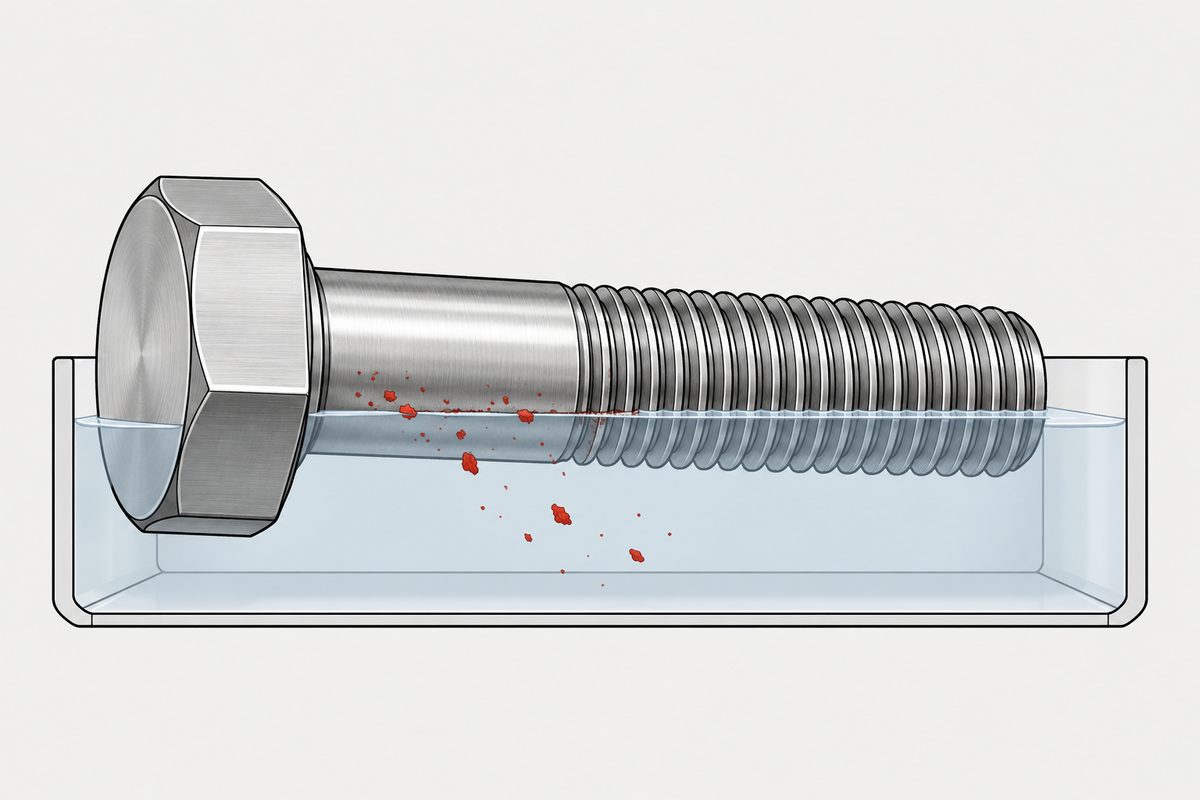
“The thickness of the layer is about 0,002 µm.” That is ISO 16048 describing the chromium oxide film on stainless steel, in its introduction, before it specifies anything. Two nanometres. And it forms immediately when the steel is produced, so passivation is not creating it. The standard’s own definition says the treatment increases the thickness of the naturally occurring chromium rich oxide film present on all types of stainless-steel surfaces.
Two documents are used on this page and they were read in full. The first is ISO 16048:2003, Passivation of corrosion-resistant stainless-steel fasteners, from ISO/TC 2. The second is a 2019 paper in the Journal of the Electrochemical Society by a group at CNRS and Chimie ParisTech, measuring the oxide film on 316L with mass spectrometry, photoelectron spectroscopy and electrochemistry. The standard says what to do; the paper says what happens.
Two nanometres, from two directions
The standard states about 0,002 µm in 2003. The paper, sixteen years later and by an entirely different route, reports that the as-prepared surface is covered by a ~2 nm thick, mixed chromium and iron, bi-layered hydroxylated oxide. Same number, arrived at independently.
The paper can also say what is in it. The inner layer is highly enriched in chromium(III) and the outer layer less so. Molybdenum concentrates in the outer layer, mostly as Mo(VI). Nickel is only present at trace level, which is worth pausing on given how much of the alloy it is. The two layers have band gaps of 3,0 and 2,6 to 2,7 electronvolts, and the authors note the film would behave as an insulator.
So the thing doing the protecting on a stainless screw is a two-layer oxide two nanometres thick, with the chromium concentrated at the bottom of it and the nickel essentially absent. Everything below is about what a chemical bath does to that.
The mechanism is dissolution, not deposition
The paper’s introduction gives the reason an acid bath works at all, and it is the sentence that reframes the whole subject. The chromium enrichment in the passive film, which is the key factor for corrosion resistance, is strong in acid aqueous environment because of the competitive dissolution of the iron and chromium oxide species and the comparatively small dissolution rate of chromium(III) oxide. The acid attacks both and takes the iron faster. What is left behind is richer in chromium because the iron went.
The authors then measured it. Electrochemical passivation in sulfuric acid caused the preferential dissolution of iron(III), which produced a decrease in the thickness of the outer layer together with its increased enrichment in chromium and molybdenum. Further chromium enrichment of the inner layer improved the corrosion protection, with the corrosion potential shifting anodically and the polarisation resistance increasing by a factor of about four.
Read that carefully rather than as a contradiction. The experiment was electrochemical passivation in sulfuric acid; the standard describes immersion in nitric acid baths. They are related operations and not the same one, and this page does not claim the paper refutes the standard. What both descriptions agree on is the direction of the chemistry: passivation is a change of composition driven by taking iron out. Whether the total film ends up thicker or thinner is a question about which operation was run, and it is downstream of the point.
What the standard actually asks for
The procedure is short and the modal verbs are worth reading. Before pickling, the fasteners shall be degreased and rinsed. Before passivation, a pickling treatment is recommended. Then the fastener is passivated in a bath selected from a table.
| Step | Chemistry named | Grades |
|---|---|---|
| Degrease and rinse | — | All; this is the only shall in the sequence |
| Pickling (recommended) | Nitric acid at 20 to 30 % by volume, or sulphuric acid at 8 to 11 % | A2, A3, A4, A5, C3, F1 at the higher nitric range; A1 and C1 at 10 to 15 % |
| Passivation | Nitric acid at 20 to 50 % by volume; 25 to 35 % is the preferred bath for two grades; sodium dichromate may be added | A2 to A5, C1 and F1 in the first group; A1 and C4 in the second |
The dichromate addition has a stated purpose that is not corrosion at all: it may be used to minimise the discoloration or etching of high carbon and free-cutting stainless steels. And a footnote covering the tables says that if necessary, values outside the specified ranges are permitted when adjusting concentration, temperature and exposure time. The numbers are guidance, not limits.
Temperatures in those tables run from about 15 to 80 °C depending on the bath, and exposure times from 5 to 30 minutes. The temperature and time columns were not cleanly aligned with their rows in our copy, so no bath is paired with a specific temperature and time here. This page is not a process instruction in any case; the chemistry belongs to the treatment shop.
The footnote about hydrogen
One line in the pickling table is a safety requirement rather than a process note. Hot forged fasteners in grades C1, C3 and C4 shall be soft annealed to the softest condition and shot-peened before pickling, in order to reduce the risk of hydrogen embrittlement. Where the raw material was already soft annealed and ground, the standard says shot peening alone may be enough.
Our page on the rust-proofing that breaks the screw names acid pickling as a hydrogen source alongside electroplating. This is the clause that goes with it: a named grade family, a named pre-treatment, and a stated reason. If a martensitic stainless fastener is going into an acid bath, that requirement exists whether or not anybody on the order has read it.
And then the standard says the quiet part
Clause 5 is two sentences long. Passivation shall be verified by the manufacturer’s quality assurance system. There is no known referee test method for passivation.
A referee test is the thing you fall back on when two parties disagree. Its absence means that passivated to ISO 16048 is a statement about a process somebody ran, not about a result anybody can check afterwards. The supplier cannot demonstrate conformity by measurement and the buyer cannot demonstrate a breach, which is the same structural situation as a finish argued about with no agreed sample: not a disagreement about the facts, but a disagreement with nowhere to look them up.
The standard’s own informative annex hints at why. It sketches the anodic dissolution behaviour of an active-passive-transpassive metal: dissolution rising exponentially with potential in the active region, then falling to a very small value and staying almost independent of potential across the passive region, then rising again in the transpassive region. Passivity, in the standard’s own definitions, is a chemically inactive surface condition, and a condition across a range of potential is a harder thing to certify on a delivery note than a layer with a thickness.
What to do with this on an order
- Do not expect a thickness. The film is about two nanometres before treatment, the standard gives no figure for after it, and this page does not either
- Ask what was run, since the result cannot be refereed. Degreasing and rinsing is the one mandatory step, pickling is recommended, and the passivation bath is chosen from a short list
- Name the grade. The tables branch by grade, and for the martensitic family there is a pre-treatment requirement attached to hydrogen embrittlement
- Remember what the treatment is for. It changes composition by removing iron; the measured benefit in the paper was a fourfold increase in polarisation resistance on 316L, which is a real improvement and not a coating
The broader point is one this site keeps meeting from different directions. A word that sounds like a layer turns out to name a condition, and the moment a specification names a condition rather than a dimension, the interesting question stops being what to require and becomes how anybody would tell.
This page covers step 5, the finish. The whole order is substrate, thread, head, drive, finish, documentation, and why doing it out of order is rework rather than a tweak is in specifying a screw.
Common questions
Is passivation a coating?
No. ISO 16048 defines it as a chemical treatment that increases the thickness of the naturally occurring chromium rich oxide film present on all types of stainless steel surfaces. The introduction notes that this film forms immediately when the steel is produced, so the treatment is acting on something that is already there rather than applying anything new.
How thick is the passive film on stainless steel?
ISO 16048 states about 0,002 micrometres, which is two nanometres. A 2019 study of 316L in the Journal of the Electrochemical Society, using mass spectrometry and photoelectron spectroscopy, reports the as-prepared surface covered by a roughly 2 nm thick bi-layered oxide with chromium concentrated in the inner layer, molybdenum in the outer, and nickel only at trace level. Two independent routes, the same figure.
How does an acid bath make stainless more corrosion resistant?
By taking iron away faster than chromium. The paper states that chromium enrichment in the passive film is strong in acid because of competitive dissolution of iron and chromium oxide species together with the comparatively small dissolution rate of chromium(III) oxide. In their measurement, electrochemical passivation in sulfuric acid preferentially dissolved iron(III), which thinned the outer layer while enriching it in chromium and molybdenum, and raised the polarisation resistance by a factor of about four.
Does passivation make the film thicker or thinner?
It depends which operation you mean, and this page does not treat the two sources as contradicting each other. ISO 16048 describes immersion in nitric acid baths and says the film can be thickened by passivation. The 2019 paper measured electrochemical passivation in sulfuric acid and found the outer layer thinner and richer in chromium. Those are related but different operations. What both agree on is the direction of the chemistry: composition changes because iron leaves.
How is passivation verified?
By the manufacturer, and only by the manufacturer. Clause 5 of ISO 16048 says passivation shall be verified by the manufacturer’s quality assurance system, and then states plainly that there is no known referee test method for passivation. So a passivation requirement on an order describes a process that was run rather than a result that can be checked in a dispute, in either direction.
Is there a hydrogen embrittlement risk in passivation?
The standard attaches one to the pickling step for the martensitic grades. Hot forged fasteners in grades C1, C3 and C4 shall be soft annealed to the softest condition and shot peened before pickling, in order to reduce the risk of hydrogen embrittlement, and where the raw material was already soft annealed and ground, shot peening alone may be enough. Acid pickling as a hydrogen source is covered more generally on our hydrogen embrittlement page.
References
- ISO 16048:2003 — Passivation of corrosion-resistant stainless-steel fasteners. Introduction, clause 1, clause 3 definitions, clause 4 with Tables 1 and 2, clause 5 and Annex A
- Wang, Di-Franco, Seyeux, Zanna, Maurice and Marcus, “Passivation-induced physicochemical alterations of the native surface oxide film on 316L austenitic stainless steel”, Journal of the Electrochemical Society, DOI 10.1149/2.0321911jes; open-access full text on arXiv
ISO 16048:2003 was read from the publicly available preview, which for this standard carries the whole of the four pages of content, and every quotation and range above is from that text. The temperature and exposure time columns of the bath tables were not cleanly aligned with their rows in our copy, so no bath is paired with a specific temperature and time here; only the concentrations, which are clearly attached to their grade groups, are given. The paper was read from the open-access version on arXiv of the article accepted by the Journal of the Electrochemical Society. The paper studied electrochemical passivation in sulfuric acid on 316L and the standard describes immersion in nitric acid baths; these are related but different operations, and this page does not claim the paper refutes the standard or carry the paper’s thickness result across to a fastener in a nitric bath. No film thickness after treatment is given, because neither source supplies one for the operation the standard describes. This page recommends no bath, concentration, temperature or procedure: the chemistry belongs to the treatment shop. Nothing from ISO 3506 is quoted, that standard not having been read for this page.
Enquiries
If stainless parts are to be passivated, put the grade and the reference on the order rather than the word alone, and say whether pickling is expected before it. Since the result cannot be refereed afterwards, what the order describes is the process, and that is the only place the requirement can live.
Request a quotation
Tell us the part and the quantity. We will come back on feasibility, lead time and price.
Or email us directly sales@tigerfasteners.com