 TIGERFASTENERS
When customers ask for carbon data, two different things are being asked
The requirements tightened, but not in the way most summaries say. Two separate lines of demand now reach fastener suppliers — one from EU import declarations, one from customers calculating their own Scope 3 — and they do not want the same data.
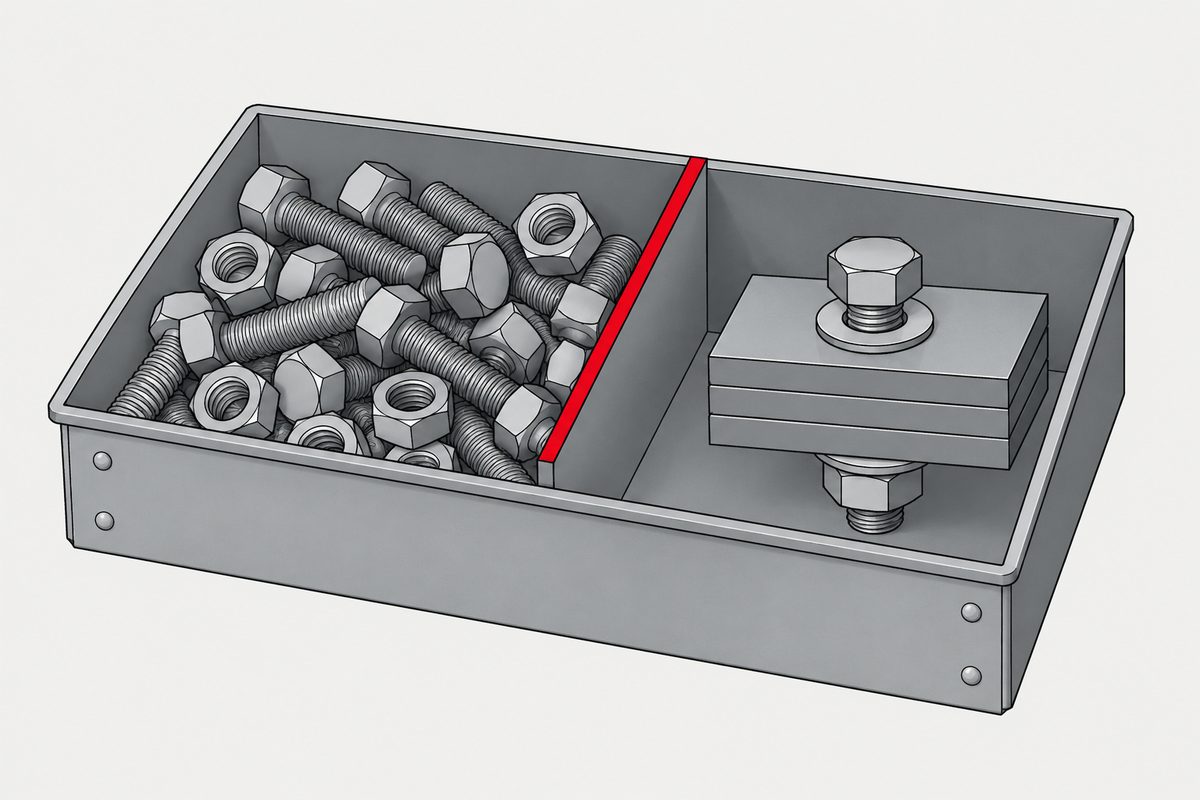
First, what we can currently provide. Wei Shiun holds ISO 9001. We have not established whether we have the capability to calculate product-level embedded emissions. This article explains the rules and the questions a buyer should ask; it is not a commitment about our services. If you need carbon data, ask us directly and we will tell you honestly how far we can go.
What changed, and a correction to this page
Correction (reviewed August 2026). This page previously stated that from 2026 CBAM would no longer accept default values, and that the era of default values was over. That was too absolute and has been corrected.
The EU issued a separate implementing regulation for the definitive period dealing specifically with default values — Commission Implementing Regulation (EU) 2025/2621, whose title is the establishment of default values — alongside an implementing regulation on emission calculation methods, (EU) 2025/2547. So default values still have rules in the definitive period, under conditions that differ from the transitional period. This site does not assert what those exact conditions are; that has to come from the regulations and official guidance themselves.
What is unaffected by that correction is the part below: what each of the two lines of demand actually wants.
During the transitional period, importers unable to obtain actual data had wider substitution available, which left upstream suppliers room to defer — the customer would find a way to file regardless. The definitive period compresses that room, and declared data additionally requires:
- verification by an EU-accredited third-party verification body
- a greenhouse gas inventory system conforming to ISO 14064-1 or the EU CBAM methodology
Check first whether you are in scope at all. CBAM has a de minimis threshold, which this site records as 50 tonnes per importer per year. Estimating from the unit weight of micro screws, most buyers will not reach that volume. Whether the threshold applies, and under which version, must be checked against the official notices — do not treat this paragraph as a compliance basis.
One misconception worth clearing up for exporters from Taiwan: having paid Taiwan's carbon fee does not exempt you from CBAM. The two systems use different price frameworks, and CBAM certificates still have to be purchased as required when exporting to the EU. Treating the carbon fee as “already paid” and skipping CBAM preparation causes problems.
Who is asking, and why
Whoever comes asking usually cares less about the environment than about the fact that they are being asked too.
Take the data centre chain: a cloud operator has to disclose its Scope 3 → pressure passes to the ODM assembling the racks → the ODM has to ask its component suppliers → that supplier is you. Every layer is doing homework for the layer above.
So the person asking usually means you no harm, and also has no flexibility. If they cannot produce it, their customer finds another supplier, so they find another supplier. That is why “suppliers unable to provide transparent emissions information will lose supply chain qualification” reads less like a threat and more like a description of pressure travelling downwards.
What the Scope 3 line wants
Scope 3 category 1 is purchased goods and services — which is what you sell. The most accurate way for a customer to calculate it is with the supplier's own data rather than an industry average.
Under the GHG Protocol's technical guidance, the supplier-specific method requires the supplier to provide:
| Data type | Specifically |
|---|---|
| Allocated Scope 1 and Scope 2 | Your direct emissions and purchased electricity emissions, allocated to the products sold to that customer |
| Activity data | Raw material, fuel and electricity consumed in production, transport distances, waste generated |
| Product-level emission factors | Emissions per unit of product, from your own greenhouse gas inventory |
Note the third row: that factor has to come from your own inventory. Which means answering “we hold ISO 14001” is not an answer, and neither is a single company-wide total. What the customer needs is data that can be allocated to a product.
What the CBAM line wants
CBAM's requirements are harder, because they determine how much the importer actually pays.
| Scope 3 (customer disclosure) | CBAM (EU import declaration) | |
|---|---|---|
| Who asks | Your customer (brand, ODM) | The EU importer |
| Purpose | Calculating and disclosing their own Scope 3 | Declaring and purchasing CBAM certificates |
| Third-party verification | Depends on the customer; usually encouraged, not mandatory | Required, by an EU-accredited body |
| Methodology | Mainly GHG Protocol | ISO 14064-1 or the EU CBAM methodology |
| Consequence of no answer | Risk of being replaced | Importer's cost rises, feeding directly into their purchasing decision |
So if you supply both domestic ODMs and European exports, both sets of requirements arrive at once, and neither substitutes for the other.
What ISO 14001 does and does not do
This needs saying plainly, because the misunderstanding is common. ISO 14001 is an environmental management system standard. It demonstrates you have a system for managing environmental aspects — processes, audits, corrective actions, continual improvement. It is not a carbon accounting standard and does not produce the number the customer is asking for.
| Standard | Covers | Answers a customer's carbon request? |
|---|---|---|
| ISO 14001 | Environmental management system | Not directly, but a good foundation |
| ISO 14064-1 | Organisation-level GHG inventory | Answers “company total” |
| ISO 14067 | Product carbon footprint | Answers “per product” — what customers most want |
The value of 14001 is that you already have working habits of data collection and internal audit. Most plants of similar size do not, and have to build that from nothing. So a plant holding 14001 has a much shorter route to 14064-1 — the difference between adding the carbon part and building a management system from scratch.
Four first steps with no budget
There is no need to commission a full inventory to begin. These four cost almost nothing:
- Put the last 12 months of electricity, water and fuel bills into one table. This is the starting point of every inventory, and the data is already with accounting.
- Record output. With energy consumption and output you can produce an intensity figure such as electricity per tonne of product — so that when asked, there is at least a number with a basis behind it.
- Ask your steel supplier what they can provide. For a fastener plant the raw material usually dominates the emissions. What upstream can give you decides how far you can go.
- Archive the questions customers have asked. The same questionnaire returns, and gets more detailed each time. The accumulation is your future checklist.
Doing these four will not make you CBAM compliant. It moves you from cannot answer at all to can describe a direction and a timeline — and to a buyer, those two are very different positions.
References
- GHG Protocol — Technical Guidance for Calculating Scope 3 Emissions, the data required for the supplier-specific method under category 1
- Commission Implementing Regulation (EU) 2025/2621 (establishment of default values) and (EU) 2025/2547 (emission calculation methods)
- Small and Medium Enterprise and Startup Administration, Ministry of Economic Affairs (Taiwan) — guidance on the combined impact of the EU carbon border adjustment and Taiwan's carbon fee on SMEs
Scope, thresholds and applicable conditions must be checked against the regulations and official guidance themselves. Nothing here is a compliance basis.
This page covers step 6, the documentation. The whole order is substrate, thread, head, drive, finish, documentation, and why doing it out of order is rework rather than a tweak is in specifying a screw.
Common questions
We are a small plant. Would a customer really replace us over carbon data?
Not over a single unanswered request, but it counts against you at the next review, and structurally so. The reason is that your customer is being asked too: every supplier who cannot produce data degrades the quality of their own disclosure. Fasteners, electronics and machinery have already been named among the mid and downstream industries expected to supply carbon footprint data, and suppliers unable to provide transparent emissions information are said to lose supply chain qualification. The pragmatic response is to have a defensible position on progress rather than waiting to be asked.
We already pay Taiwan’s carbon fee. Do exports to the EU still incur CBAM?
Yes. Taiwan’s carbon fee and the EU ETS use different price frameworks, so paying the Taiwanese fee does not fully offset CBAM, and CBAM certificates still have to be purchased as required when exporting to the EU. Treating them as the same thing is a common and costly misunderstanding, because the data formats and verification requirements CBAM needs also differ from a Taiwanese carbon fee filing and cannot simply be reused. They have to be prepared separately.
Does ISO 14001 not already cover carbon?
No. ISO 14001 is an environmental management system standard covering whether you have a system to identify, control and improve environmental aspects, which can include greenhouse gases, but it does not prescribe how to conduct an inventory and does not produce a verified emissions figure. Organisation-level inventory is ISO 14064-1 and product carbon footprint is ISO 14067, and customers usually want one of those two. That said, the audit and record-keeping habits from 14001 are a good foundation and make the route considerably shorter than starting from nothing.
Do raw material emissions have to be included?
Yes, and for a fastener plant they are usually the largest share. Your own in-plant electricity and process emissions are often far smaller than the emissions from producing the steel itself. This is also why whether your steel supplier can provide data directly determines how detailed you can be — if the raw material end cannot give you figures, you are left substituting industry averages, and the conditions for using such substitutes in the definitive period are stricter than in the transitional period. So asking the steel supplier should come before engaging a consultant.
Enquiries
If you need carbon data, ask directly rather than assuming. We will tell you what we can currently provide and what we cannot, and we would rather say so than promise a figure we cannot substantiate.
Request a quotation
Tell us the part and the quantity. We will come back on feasibility, lead time and price.
Or email us directly sales@tigerfasteners.com